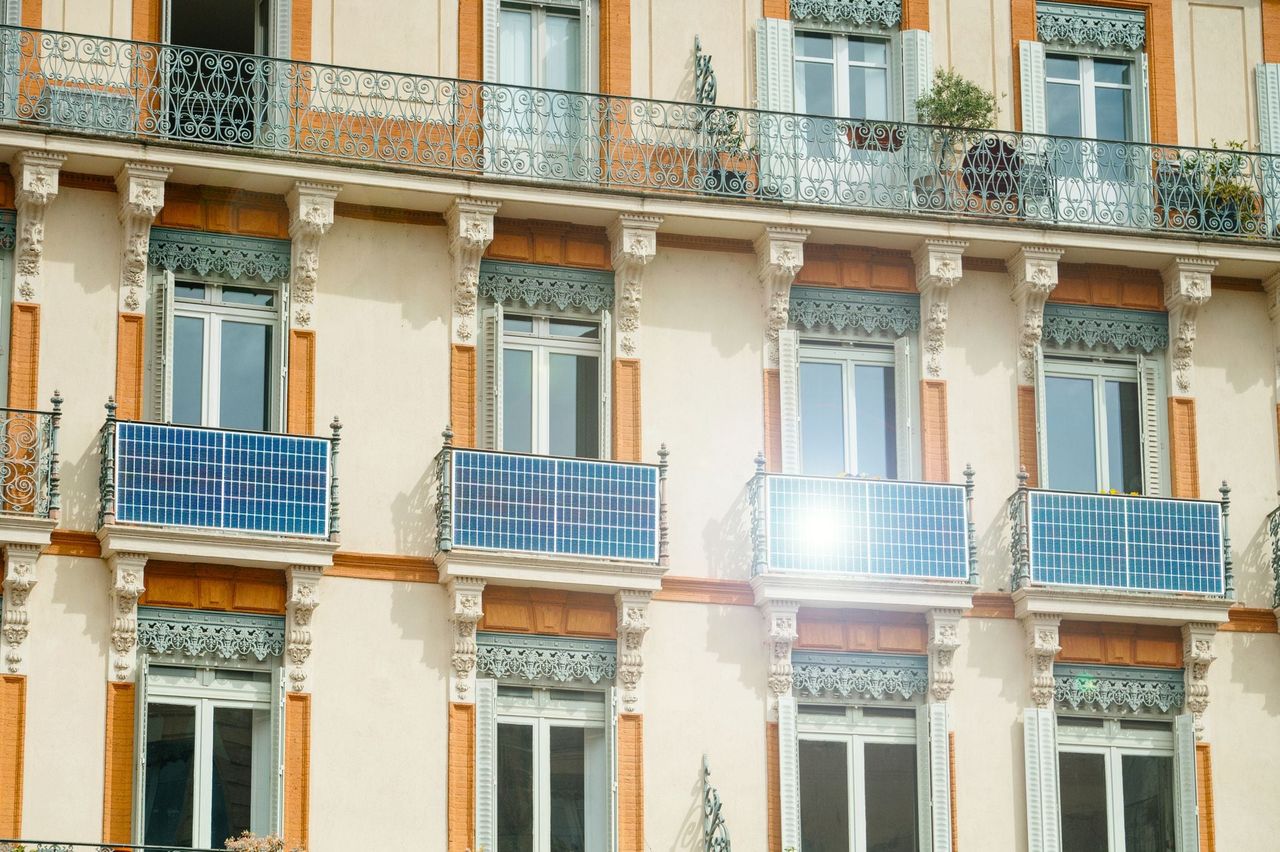
| Fifty-three million U.S. households cannot install rooftop solar, primarily due to building and roof limitations, because they live in apartments or because of their status as renters. I'm one of them. But as prices plummet and technology shrinks, soon almost anyone in the United States may be able to plug in to the sun. For a few hundred dollars, portable panels that hang on any sunny surface can pump free solar electricity into your home via a wall socket. "Balcony solar" and other portable solar equipment avoids the complicated installation, roof mounts, permits and other annoyances that can get in the way of rooftop solar — and drive up costs far beyond the panels themselves. In Germany, balcony solar is hugely popular: as many as 4 million systems hang on railings there, equivalent to the capacity of several large power plants. (Yes, there is a one-word German name for it: Balkonkraftwerke.) I wanted to test how a system might work at my home. So I called up Pranav Myana, a physics major who recently dropped out of the University of Texas at Austin to launch a balcony solar start-up, Zoltux. With his guidance, I threw four panels on my patio, hooked up an inverter and plugged the system into my wall. During the demo, on a cloudy San Francisco morning, I managed to generate about 200 watts — almost enough to power my fridge. I was impressed that setup took only 15 minutes and would be easy enough for someone to do on their own, without having to pay for installation. In sunny conditions, a four-panel, 800-watt unit like the one I tried should generate enough power to juice household appliances. With more hardware, these portable, modular systems can scale up to 4,000 watts, powering a significant share of the electrical load in the average home. Unlike Germany, the United States doesn't yet have clear rules for balcony solar. Only Utah explicitly allows it. There is no agreed national safety standard, and most utilities are, to say the least, wary. As the technology proliferates, specific laws and guidelines are needed to ensure safe products and a reliable grid. But some companies aren't waiting. Here's what to know about plugging in. Read this week's column on what to know about plugging in. Do you have experience with plug-in solar? Write me at climatecoach@washpost.com. I read all your emails. | 













No comments:
Post a Comment