| |  | | | | February 7, 2017 | Letter No. 72 | | | | | | | | | | | | My sweet Lennys,
I've never been much for leaving the house. As a child, I would shriek at the mention of the playground, and my parents had to spell out the word B-E-A-C-H so I couldn't figure out where we were going in advance. Even in the best of times, a day spent sprawled across my bed with books, magazines, and various sundries is my idea of heaven. At least half the time I think I'm sick, it's some combination of dehydration and my legs having fallen asleep. Some people get homesick, while I get bedsick, in every sense of the term.
So you can imagine that the current state of the world would make me even more prone to horizontal living, which is a problem for two reasons. First, part of resistance is showing up physically to protest and organize. And second, Jenni and I happen to be in the heat of promoting the final season of Girls. Press makes me feel raw, stupid, and crazy in the best of times. How do we lend relevance to fashion, hair doodads, and self-promotion in our horrifying political reality?
Jenni and I vowed to enjoy our premiere, to embrace our right to celebrate what we've worked so hard for, despite the many reasons that knocking back flutes of champagne doesn't feel remotely appropriate right now. Still, I was gone from the party in 30 minutes (Jenni bravely outlasted me, as she always does). My social anxiety rose like a bad lunch in my throat as I catapulted myself toward a cab.
The next day, I told my father how much the party had scared me: the fumbled greetings, the lack of understanding of how to frame anything going on, the sadness about the show ending mingling with the deep sense of transition and loss a lot of us feel these days. "Finding out you're afraid of parties," my father said, "is like learning that Joseph Stalin was afraid of mice."
I got his point. My father sees me as strong, tough, impervious. I do a lot of shit that leaves me very exposed, and a party with loved ones and tiny mac 'n' cheese shooters seems like the least of my worries. But we are all split down the middle, surprising even ourselves with what shakes our cores. For me, this month, it's talking about my long history of disassociating during sex as a result of trauma, and trying to find my way back to a healthy fantasy life. To unite my sexuality and my imagination would be a gift, especially in this climate where escape is so necessary. Right now, the division is still painful.
For Girls writer Jason Kim, he had to reconcile the part of himself that wanted to erase his Korean identity with the part of himself that's a deeply political artist committed to true representation. Jenni and I were lucky enough to work with Jason on three seasons of Girls, and I'm pretty sure you'll see why we fell in love.
Meanwhile, Lauren Bohn checks in with Ibtisam Masto — a Syrian refugee she interviewed for Lenny last year — who is now living in Ohio. Ibtisam, too, is bifurcated; her family is grateful for the safety America offers yet desperately homesick for the lives they so carefully built, as expressed through the food they continue to make as a reminder of what they've lost. I'd really love to taste Ibtisam's kibbeh (and you can if you live near Cincinnati!).
On the eve of what would be Sylvia Plath's 85th birthday, we are sharing a stunning poem by J. Hope Stein, who perfectly captures Sylvia's internal battle between life as mother, lover, and poet and the torture of being resigned to the status of great man's wife, despite the passion they shared. Finally, you may think that Melissa Broder writes horoscopes, but make no mistake: this shit is the most high-level philosophy out there. I don't even pay attention to my own astrological sign, I just gobble up the wisdom.
I hope this week the two selves warring within you, whatever they are — lover and fighter, child and adult, angry citizen and cozy, happy friend — can find a way to peacefully cohabitate. We are all as complex as the world we are living in. Brutal and gentle. Raging and carrying on. Stalin jumping on the table, afraid of the mouse. But there's no shame in fear, as long as you grab the broom anyway and chase that thing out.
Love you,
Lena | | | | | | | | | | | | One of a Kind | | | | By Lena Dunham | | |
A therapist once told me that a hallmark of trauma is losing the ability to fantasize. The space where possibility was is now filled to the brim with disruptive and painful reality. She told me that when you've been raped — which I was, early in my life as a sexually active woman — your sense of a sensual self shrinks and often recedes.
And it's true. I had enjoyed a rich teenage life of dreams and desires, sitting in my bedroom writing what I called short stories but were actually florid and off-putting erotica. About camp counselors in the Catskills, or a rough but kind woodsman with a glass eye just waiting to be touched by someone who understood him. One story was about two teenagers on the run in the Italian countryside (one rich, one poor, natch). They made Bonnie and Clyde–style sex stops in the bathrooms of gas stations they had held up for cash, hurling each other around like backpacks.
After my assault, all I could imagine when I thought about sex was not being injured or, when I really didn't like myself, being very injured. That's all there was room for.
And I never got good at fantasizing again. I got good at performing: back arched, hair flying, assuming attitudes I thought were desirable to a partner who watched either porn or foreign films. I got good at making small, meaningless sounds. I got good at those sounds that made my partner think I was having ideas. But, whereas in every other area of my life I was exhausted by my own litany of ideas, sex left me blank and needy.
For a few years I had an on-again, off-again partner I valued mostly because he supplied the concepts I lacked. Quiet and morose in everyday life, in a sexual context he came alive with scenarios and maneuvers so complex that I was left with no job whatsoever except to consent. It didn't matter to me then that many of the fantasies he summoned mimicked the circumstances under which I'd been assaulted — lost drunk girl with questionable self-worth finds herself in the wrong set of hands — but I'd never told him what had happened to me, and he had never asked. I wondered whether I exuded something, a kind of flickering neon brokenness, and started to question whether in fact I'd been asking for this all along. But it felt so good to be engulfed, to disappear from myself, albeit briefly, that I stopped questioning.
After that ended, and during the dry spells when he disappeared, I was forced to return to the world of the living, and only once was I really caught red-handed in the lie that was my sexual persona.
At 22, I projected an almost-cartoonish level of self-actualization: "Hi, I'm Lena. I like awkward jokes, big gold earrings, and dresses meant for grandmas. I have the bearing of an '80s stand-up comedian and the heart of Annie Potts in Dangerous Minds. Please love me."
The aggressive totality of my image wore some guys down, made them laugh and shove me by the shoulder and say, "You little weirdo." Sometimes it made them kiss me in a bathroom just to see what I'd do, how far the fuck-it attitude went, which is how I ended up tripping down the West Side Highway with a beautiful James Dean look-alike, stopping every block to grind against a mailbox or drunkenly debate whether we should be in a cab. It was over 90 degrees and I had on bike shorts, which I told him were to prevent chafing, and he said, "You're somethin' else," and I thought, I'm somewhere else.
Back at my parents' house, he threw me down on the bed and slapped my ass once. I pulled the bike shorts off and turned onto my stomach. And then he lay down next to me, his breathing slow, and he kissed me very gently and looked me in the eyes. And I froze.
I had known how to play it during every step leading up to this one: drunken city kid, hair tangled. Brash chubby queen who will say aloud what no one else will, who will scream over Swedish dance music: "You dumb motherfucker!" Brave creation who will show you their tits in the middle of a crowded thoroughfare. But here he was, pretty and pale and kind, looking at me with wide eyes.
"Hi," I muttered.
"Hi," he smiled. A beat. "Tell me all your fantasies."
The panic I felt was akin to being asked to explain exactly where I'd been when a murder was committed and knowing I had no alibi, or maybe even that I'd done it in a blackout. My face turned red. I could feel sweat soaking through my polyester Topshop minidress, which I pulled off, hoping my sudden and total nakedness would change the mood. It didn't.
"I … I dunno …" I stuttered. "To, uh … to be fingered?" He began, dutifully and silently, to perform my wishes. My new fantasy became being buried alive.
It may surprise people who see what I do on television to learn about this almost total lack of sexual imagination. Or maybe it won't, considering the sex scenes I write and perform in aren't exactly bodice rippers. They don't reinvent sex, but rather reenact it, often at its worst. They're verbatim moments from the ridiculous tapestry of life or, occasionally, the deeply heartfelt projections of a woman who just wants to be told she's worth time and touch.
In the past few years I've started to ask myself what I really want out of sex. Like an amnesia patient trying to piece my old life back together, I look back on the fantasies that propelled my solitary teenage lust and I wonder what I'd want now, at age 30, if I were unloosed upon the dating world and presenting a completely new me to someone who had zero relationship to my trauma.
Recently I described one to Jenni, who knows about this struggle like she knows about all my struggles. "I'm wearing a white bathing suit, very casual Christie Brinkley vibe. I give a blow job," I tell her, testing the waters. "When I'm done the guy looks really amazed and says, 'That was fucking unreal. You're one of a kind.'"
She nodded, full of sisterly sympathy. "I think it's sort of sad," she said "that your fantasy involves impressing someone else, not the other way around. What about the other person making you feel good?"
I didn't have an answer for that.
It's hard to know how best to protect yourself right now as an American woman. So much is unclear. So much feels out of our control, like strategy being played out in a remote locked room. So much is up to men who have never seen us and will never see us, who don't even want to see us. We gather to talk about actions to take, about places to donate, about marches and hashtags and urgent causes. It's all important and beautiful. It's all essential and brave.
But what about a single step of your own, one that doesn't immediately help anyone besides you, yet may in fact save our entire world? What about something that tells a story words can't? What if every time you fuck for the next four years, you say exactly what it is that you want? You move the hands on your body to the place you need them to be so that you can get off? What if you take control of systems that were put in place a very long time ago to keep you from getting off? What if you never have sex again where you're just lying there wishing you were somewhere or someone else (and if you've never had that kind of sex, genuine and worshipful congratulations!)? What if you always recognize your voice? What if you ask for more? What if, as a result of this asking, you get exactly what you want?
So what is it, I ask, that would transport me? Can I separate fantasy from trauma, and is it even important to make that distinction?
Maybe I want to look like a Tumblr queen in strappy Helmut Newton lingerie, a few stray pimples visible, having sex against a white wall next to a drooping houseplant. Maybe I want to have sex in a bush at night by the Brooklyn Bridge, like the coolest girl I knew senior year of high school. Maybe I want it on a fire escape, slightly afraid of crashing to my death but too dizzy to care. Maybe I want someone in a ski mask to say "You're safe, but only if you don't speak." Maybe I want to be freezing cold and crying.
I don't know what I want yet. In this one area, at least, I don't know what I crave or what will be good for me. I'm feeling around in the dark. But when I find it, I will know that I am healed.
Lena Dunham talks a big game. | | | | | | | | | | | | "I Have Faith That This Country Will Keep Their Doors Open" | | | | By Lauren Bohn | | |
The day I heard about Trump's immigration ban, I spent most of the morning on Google Maps' satellite view, looking at Ibtisam Masto's new home in Cincinnati, Ohio. It's a long way from the one she left behind four years ago in war-torn Idlib, Syria. I haven't seen her since she resettled to the Midwest, and I wondered what things looked like from her bright, blue eyes. I wondered what she'd been up to in her new brick home with a red door on a tree-lined street.
In 2014, I had met Ibtisam thousands of miles away, in Beirut, not long after she had fled Idlib in a packed bus with her six children and husband. When shrapnel landed on her balcony one cold Syrian afternoon, just narrowly missing her three-year-old son, she knew it was time to leave.
So, they left. Everything. She left her beloved mazhar, an Arab tambourine-like instrument, back in Syria, along with her favorite gold-rimmed teacups and sepia-toned family portraits. She also left behind one of her favorite cooking pots, given to her by her aunt on her wedding day. "I feel like I've lost myself," she told me one sunny February morning in 2014. Before fleeing Idlib, she had not even been out of her own city, much less the country. And while Lebanon and Syria share similar cultures, fast-paced Beirut — with its noisy streets and, at times, cosmopolitanism that borders on snobbery — was a huge transition.
"I'm staying strong for my kids and my husband," she told me, tears streaming down her face at a Lebanese restaurant where she had found work — and a community — as a cook. Without proper access to medical care, her husband's diabetes had deteriorated, leaving her as the sole caregiver for their kids.
I've had the pleasure of getting to know Ibtisam, mostly as she waded through purgatorial hell in Lebanon, trying to find a way out for her family. Lebanon now has the most refugees in the world per capita, its resources severely strained.
In the face of the worst humanitarian crisis since WWII, Kamal Mouzawak, a well-known Lebanese restaurateur, helped Ibtisam and scores of other women gracefully navigate their new lives with dignity. In 2012, he created Atayab Zaman, "The Delicious Past," a culinary training program for female Syrian refugees in which they cook to remember just as much as they cook to survive. Before the war in Syria, cooking was the proud pinnacle of Ibtisam's day — a trip to the market as crucial and pivotal as sunrise and sunset. Now, steaming lentils and roasting chicken is bittersweet. She loves it because it reminds her of being back in her large, yellow Idlib kitchen; she dreads it because it reminds her of being back in her large, yellow Idlib kitchen.
In the summer of 2016, I wrote an update for Lenny on Ibtisam's journey. Since I had last seen her, in 2014, she had lost 35 pounds. She was so proud to show me her new waist — giggling and tapping on her hips like an excited schoolgirl. In addition to cooking, she had picked up a sales job at the LA-founded nutrition and direct-selling company Herbalife. She had also registered her family for asylum and relocation in America. In May 2016, she received news that her application had gone through to the next level.
"I'm nervous. I don't want to get my hopes up," she told me.
"Do you think they'll like me?" she hypothetically asked her fifteen-year-old daughter Asma, with a nervous laugh. Asma joined her at the market that Saturday to help sell her mom's delicious food to impeccably dressed Beirutis. Like most Syrian youth, she hadn't been to school for three years; there was simply no room for her in the local Lebanese high school. "I fear I have forgotten everything I learned in Syria," she told me. "I feel like I'm no longer myself."
Ibtisam always said that if she got the green light or "golden ticket" from UNHCR, the UN agency that resettles refugees, she'd pack up their small Beirut apartment in minutes and be on the next flight.
When she got the call one May day, it took more than a few minutes to pack up all of their stuff. In fact, once they got word that they would be relocated, it took a month or so to sift through all the papers. At first, they didn't know where they were being sent. California? She had heard it's sunny there. Michigan? She had heard there are a lot of Arabs there. When she found out that Cincinnati would be their new home, she looked at a map on Google and smiled. It was more than good enough.
The UNHCR helped them with the rent on their home. And her husband now has access to medication for his diabetes. Every morning, he crosses the nearby border to Kentucky, where he works at a fruit and vegetables shop.
While their new Ohio street could be the setting for a Hallmark postcard from Happy Suburbia, USA, life hasn't been easy for Ibtisam. Her eighteen-year-old daughter, Amal, who had also been out of school since the family had fled four years ago, isn't able to attend the local high school because she's too old and too far behind. Her other five children are struggling to make friends. Every day, Ibtisam studies English for three hours at a nearby cultural center.
Over the past few months, I've watched her progress skyrocket over WhatsApp. The woman from Idlib who could barely look me in the eyes three years ago and cowered in the corner of a Lebanese restaurant in dejection was writing in almost perfect English, putting my six years of on-and-off Arabic lessons to shame.
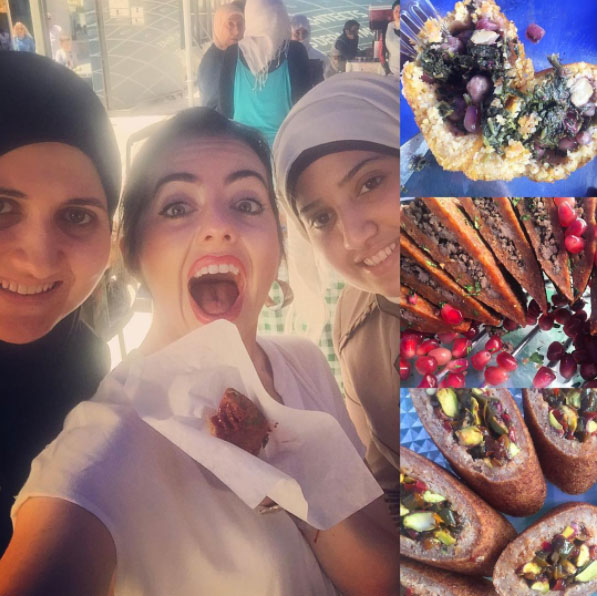
Last month, "Chef Ibtisam" even sent me a promotional flyer for her new catering business — an extension of the Beirut program she participated in. She hopes to cater dinners within 90 miles of downtown Cincinnati. "Americans are going to love my kibbeh!" she exclaimed. Kibbeh are dough-like balls filled with minced meat and parsley and cooked in rich chili sauce. For the record: they are banging.
While Ibtisam says she hasn't paid that much attention to politics, she grew worried after Trump was elected — worried for her place in a state where he won 51.3 percent of the vote (Hillary won 43 percent). She says her neighbors are "nice" but she doesn't "see them much." I can tell she hasn't made many American friends. "I have faith, though, that this country will keep their doors open," she told me. At least in Cincinnati, which Hillary won by an almost inverse margin as the state, Ibtisam says she feels welcome. But ever since shrapnel landed on her porch one cold afternoon in Syria, welcome has become relative.
On January 29th, a day after Trump signed the executive order effectively banning all refugees, I flew into my hometown of Philadelphia and joined hundreds in protest. A 23-year-old Syrian girl named Majd from Aleppo took the small mic and thanked the crowd for standing with Syrians. For many at the protest, it was the first time they had met someone from a country they had learned about only through horrific headlines. They all waited in line to hug her, their faces drenched in tears.
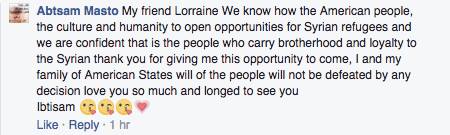
I posted a selfie of Majd and me, our hands locked in love and resistance. Ibtisam was the first person to comment, in almost perfect English. For the first time in weeks, my heart swelled. I noticed that on Facebook, she had started spelling her first name "Abtsam." Abtsam and Ibtisam are two English spellings of her Arabic name. Because Arabic letters don't always have a direct Latin-alphabet equivalent, spellings can vary. In other words, it was only until she was essentially forced to interact with English-speaking people that she had to think about how she wanted to spell her name in English — a new name for a new life.
If you want to help refugees like Ibtisam, have your Ohio-based friends order her awesome food! And if you don't have any friends in Ohio, you can help sponsor a Syrian family who hasn't been lucky enough to be relocated in America or Europe through the Karam Foundation. The founder is Lina Sergie-Attar, an awesome Chicago-based Syrian-American writer and architect who has worked tirelessly for Syrian youth.
Lauren Bohn is the GroundTruth Project's Middle East correspondent, based in Istanbul, and a co-founder of Foreign Policy Interrupted, an initiative to amplify female voices in foreign policy.And she feels blessed af that she gets to talk to incredible souls like Ibtisam for "work." | | | | | | | | | | | | Hello, My Name Is _______ | | | | By Jason Kim | | |
I will never forget the day I picked a new name. I was standing in front of my class on my first day of school at Craig Elementary in St. Louis, Missouri. I had, only a day before, landed at Lambert airport after a sixteen-hour flight from Seoul, South Korea. I was ten years old. I was nervous, terrified, and jet-lagged, and I was wearing a vest because I thought it was chic.
For my entire life, everyone, including me, had known me by my Korean name: Jun Hyuk. But here, in this new country, in a brand-new classroom full of foreign faces, I had to pick a new, easy-to-pronounce, American name.
Jason.
Jason Kim.
How did I settle on Jason? Because I didn't speak any English. Because my teacher didn't speak any Korean. And because it was either going to be Aladdin, from my favorite childhood Disney tale, or Jason, from the Mighty Morphin Power Rangers.
I spent the next decade wanting nothing more than to look like a Larry Lorberbaum or a Garrett Kennedy. I still vividly remember my first time at recess, a confusing experience for several reasons, in large part because hanging off monkey bars and making each other cry during dodgeball were not educationally sanctioned activities in Asia. What was so fun about waiting in line, running up the steps, and going down a tiny slide over and over again? What was the value in sprinting after your classmate like a person with rabies, screaming, "TAG!"
Why didn't anyone look, sound, or act like me?
I spent most days at recess sitting alone on the sidelines, eating the special snack that my mother had packed. The snack, a rice cake or a piece of candy from Korea, was always accompanied by a note, usually a joke, and sometimes embellished with a drawing, which often looked like an abstract painting when it was meant to be a sketch of our beloved deceased poodle.
A month had passed when a teacher finally tapped me on the shoulder.
"Are you OK, sweetie?"
Before I could answer, another teacher rang out, "Maybe he likes sitting alone. Maybe that's the Asian way."
But in truth, I wanted to participate. I wanted to run up to Timmy like a crazy person and yell, "YOU'RE IT!" I just didn't know how.
Outside on the playground, sitting alone at recess, I learned to hate being Asian. I wanted desperately, more than anything, to be white.
I immediately forced my parents to stop calling me Jun Hyuk at home. I named myself after some guy in a live-action children's television series, and by God, they were going to call me by that name. I got rid of my fitted vests for loose-fitting basketball jerseys. I bought tickets to an Incubus concert and threw away my K-pop CDs. I stopped reading Korean children's books in order to figure out what the hell was going on with James and his giant peaches.
At the dinner table, I committed the two worst sins that a Korean son could possibly commit: I stopped speaking Korean and I stopped eating Korean food. My parents would try to talk to me over a bowl of kimchi stew, and I would pout and ask, in English, if we could order the Meat Lover's pie from Pizza Hut. For my eleventh birthday, my mom made me my favorite Korean dish, oh jing uh bokkeum (spicy stir-fried squid), and I looked at her with disdain as I declared, "This is disgusting." The next day for dinner, she made me a cheeseburger. I promptly told her it tasted inauthentic and made her drive me to McDonald's. Oh, and no more special snacks either. Unless they were artificially flavored and made by Kraft. (I was a heinous child. Sorry, Mom.)
I graduated from high school and moved to New York City for college, where my primary goal was to blend in. But more and more, my new friends wanted to know about all the things that made me uncomfortable in the Midwest. To them, being an immigrant made me interesting. At dinner parties, people would fawn over the Korean food and ask for my mom's recipes. They even wanted to know about my childhood in Seoul. And at karaoke, people were genuinely excited that I could sing both Girls Generation and Natalie Imbruglia's "Torn." All of a sudden, being different was an asset, not a risk. In New York, I didn't have to be ashamed about being an Asian immigrant. I could just be ashamed about everything else in my life.
A year after I finished graduate school in playwriting, almost two decades after I'd landed at Lambert airport, Lena and Jenni cast me as an Asian American graduate student on the fourth season of Girls. Almost immediately after the episodes aired, I began receiving emails, tweets, and Facebook messages from young Asian American writers, actors, and performers, who were excited to see a fellow Asian face on TV.
I was shocked. How could this be? I appeared on the show for, like, a millisecond, and my Beyoncé sweatshirt was definitely doing more work than I did onscreen. It was genuinely baffling to think that anyone could look at my very Korean face and feel a sense of connection, much less react in a positive way to the very features I hated about myself for so long.
We are at the point in our culture where people are finally beginning to talk about Asian identities in the media. I have not been at the forefront of those issues. I have been crouching in the back, hiding in the corner, watching people like Margaret Cho, Daniel Dae Kim, Ali Wong, George Takei, Constance Wu, and Aziz Ansari courageously speak up about the various issues that Asian Americans face in Hollywood.
The issues exist both in front of the camera and behind the scenes. There are barely any roles written for Asian actors. And in general, the roles that can be played by a person of any race do not tend to go to Asian actors. Worst of all, the few roles that should go to Asian actors — some very high-profile — are being portrayed by white actors. Behind the camera, there are equally few Asian American writers, producers, studio executives, authors, and editors, and while there are certainly a significant number of people struggling to make it, their efforts seem to go largely unrecognized.
I have always been terrified of speaking up on behalf of diversity, which to me means a state of inclusion — a choice to be aware of the vast and profound range of identities in this world, including your own.
I have been terrified because I grew up in a country without many visible Asian Americans in the culture, and I learned to hate every part of myself that felt foreign and strange. Unfortunately, years later, this is a problem that many young Asian Americans continue to face. How do you understand yourself in a diverse country that actively chooses to ignore your particular kind of diversity?
At one point during my twenties, I took a long, dramatic look in the mirror and realized, You will be Korean for the rest of your life. As a teenager growing up in the Midwest, that thought made me cringe. Now, it makes me happy and deeply proud.
My dream now as a 30-year-old is for our country to become a place where a cameo like mine would go completely unnoticed. And to see every third-grade teacher tell his or her students, "Keep your name. You don't have to change a thing."
Jason Kim is a writer on Girls. | | | | | | | | | | | | Ted & Sylvia | | | | By J. Hope Stein | | | |
When we first met, you asked me to be Ted
& I said it's easy to be Ted,
I want to be Sylvia & we walked so slowly
time was a toy sailboat on a park lake
& I kept 2 hats in my bag in case we got cold.
When Sylvia told Ted he was a great poet
she meant he was a great manipulator of people —
the way he made their tongues
go eSSS and eLLL in different parts of the mouth.
When we first met,
you asked me to be Ted.
& I said to myself, come on,
what would Sylvia do?
When I say SPRING I mean SPRING.
When Sylvia told Ted
he was a great poet
she meant, like his line breaks,
he was delicate
& elegant in bed.
When I met you I had just given up being Ted
& I begged you to let me be Sylvia
& you were Ted enough to oblige
& time was a boot print on a boat deck
& I was seasick or sealorn
& we sat on a bench & put on our hats
& you gave me some advice that was really for yourself.
When Sylvia told Ted he was a great poet
she meant words were clay & he was a potter.
For instance, she asked him questions she knew the answers to,
to watch him mold his syllables into little gull-shaped lies
that would swoop in the air between them.
When we first met,
you said you could see by the way my front teeth
bit softly my bottom lip
to say love
that I was Ted.
& it was you who wanted to be alive
on the page like Sylvia.
But I had just given up being Ted.
So I begged you to let me be Sylvia & we sat on a bench
& we put on our hats
& you gave me some advice that was really for yourself.
J. Hope Stein is a secret poet living in Brooklyn. "Ted & Sylvia" is from her forthcoming publication titled Occasionally, I Remove Your Brain Through Your Nose. | | | | | | | | | | | | February Horoscopes | | | | By Melissa Broder | | |
AQUARIUS
(January 20 to February 18)
Happy birthday, boo. This year I hope you continue to get free. There is a myth about Aquarians, likely due to the show Hair (my fave tbh), that you are all a hippie lot, unconcerned with what others think, unafraid of losing control, draped in ugly beads. But it's a lot of pressure to be that laissez-faire, especially when you are a human being with an active mind, people you care about, and a desire to succeed. So how does one "get free" while tethered to a human body, living in a system of currency, and caring about others? That's a question for you to start to answer for yourself: not as an Aquarian but as a human being.
PISCES
(February 19 to March 20)
If you don't particularly believe in yourself right now, I would suggest not adding another layer to the napoleon of self-doubt by beating yourself up for feeling this way. Like, have your feelings, have your thoughts and insecurities, but no need to judge any of them. Let them move like clouds or some shit.
ARIES
(March 21 to April 19)
OK, Aries, I'll tell it to you straight: I used to be your hater. This is because I had one or two or four negative experiences with Aries people who were dicks, and so assumed you were all the same. Luckily, I've come to believe that astrology is bullshit in terms of grouping large swaths of the population together and writing them off. Don't we spend enough time in our reductive minds? So now that I'm open to you, Aries, I want you to do the same this month with other "types" of people you've written off. Stay open to questioning what you think is what.
TAURUS
(April 20 to May 20)
Not to get too woo-woo, but pay attention to coincidences this month — especially if you've been looking for direction in terms of what to do next on a particular issue. Even if you don't believe in a universe-driven synchronicity, the patterns you perceive are your instincts telling you what you already deep down know you should do.
GEMINI
(May 21 to June 20)
There is a difference between asking for help and neediness. Sometimes we are scared to reach out for help because we fear we are "too much" and risk what we perceive as rejection. But on the whole, human beings like doing service for one another, because it gives us a sense of purpose on a sometimes seemingly meaningless planet.
CANCER
(June 21 to July 22)
If you don't take hot baths, start taking them this month. If you already take them, take more of them. If you don't have a bathtub, literally just sit your sweet ass down on the shower floor and let the water pour over you. If you live in California, don't feel guilty about the water shortage. It's not your fault. It's the almond corporations' fault or something. Not everything is your fault.
LEO
(July 23 to August 22)
Remember that spring is coming, because spring always comes. Nothing doesn't change: inside us and externally. Can you find anything to love about the cold, internally or externally, knowing that it is impermanent? Can you just hang out with it like a temporary guest?
VIRGO
(August 23 to September 22)
It's important to do things that seemingly have no significance whatsoever other than the pleasure of doing them. This is one of the great challenges for Virgo: to cease questioning the meaning behind everything and just live. This month, I encourage you to engage in at least three activities that benefit your life in no other way other than their deliciousness.
LIBRA
(September 23 to October 22)
Be mindful of groupthink right now and the way it makes you feel. When you speak, does it feel true? Is it something you came up with? If not, then who does the idea come from? What are their motivations in teaching you to think this way? Where did they get the idea from?
SCORPIO
(October 23 to November 21)
Being in control of everything would be a lot of fucking work, so it's a good thing that's not your job on earth (or anyone's). This month, when you feel like you are really pushing to make something happen and you are coming up against resistance, that's the time to back off and focus on something else. It would be like when you can't remember a word and then later in the middle of the night it comes to you.
SAGITTARIUS
(November 22 to December 21)
If you've been feeling uninspired, this month it would be good to hang out with a living thing that does not belong to you. It could be OPP (other people's pets), a friend's kid, even a friend of a friend who you were never close to. You may find that you don't have to travel far away or change everything to get a little lightning, but that there is plenty of spark right in your orbit.
CAPRICORN
(December 22 to January 19)
This month, it's important to remember that some of the people, places, and things you love the most are things you felt neutral toward or even disliked in the beginning. You just don't know where anything is ever going to end up, which might seem annoying — but could perhaps be perceived as exciting.
Melissa Broder is the author of four collections of poems, including Last Sext (Tin House 2016), as well as So Sad Today, a book of essays from Grand Central. | | | | | | | | | | | | | | The email newsletter where there's no such thing as too much information.
From Lena Dunham + Jenni Konner. | | | | | | | |  |  | |




No comments:
Post a Comment