|
|
|
|
| |
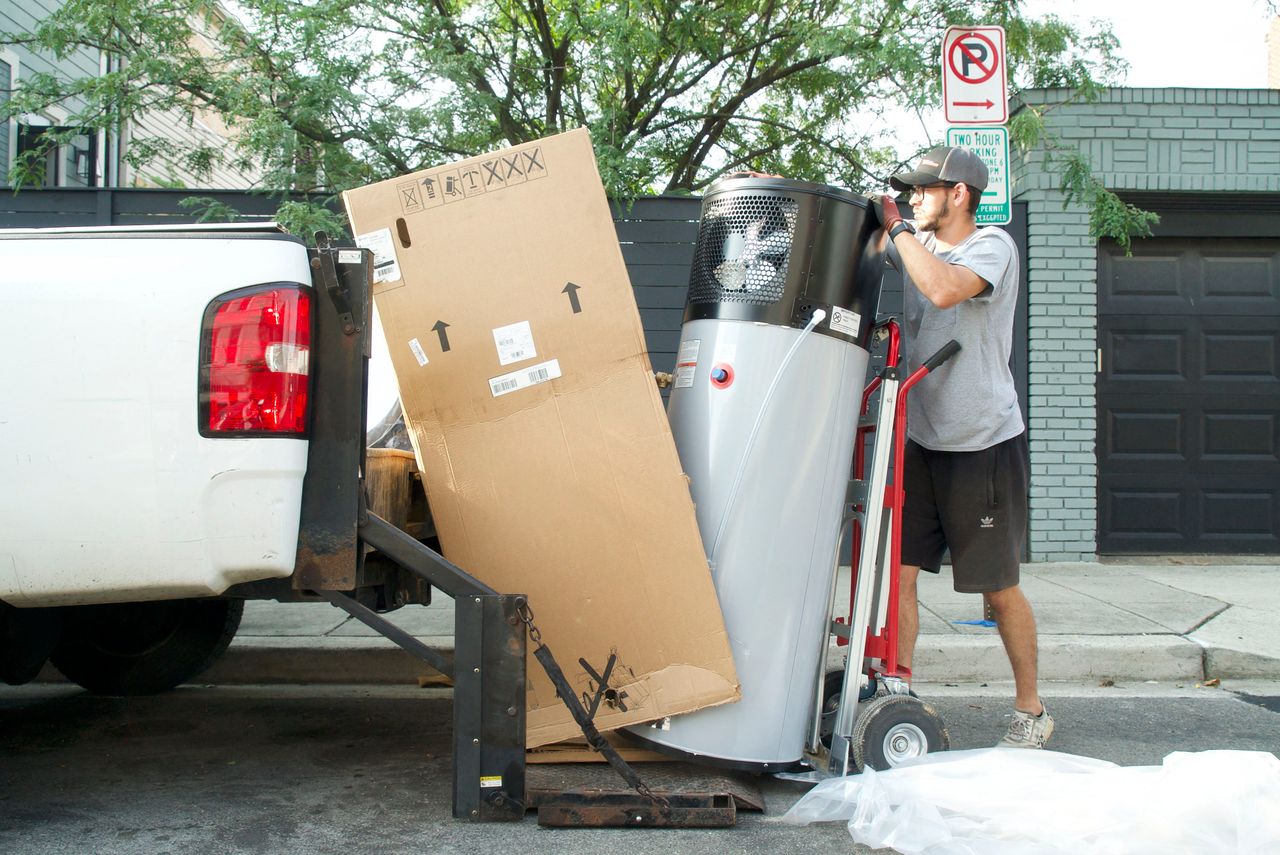
An electric heat pump hot water heater is delivered to a house in Washington, D.C. (Bastien Inzaurralde / AFP via Getty Images) |
In December, I became the proud parent of a new heat pump water heater. Contractors showed up at my house and plugged it in. Presto, my gas bill fell by about 75 percent. A little free air conditioning came as a bonus. The Navien NWP500 adorning my garage soaks up cheap, often-clean electricity during off-peak nighttime hours, while supplying copious hot water the rest of the day. It pulls heat and humidity from the air, leaving my garage cool and dry. The heat pump is about three to six times as efficient as any other technology on the market. Over its 15-year lifetime, I expect to net more than $2,000 in savings compared to its gas predecessor.
Right now, this piece of cutting-edge heating technology is a bit lonely: Just 2 to 3 percent of the U.S. water-heater market uses heat pumps (the rest is roughly split between gas and electric resistance), according to the Northwest Energy Efficiency Alliance (NEEA), a regional nonprofit. But that will change. By 2029, new federal efficiency rules mean that all new electric water heaters over 35 gallons sold in the U.S. will employ the new technology (gas appliances are subject to different rules). In theory, most Americans should save a bundle. In practice, as I discovered, it can take some work to ensure you see the savings. Read this week’s Climate Coach column on what I learned about what to buy, how to save and what to avoid before plugging in a new water heater. What’s the last natural gas appliance in your home? Write me at climatecoach@washpost.com. I read all your emails.
|
 |
There has been a “crazy early” start to spring, say scientists who observed temperatures 7 degrees above average across the country during March.
As flowers bloom in the Mid-Atlantic and Central states, and leaves burst out across the West, The Washington Post created a map for you to follow along. See where flowers and leaves are emerging after a record-warm March. |
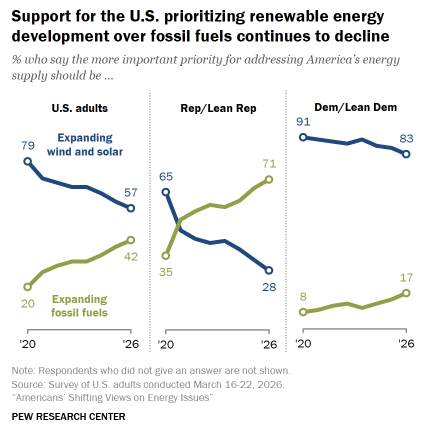
Learning CurveAmericans are cooling on clean energy. But it’s mostly partisan. A growing share of Republicans prioritize developing fossil fuels like oil and natural gas over wind and solar power, doubling to 71 percent over the last six years. While an overwhelming majority of Democrats continue to prioritize wind and solar power, the number has ticked down slightly since 2020.
Read more about Americans’ shifting views on energy issues from the Pew Research Center.
|
SnapshotThe Gulf of Mexico is home to one of the world’s rarest creatures: Rice’s whale. It’s also where the Trump administration wants to expand oil and gas drilling, which scientists say could edge the mammal toward extinction. Read more about what we know about the last 100 — possibly fewer than 50 — Rice’s whales. |
A Rice’s whale at the surface in the Gulf of Mexico. (NOAA Fisheries via AP) |
 |
The Second DegreeLast week, I wrote about breaking up with my Kindle because my new e-reader treats me better. What about you? Many of you professed your love for print. “What is wrong with getting back into the slow lane and reading physical books?” wrote reader Almuth Tebbenhoff. But others are onboard with e-ink. Another reader, Keely, opted out of the Amazon ecosystem (which includes Goodreads) and purchased my Kobo about two years ago. “It’s the best purchase I’ve ever made,” Keely wrote. “I have also switched to StoryGraph, a black-woman-owned app that I highly recommend. If you like stats, graphs, and charts, it’s a haven.” Erin in Madison, Wisconsin, favors leaving devices behind entirely. “I once saw a talk by Sam Levin on evolutionary social structures [suggesting] that the only way to keep things fair is if people have the option to simply opt out. I suppose that is what I’m doing.” For those of you making the switch from Kindle, Kobo provides instructions for how to convert AZW files to a file format supported by Kobo. You can find out how to upload non-protected ePub files onto your Kobo device here. To add DRM-protected files to your device, follow the steps here. |
 |
On the Climate FrontFrom The Post: U.S. Forest Service will move its headquarters from D.C. to Utah The secret sex lives of octopuses, revealed NASA’s Artemis II crew has flown farther than any human has before As megafire risks grow, Trump bets on a wildfire super agency to fight them From elsewhere: “On a whole other level”: Rapid snow melt in the West stuns scientists (The Guardian) as states risk running out of water (Vox) Republicans seek protections for oil giants against climate lawsuits (New York Times) How reverse game theory could solve the housing shortage (Noema Magazine) |
 |
What’s blooming in your neighborhood? After Marcie Meditch learned about Doug Tallamy’s Homegrown National Park movement converting backyards into biodiversity refuges, she created this meadow next to her house in northern Michigan. “I worked with a local landscape architect Anita Silverman to select all native, drought-tolerant species of plants for the yard,” wrote Marcie. “Not only has the garden thrived, but it has become a magnet for insects, birds, wildlife and neighbors! People stop by daily to share how much they appreciate its beauty.” Send your photos to climatecoach@washpost.com |
Was this email forwarded to you? Sign up here to get The Climate Coach in your inbox every Tuesday. See you next Tuesday, Michael Coren, Climate Coach |
|
|
|












No comments:
Post a Comment