Warren's new math
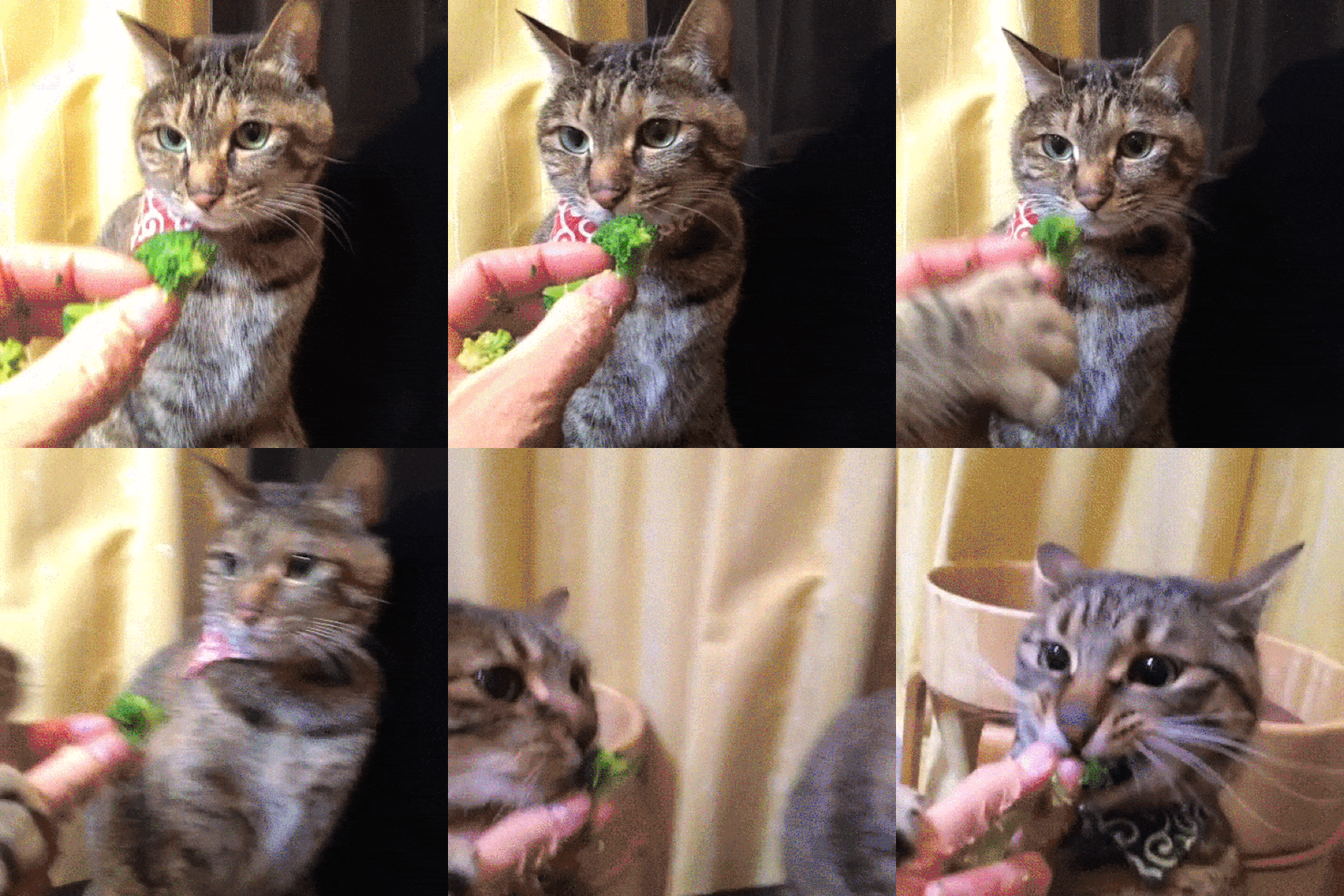
Sen. Elizabeth Warren, a top contender for the Democratic presidential nomination, may need three cats to cover the cost of Medicare-for-all. Allow us to explain: When The Fact Checker evaluates campaign policy proposals, we're often reminded of the story of the man who claimed he sold a dog for $50,000. "It was easy," he said. "I traded him for two $25,000 cats." In other words, the numbers underpinning a policy proposal may add up on paper, but the assumptions baked into the math might be unrealistic. Which takes us to Warren's most recent plan. The liberal senator released a detailed rundown of how she would fund the transition to a single-payer health-care system — without, she said, raising taxes on the middle class. To her credit, Warren issued two lengthy letters from well-respected experts, which explained (over 41 pages, with 146 footnotes) exactly how much her plan would cost and how she'd round up the funds. Warren starts off with a $34 trillion cost estimate for Medicare-for-all over 10 years. She then subtracts $13.5 billion from that estimate by proposing to lower some of the costs: Warren would grab current state and local health care funds to the tune of $6.1 trillion, change Medicare reimbursement rates for doctors and hospitals to save $2.9 trillion, among other optimistic assumptions. Then, Warren proposes to cover the remaining $20.5 trillion cost by making employers spend what they currently do on insurance company bills on Medicare-for-all instead (that's $8.8 trillion in revenue). She would raise taxes on billionaires, capital gains and dividends ($3 trillion). Warren would repeal President Trump's tax cuts and institute a new 35 percent tax on foreign earnings ($2.9 trillion). She would institute a new fee on large banks, improve tax collection rates through better enforcement, cut defense spending and pass comprehensive immigration reform to make up the rest. The numbers add up ... but the whole thing starts to fall apart if some of the savings Warren proposed turn out to be unrealistic. Or if the revenue raisers are suspect, such as the money obtained from better tax enforcement. Or if the politics are unmanageable (immigration reform has stalled for years). For the full fact check, click here. Enjoy this newsletter? Forward it to someone else who'd like it! If this e-mail was forwarded to you, sign up here. Hear something fact-checkable? Send it here, we'll check it out. Have the Turks and Kurds been fighting for centuries?
After his announcement that U.S. forces would withdraw from Syria, President Trump repeatedly made variations on the same point: The Turks and Kurds have been fighting for hundreds, or even thousands, of years — as if to say, how are U.S. forces ever going to stop them? But the reality is more complex. After World War I, the Allied forces divided what had been the Ottoman Empire along ethnic and religious lines to suit their interests. The Kurds were split between four new nations — Iran, Iraq, Syria and Turkey. The Kurdish population in Turkey would be heavily suppressed for the next several decades. A militant Kurdish organization called the Kurdistan Workers' Party (PKK) emerged in the 1970s and 1980s, ultimately declaring war on the Turkish state in 1984 What does all this have to do with current events in Syria? After a civil war erupted in 2011, the Syrian government controlled by Bashar al-Assad pulled troops out of primarily Kurdish areas, allowing Kurdish groups tied to the PKK to emerge as the dominant ideological and militant forces in the area. All of that is to say, the Turks and Kurds haven't been fighting for centuries. The president earns Four Pinocchios. Check out our video fact check, part of The Fact Checker's series on YouTube. For the full fact check, click here. We're always looking for fact-check suggestions. You can also reach us via email, Twitter (@GlennKesslerWP, @mmkelly22, @rizzoTK, @SarahCahlan or use #FactCheckThis), or Facebook (Fact Checker). Read about our rating scale here, and sign up for the newsletter here. Scroll down for this week's Pinocchio roundup. | 


 Email
Email








No comments:
Post a Comment