| |  | | | | November 14, 2017 | Letter No. 112 | | | | | | | | | | | Advertisement | | |  | | | | | | | | | Dear Lennys,
Last month, I went on a date where the guy straight up told me that he thinks I hate men. I had just gone on a rampage against Harvey Weinstein, and, given my date's lack of reaction, I asked him if he had feelings about the whole situation (he just thought that was an unfair question (!!!)). Then he told me that I was being combative. Earlier in the year, another guy was offended that I brought up Casey Affleck's reported history of sexual assault, even though it had just been in the news.
These are only the most egregious examples of trash male behavior I've dealt with in person this year, and I'm stuck with so much rage about how and why it all went down. How can we move forward if men won't talk about these issues? How could they blame me for bringing up facts just because they don't want to talk about them? Maybe there was a better way I could have started these conversations, but the fact that I've come away feeling like I've done something wrong still seems outrageous.
What's so infuriating is that these men have turned my words back on themselves with the oldest anti-feminist trick in the book — telling me that I'm crazy, that my opinions don't matter, that women's stories are a waste of time.
As I'm still reeling, I admire the writers in this week's issue, who are navigating their own relationships so thoughtfully.
—In a beautiful essay, actress Joy Bryant writes about how her mother's own experience with sexual assault splintered their mother-daughter bond.
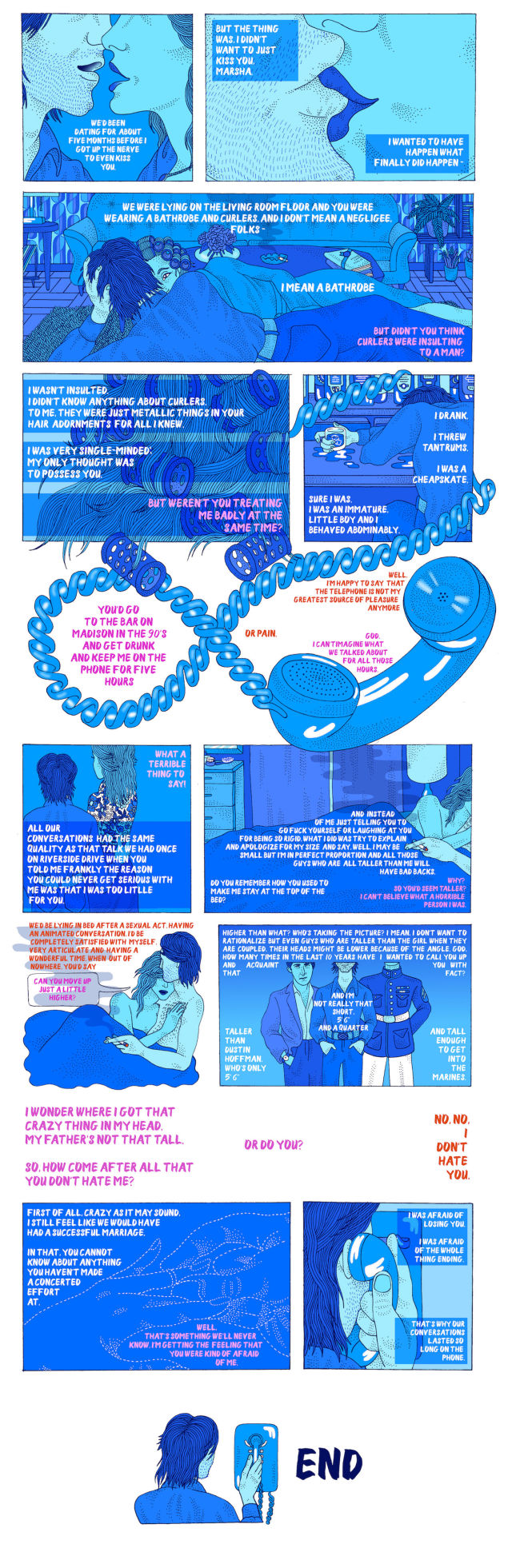
—In a new comic series by author Linda Rosenkrantz and illustrator Lauren Cierzan, Linda investigates what went wrong with a handful of her ex-boyfriends.
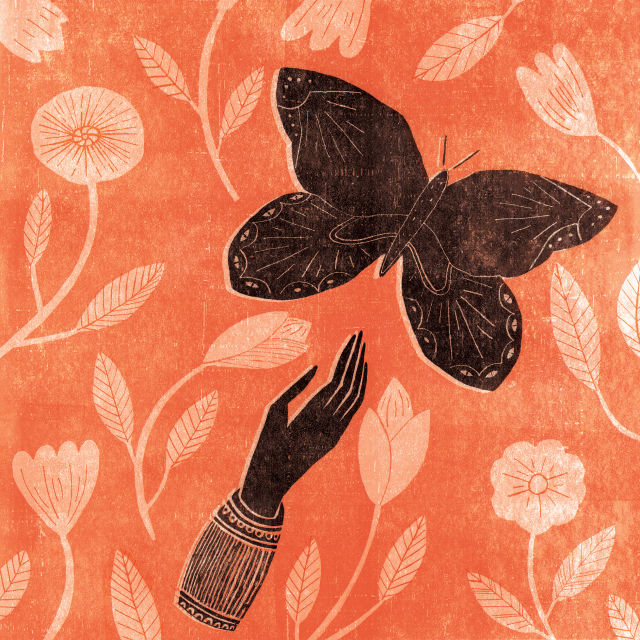
—Angely Mercado reflects on the Dominican tradition of memorializing death and her mother's habit of reminding her children that she won't be around forever.
—Jaclyn Friedman does a deep dive into how the religious right wasn't always obsessed with abortion and our sexual freedom.
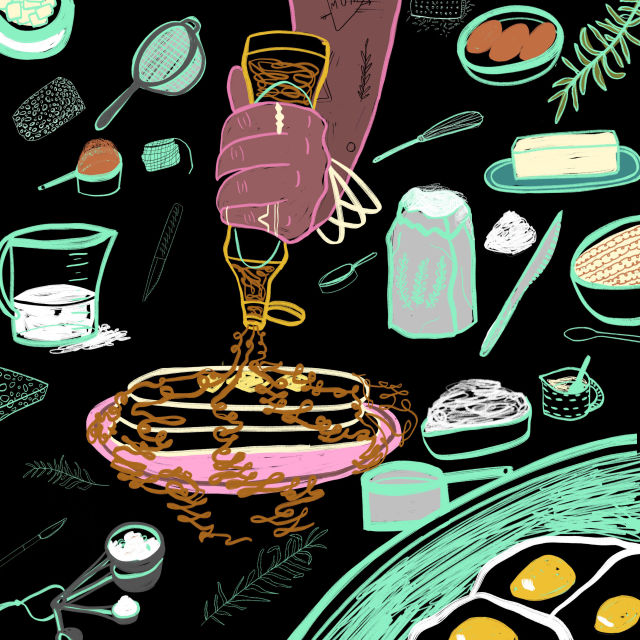
—And finally, the authors of the new cookbook Hot Mess Kitchen share the recipes that help them rise above self-doubt, news from their exes, and more.
Whatever you're feeling this week, I hope you find some release in these stories — I know I did.
Xoxo,
Molly Elizalde, associate editor | | | | | | | | | | | | Advertisement | | |  | | | | | | | | Her, Too: My Mother, and the Legacy of Abuse | | | | By Joy Bryant | | |
The last thing I expected to do on the morning of my birthday was cry. But the tears of Joy were not tears of joy but tears of pain and sadness. I couldn't stop thinking of my mother. I'd never thought about her on any of my birthdays, in all these years. My birthday had always been about me and how great it was for me to be living my life. I'd never thought about the woman who gave me that life, the woman who birthed me into this world on that day. That was no joyous day for her but a sign of hurt to come.
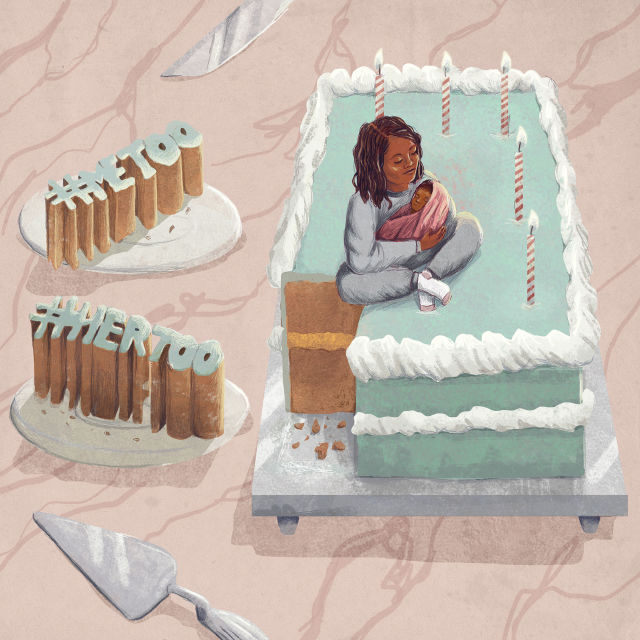
The recent outing of Harvey Weinstein, Louis C.K., and others has been shocking in its gross criminality yet not surprising in its existence. Women have long been victimized by the evil that men do, especially men in power. Men who rule with iron fists, limp dicks, and egos as big as the sky.
To see woman after woman lift up her voice in a #MeToo clarion call of solidarity and acknowledgment of the pervasive abuse that we've experienced is liberating on the one hand and sobering on the other. It's comforting to know that you're not alone. But goddamn — who hasn't been abused, harassed, assaulted, or traumatized?
So it was on my birthday morn when I watched an interview with Tarana Burke on Democracy Now. Tarana, a black woman and community activist, started the Me Too movement more than ten years ago to give voice to survivors of sexual violence, particularly women of color — women left without the resources to deal with the trauma of their experiences. By "empowerment through empathy," they could connect with one another and know that they are not alone. And while #MeToo has taken off in ways Tarana hadn't anticipated, she said in the interview, "It's not a hashtag, it's not a moment. This is a movement." And there's hard work that needs to be done to eradicate this "pandemic" of sexual violence against women, especially those who are not famous.
I thought about my own experiences of abuse, assault, and harassment, pre-fame and post-fame. The male babysitter when I was five, the male photographer in my early twenties, the male studio executive a few years ago. Yeah, me too.
And in my acknowledgment of common cause with the countless women coming forward in Hollywood and beyond, I thought about my mother, Joyce. Yeah, her too.
On October 18, 1974, Joyce gave birth to me, not in love but in shame, after hiding her pregnancy from my grandmother for six months. I am the product of a fifteen-year-old girl and an older man she knew. It doesn't matter how or why or when. It happened, and with both my mother and my father dead, I'll never know the specifics. What matters is that no one protected her before or after. What matters is that my mother was the one who was shamed. What matters is that my father ruined her life just as it was blossoming. What matters is she was trapped in a trauma she could never escape, a trauma that prevented her from being the mother I needed her to be. What matters is that she didn't matter. And because she didn't matter, I didn't matter to her.
For most of my life, I've been too wrapped up in my own pain to ever acknowledge hers. Part of that is due to the fact that there was so much I didn't know, so much that was kept from me, like my father's identity, for one. But it was also due to my own righteous victimhood. What could be worse than being the recipient of her resentment, abandonment, anger, and disregard? I had no idea. I was well into my adult years when I learned who my father really was, and even then I couldn't see past my own pain.
A family member once told me, "Your mother ain't been right since she had you." I was eighteen at the time and thought I knew what he meant. She was just "crazy." It was the night before my grandmother's wake, and Joyce and I had a big fight. She didn't appreciate how I was speaking to her, and I didn't appreciate her grabbing me, so we went at it. It was the first time I ever hit back. Years of anger and disappointment will do that to you sometimes. As family members pulled us apart, my mother yelled, "Your grandmother ain't here to protect you anymore, bitch! Imma get you!"
What was I supposed to do with that?
While she was alive, my grandmother did what she could to protect me, but she didn't do enough to protect her own child. I'll never know how she felt about that. Guilt? Shame? Embarrassment? My grandmother took on the full responsibility of raising me. Was I her chance to make it right? She became the mother to me that neither my mother nor I had had. Was my mother jealous of that, and did that only add to her resentment and our estrangement?
It didn't help that neither one of us had the tools to actually have the unspoken conversation that was the subtext of our entire relationship:
Mommy, why can't you love me?
Because I can't love myself, baby. I don't know how.
For years, the silence between us was so loud, I had to cover my ears. I never knew who my mother was as a woman. I never heard her story from her. She never let me in. I never asked. I didn't know how. Neither did she. So my experience of my mother was based on how she treated me, what I heard, and what I saw, most of which was far from nurturing and kind.
But I was always my mother's child, no matter how much I tried to erase her or how much she pushed me away. In addition to our similar names, we looked just like sisters but spent most of our lives living as enemies. I became everything she wasn't, everything she could have been if she hadn't had me when she did, the way she did. So much of who I am as an artist is a reflection of who she was and could've been. She had more talent in her pinky than I possess in my entire being. She could sing and dance, and she was a much better actor than I could ever be. She was also a poet and the most beautiful woman I had ever seen. It's taken me a long time to give her that due.
Hers is a story of what happens when Black Girl Magic becomes Black Girl Tragic and the casualties it leaves in its wake. Her story is one of stolen innocence and lost potential, a record of pain spun on a never-ending loop. Her story is sadly the story of so many.
It's taken years of therapy for me to begin to understand who I am and why I am. And because of that, I've come to understand who and why my mother was, better than I could when she was alive. But on my birthday this year, I accepted my mother's story as a part of my own. It always was and always will be.
Joy Bryant is an actor, writer, and survivor. | | | | | | | | | | | | Advertisement | | |  | | | | | | | | Ex #1: Barney | | | | By Linda Rosenkrantz | | | Just before my novel Talk was first published in 1968, I had the idea for another taped book. The concept was to invite a number of ex-boyfriends over for dinner one by one, serve them each the exact same meal. I'd turn on the tape recorder the minute they came to the door of my New York apartment, and keep it running until they left. Then, I'd edit the recordings into a book, hoping, in the process, to discover What Went Wrong.
I invited — or at least considered inviting — twenty guys; in the end, twelve showed up, including a crime reporter, a radical radio personality, two sculptors, an auctioneer, and one businessman. Each encountered a different version of me. The shortest session was only seven minutes (after which the paranoid invitee fled at the sight of the microphones); the longest lasted until late the next morning. Certain things didn't play out as planned. The menu changed from homey Jewish to more classy career girl, and there may have been a little too much wife talk. One purist was disappointed that the tapes would be edited and not exposed raw; another said he'd kill me if the book were ever published.
This story is part of a series of five excerpts from the taped dinners — but not that last guy's. Here's Barney.
Linda Rosenkrantz is best known for her taped novel Talk, recently republished as a New York Review Books Classic, and she is also the co-founder of the popular baby-name website nameberry.com.
Lauren Cierzan is an illustrator based in Nashville, Tennessee. Her scribblings and more can be found at laurencierzan.com. | | | | | | | | | | | | Advertisement | | |  | | | | | | | | Mami Is Dy-ing | | | | By Angely Mercado | | |
My mother is dying. Dy-ing in fact. She's dying in a Dominican way, which means that she's dying just as fast as I'm dying, which is as fast as anyone this stressed is dying. But it also means that she must remind me that she is dying on a weekly basis. Daily if we're arguing. Hourly if I mention moving out. I'm often bombarded with images of me, standing over her open casket. Her hair is freshly cut and straightened by her friend at the salon over on Seneca Avenue. I am standing by that casket in a dress she requested in her will, making sure that she is buried with all her rosaries.
But nonetheless, my mother is dying, and I'd better not forget it.
There are a lot of cultures around the world where death is talked about openly in folklore, music, and everyday discussions. Mainstream U.S. culture is not one of them. Death is barely discussed in a meaningful way here. Movies highlight people who are forever young. We have pop-culture obsessions with coming back as zombies or living forever as vampires. Funerals for more-Americanized households seem pretty quick, as are the wakes. Prayers in funeral homes usually last only a few hours, and bodies aren't viewed at home, and there don't seem to be official mourning periods — compared to the nine days of prayer I grew up with so that the loved ones' souls could make it out of purgatory.
Meanwhile, both the Puerto Rican and Dominican sides of my family talk about death. Old stories mention ghosts and hauntings. My maternal grandmother used to tell me not to catch fireflies because they were souls that had to make it to the other side. Funeral homes in my dad's hometown serve snacks and juice because families and friends plan on spending an entire day there — or more.
My 95-year-old grandfather's favorite way to say goodbye when he's about to catch his flight back to the Dominican Republic is to tell us that he'll see us eventually, if he doesn't die first.
One particularly eventful morning when he was visiting about two years ago, I heard him yelling over in the guest room, and I ran over to make sure that he hadn't hurt himself in any way.
"Estoy vivo," he told me.
"Of course you're alive; you're right there," I told him.
"Yeah, you're right," he said. "Anyhoo, gotta go pee."
The first time I remember mom mentioning her upcoming death was in elementary school. All I recall is feeling afraid that my mom would actually disappear one day if I wasn't careful enough. That was before I was old enough to notice nuances, like how an ultimatum in Spanish isn't necessarily one in English. So that whole time, my mother wasn't dying. She was just dy-ing. And when we didn't come across a body the next day, I figured that it wasn't all that serious. That epiphany didn't erase my own nerves when I had to confront the fact that I, too, would age and die one day. But I figured I'd be better off adding memories to my life instead of having a countdown in the back of my head.
Sometimes I'd forget myself and actually panic when my mother spoke about dying. I'd forget a sock on the floor, and she would tell me that one day she wouldn't be around to remind me how that one sock had almost destroyed a household.
"You don't understand," she'd say, pointing around my room with the renegade sock. "You're killing me. This is killing me. It's like you do it on purpose."
Other times, my rebellious older sister would announce a new boyfriend, or my mother would get a call from my brother's school about his behavior, and death would slowly shroud our home as mom would begin to lecture and remind us that her time is near. And if we didn't stop, we'd make it nearer.
"Don't you dare cry at my funeral," she'd spit out angrily at us. "Yo no quiero que me lloren después que yo me muera."
My favorite death argument happened right after my graduate-school graduation. I gleefully told my mother that my school did not provide photo sessions for students while wearing our caps and gowns. I am pitifully unphotogenic in a time when Instagram reigns supreme. Therefore, any situation where I don't have to present my face in front of any camera translates into a very good situation for me.
My mother wasn't about to let this opportunity slide. She wanted to go over to the photo studio nearby where the cameraman who took all of my awkward elementary-school photos still works. I said no. I dug my heels in and said that there was no way in hell that I was going to smile through a photo session with problematic skin, a large forehead, a wide nose, and a weak chin.
Her first reaction was disbelief. She didn't understand how I didn't want a photo to commemorate my accomplishments. And then the guilt showered down on me like a mid-summer monsoon.
I tried to ignore it for a day. She would passive-aggressively bring up that she really wanted a graduation photo to send to my godparents. I tried calmly explaining that I wasn't going to take more photos.
That's when she started in with the death talk. "Mami isn't going to be here forever," she said in her eerie low voice, the one she uses before she yells. "Can't you do this one thing for me … just to make me happy?"
If I were to say no to that, she would be devastated, which would mean that I'm devastated. She swore up and down that all she ever wanted before her death was to have a token of my accomplishments to hang on her wall. So I watched four contouring tutorials on YouTube and listened to a soft-spoken man telling me to be confident and serene, and I took the goddamned photos.
Some reminders of death are more concrete. Life-insurance papers arrived in our mailbox, and I saw that there was an option for planning funerals down to the smallest detail.
"Look, you get to choose having a rosary in the casket with you," I told her, pointing to the options on the paper.
"I have a hundred rosaries. I'm not paying extra for one of theirs," she told me.
Other times, when I'm in the car with my parents and we're driving up Cypress Avenue, past the large graveyard near Cooper, we make plans.
"You can't cremate me," Mom always says. "I swear to God, don't you dare cremate me. You have to have my body all in one place."
My dad says that he wants to be buried in Puerto Rico. I visit the graveyard where most of his side of the family is buried in tiers on the mountain. It's scenic, and there are trees, and he wants a flamboyant tree of his own nearby. I want one, too.
"I want an ecofriendly tree grave," I tell them. "Don't embalm me. I want to become the tree for a little bit before Judgment Day comes."
Sometimes I want a weeping willow tree. Other times I want a quenepa tree, but I don't know if it'll grow in New York, assuming I die here. Other times I want a headstone and an ecofriendly casket or just a rosebush. Mom doesn't give any suggestions at all; she just reminds me that after I turn 27, I should call up a lawyer and make sure that my funeral demands are documented. Twenty-seven is a decent age, because I'll be a little older, and by then I'll have made up my mind about certain details. I understand that they're subject to change, but if I want to save money in the long run, I'm better off getting my affairs together now.
My grandmother had picked out her own funeral clothes years before her strokes started. My mother and my aunt carried them around during her last month. When she stopped breathing, everything was ready. Her death hurt, but it was dealt with. It gave us time to mourn. No one was inconvenienced. I don't want my death to be an inconvenience.
I think about all the times I've longed to pass over ever since I learned about mortality. That lesson came very early in my life. It was mentioned in my Catholic religion classes during elementary school for my first Communion. But then death became so much more real after my mom brought it up when arguing about the cleanliness of the house.
Sometimes the supermarket runs out of that low-sugar protein ice cream I stress-eat after a long day. I've died a little death.
Sometimes a pitch I worked very hard on isn't accepted, or sometimes I'm sick and I miss a deadline or an opportunity. I've died a hundred deaths.
Sometimes I get into an argument with someone I care about deeply. And before we part ways, or before we put our phones to the side for sleep, I text, "I love you." And sometimes I don't get that as a response back. I've died a thousand deaths.
Sometimes a relationship reaches its last straw. I accidentally turn my phone over in class because I can't figure out how to shut the vibrate setting off, and so I read a dissertation of texts that hurt. I quietly ugly-cry behind my laptop screen because I don't want to leave the room and show everyone my tears. When I try to hold in my tears, my eyes get red, and I want to turn to my classmates nearby and whisper, "I'm not high, I promise … I'm just sad." I've died a million deaths.
A million to my mother's billion. So she wins and I lose. A stray shoe is a score of little deaths. As is my giving sass, or when I painted my nails black for the first time like those "crazy people she heard about on the news." Or when I announced that I wanted to go on vacation with my boyfriend, to which my mother replied, "Are you trying to kill me? Because I swear to God you are. Eso no está bien. Eso no se hace."
She said the same thing when I casually dropped that I was saving up to move out.
"You don't know how stressed out I am," she tells me some days after work if I happen to complain about freelancing.
I want to tell her that she's not special, that I've had a full day of work, too, and that I've stayed up all night applying for jobs. But I can't. Because she'll suddenly be out-dying me. Dy-ing with a capital D. I know it means that she just wants attention. She was a middle child like me. The good child like me. She wants love. I want love. She wants to live out her life and not face little deaths at every bump or every milestone. I know she wants me to appreciate her, to cherish my time with her since it won't be forever. I'd rather remember that than ignore it. Maybe it'll make me a better daughter.
It will definitely hurt when she's gone, if I don't go first (I'm clumsy, so we'll see how that goes). And until then, I want her to be happy, even if she mentions her impending demise at every given situation. Until then, I need to pick out a lawyer and a tree.
Angely Mercado is a native New Yorker, writer, and part-time troglodyte whose work has appeared in the Billfold, Hello Giggles, City Limits, and more. | | | | | | | | | | | | Advertisement | | |  | | | | | | | | How the Religious Right Broke Into Americans' Bedrooms | | | | By Jaclyn Friedman | | | |
"I had a case in rural upstate New York in which my client was a Republican police officer," Diana Adams tells me. She's a lawyer who specializes in family law. "It was a child-custody case. [My client] was living with his girlfriend before he and his wife had finalized their divorce, which had been delayed for years because neither of them could afford to pay the filing fee. They had been separated for years, but the very first thing that the judge said to me was that sodomy and extramarital sex were crimes in New York State and crimes in the Bible, and I should read the Bible to my client, and I might need to read it myself. Immediately I tried to get the case removed from that judge, [but] the only other judge in the county was his brother, and the only court-appointed child attorney, who interviews the child and says what's best for them, was his best friend of 50 years. They had the case dismissed, so I couldn't bring it up on appeal. So basically this dad was losing custody because he was living with his girlfriend before his divorce had come through, and they thought that just wasn't Christian."
Because too many people seem confused on the matter, it pays to say this plainly: We are not supposed to be living in a theocracy. The Constitution is clear on that matter. Only 20 percent of the country goes to church on a regular basis. But you wouldn't know it by looking at the federal government, where 92 percent of U.S. House and Senate members identify as Christian. Our president openly campaigned on giving Christians preferential treatment. Our vice president's entire political career has been bankrolled in part by a family, the Princes, who are working toward a Christian-right takeover of the U.S. government. Our secretary of Education is literally a member of that family and has said she wants to use public education to "advance God's kingdom." Adams's client was far from an anomaly: we're all being screwed over by our government in the name of Jesus.
Politicians weren't always so subservient to right-wing-Christian agendas. For most of the twentieth century, the evangelical church considered politics too earthy and mundane to sully themselves with. That was until 1976, when the IRS revoked the tax-exempt status of Bob Jones University, citing the Christian school's policy against interracial dating.
With the backing of evangelical leaders, the school refused to rescind its racist rule and instead filed a suit to retain its tax-exempt status. Even before the case reached the Supreme Court (where the university lost), the suit galvanized religious leaders, who saw the IRS ruling, and the Civil Rights Act from which it drew its authority, as "government interference" in their segregated white fiefdoms. They wanted to put politicians and bureaucrats on notice.
But they knew that organizing ordinary rank-and-file evangelicals to explicitly defend racism would be a harder sell. So they cast about for other issues to organize around and decided, for reasons we can only guess at, to go after abortion and the sexual freedoms it represents.
It took a while to take hold. Evangelicals were unaccustomed to thinking of themselves as political actors, and they didn't much care about abortion, either. (That was Catholics. In fact, the Baptist Press praised Roe v. Wade when the court handed it down, saying, "Religious liberty, human equality and justice are advanced by the Supreme Court abortion decision.") But the leadership persisted, and as evangelicals began to stir, Republican politicians paid attention. A deal was struck: Evangelicals would help elect Republicans, and Republicans would become the party that opposed abortion and sexual freedom in general, while of course defending the Church's right to be as racist as they want to be. The Religious Right was born.
Today the movement is fully grown and their tentacles are everywhere. Their latest obsession is using something called the Religious Freedom Restoration Act (RFRA) to legalize discrimination against anyone who doesn't meet their rigid, retro gender standards for sex and love. RFRA was a fairly innocuous piece of legislation, passed in 1993 in a bipartisan effort to shore up the "Free Exercise" clause in the First Amendment ("Congress shall make no law respecting an establishment of religion, or prohibiting the free exercise thereof …"), after a much-criticized Supreme Court ruling allowed a private employer to discriminate against two Native Americans who used peyote as part of their religious rituals. RFRA was drafted as a rebuke to that ruling. Over the years, it's been used appropriately in a few cases, including ones involving Orthodox Jewish prisoners wanting kosher meals and churches that would be otherwise barred by state or local ordinance from feeding the homeless.
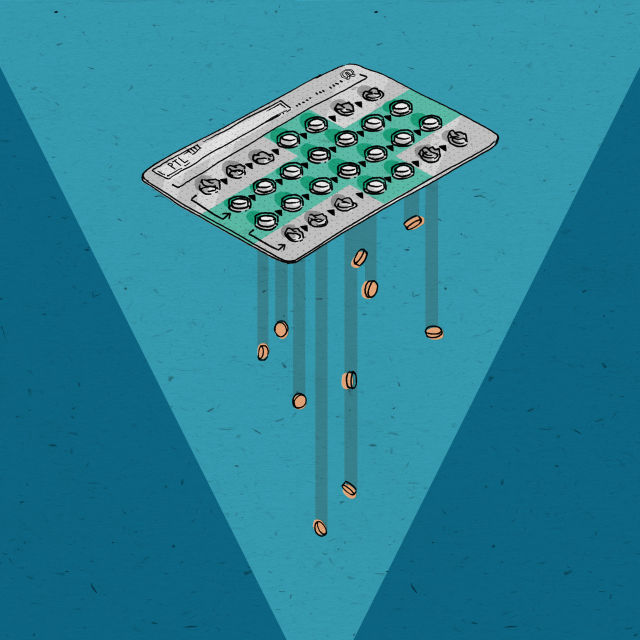
With those few exceptions, RFRA was mostly dormant until 2012. Enter Hobby Lobby, a chain of craft-supply stores owned by an evangelical-Christian family who objected to the Affordable Care Act's provision mandating that employers include contraception coverage in their health-care plans. Hobby Lobby filed suit against the mandate, claiming it violated the owners' religious freedom, as protected by RFRA, to have to pay for five kinds of contraception that they believed, science be damned, to be a form of abortion. (Hobby Lobby conveniently ignored the fact that its own, pre-ACA health-insurance plans already covered two of those five kinds of birth control; none of those devout Hobby Lobby owners seemed troubled about it until Obama came on the scene.)
Hobby Lobby pursued its case all the way to the Supreme Court, where it paved the way for a monumental shift in the use of RFRA. Writing for the majority, Justice Alito's opinion was constructed to free the Court from adhering to previously settled case law, most specifically a precedent case in which the court ruled against an Amish employer that refused to pay Social Security taxes for religious reasons on the grounds that "granting an exemption from social security taxes to an employer operates to impose the employer's religious faith on the employees."
Far from defending religious "freedom," that religious imposition is exactly what the Supreme Court endorsed in its Hobby Lobby ruling. And a flood of legislation has followed, mostly in the form of state-level RFRA laws designed to permit "Christians" to discriminate against LGBT people in every conceivable way.
In 2015, Arkansas made it illegal for cities to pass nondiscrimination ordinances that protect LGBT people on the grounds that requiring people to not act like homophobic bigots infringes on their religious freedom. In Michigan, it's perfectly legal for a private adoption or foster-care agency to refuse to place a child in a home that runs afoul of that agency's religious beliefs, whether the agency is against gay marriage, unmarried couples, or single parenthood, or even just find that the wife in a heterosexual couple is insufficiently submissive to her husband. Mississippi's "Protecting Freedom Of Conscience From Government Discrimination Act" is so broad that it protects therapists from having to treat clients who may be too queer or too slutty for their tastes, protects any business that refuses to provide wedding-related services to gay couples, permits state and local employees to refuse to process any paperwork or do anything at all related to gay marriage, permits businesses and schools to institute "sex-specific standards or policies concerning … dress or grooming, or concerning access to restrooms, spas, baths, showers, dressing rooms, locker rooms, or other intimate facilities or settings," and much, much more.
And those are just some of the laws that have passed. Despite the fact that most Americans oppose these kinds of laws, in the two years post–Hobby Lobby, state legislatures considered nearly 200 bills to expand religious "freedom." Most failed, but the ones that have become law are daily making many citizens less free, by forcing us to choose between ongoing legal discrimination and adhering to a faith to which we do not subscribe.
Every time lawmakers champion these kinds of efforts, they claim the moral high ground. Roy Moore claimed he was taking a moral stand when he ordered Alabama judges to refuse to issue same-sex marriage licenses in defiance of the Supreme Court, but he seems to have had no such moral concerns about preying on teenage girls. At the "Values Voter Summit" last month, Trump proclaimed that his administration is "stopping cold attacks on Judeo-Christian values," though there's nothing Jewish, or even Christ-like, about denying millions of women access to birth control or refusing to condemn countries that put their gay citizens to death. Nor, of course, is a thrice-married serial adulterer and accused sexual predator a very good standard-bearer for the values Christian conservatives claim to hold.
But then, as their history shows, the Religious Right takeover of our government has never really been about piety. It's always been about power. And the best way to take it back is to exercise ours at the ballot box.
Adapted from Unscrewed: Women, Sex, Power, and How to Stop Letting the System Screw Us All, by Jaclyn Friedman. Copyright © 2017. Available from Seal Press, an imprint of Perseus Books, LLC, a subsidiary of Hachette Book Group, Inc. All rights reserved.
Jaclyn Friedman is an author, activist and the host of the podcast Unscrewed. Visit her at jaclynfriedman.com.
| | | | | | | | | | | | Advertisement | | |  | | | | | | | | Even the Hottest of Messes Deserve a Nice Meal | | | | By Miranda Berman | | |
Since I was a little girl, cooking has been my therapy (therapy has also been my therapy, but that's a whole other story). I was a sensitive, moody, and probably clinically depressed kid. I was smart and creative, but I had a hard time fitting in. When I was eight, my mother bought me an antique set of pots and pans to play with. I begged to use them for real cooking, so she gave me her copy of Mollie Katzen's The Enchanted Broccoli Forest and let me try my hand at some simple dishes.
In the kitchen, with my little mixing bowls, frying pan, and kid-size chef's knife, I learned to dice, chop, bake, and sauté. I learned to trust my instincts with flavor combinations, putting my own stamp on recipes. I learned that if I could taste, I could cook — it was just a matter of learning a few simple techniques and being a little bit brave. The world was hard and scary, but the kitchen was a place where I could always be myself and where my hard work was rewarded with something delicious.
Growing up and moving out on my own made some things easier (I made cool, like-minded friends and finally got those boobs I had been wishing for), but it also made some things a lot harder. My twenties were full of adventure and self-exploration, but they were also loaded with self-doubt and worry: Was I smart enough? Pretty enough? Strong enough? Would I ever be?
When we fail to meet the impossible (and often contradictory) standards set for us by magazines, TV shows, movies, and insane Instagram filters, it's easy to feel like a complete and utter failure, even if your conscious brain knows that's not the case. But as I learned as a little girl, choosing to cook for myself is, in my experience, an excellent way to improve your mood when things go south. This is because cooking is about loving yourself exactly as you are: whether your apartment is spotless, your credit-card bill is paid in full, and your professional and personal lives are exactly where you want them to be — or not.
And the process of making a meal from scratch — slicing vegetables, sautéing garlic, turning a few simple ingredients into more than the sum of their parts — can help you feel in control of your world, especially when the actual world feels so out of control. My friend Miranda and I wrote Hot Mess Kitchen to make you laugh and inspire you in the kitchen but also to share our favorite way of re-grounding ourselves when things get crazy: getting into the kitchen. We hope these recipes can take you there, because even the hottest of messes deserve a nice meal.
— Gabi Moskowitz
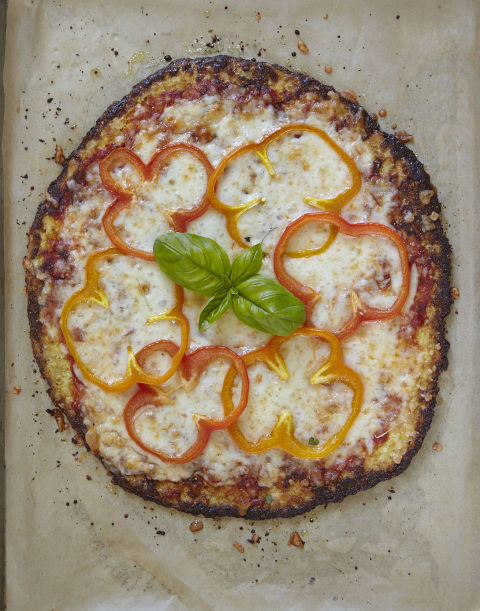
Basically Carbless (Not That We Care) Cauliflower-Crust Pizza
We're sure you've seen cauliflower-crust-pizza recipes, and maybe you've even tried one or two yourself, but we have to be honest: you haven't had one as good as this. And the best part is that it's really not that hard. There are a few little techniques required (like using a light hand with the delicate crust), but they're easy to do and so worth it (don't forget the parchment paper — trust us). Oh, and if you don't have a food processor to make the cauliflower rice, feel free to use bagged riced cauliflower instead (Trader Joe's and Whole Foods both sell good fresh and frozen versions).
You can literally top this cauli pizza with anything you're into (pepperoni, thinly sliced vegetables, caramelized onions, and crumbled veggie sausage are a few ideas). That said, when I'm feeling sad, anxious, or overwhelmed, I find that there are few things more comforting than a classic cheese pizza — cauliflower crust or otherwise.
—Gabi Moskowitz
Ingredients
1⁄2 large cauliflower, cut into florets
2 eggs, lightly beaten
2 tablespoons extra-virgin olive oil, divided
1⁄2 cup grated Parmesan, plus more for topping the pizza
Pinch of salt
1⁄4 cup sauce of your choice (tomato, pesto, romesco, etc.)
1 cup shredded mozzarella cheese
1 to 2 toppings of your choice (we love sliced bell pepper, pepperoni, mushrooms, olives, and caramelized onions)
Fresh herbs (we like sliced basil and chopped parsley), optional
Red chili flakes, optional
Directions
Preheat the oven to 400°F.
Place the cauliflower florets in a food processor and purée until the mixture resembles ricotta cheese and each grain is about the size of a piece of couscous. TIP: If you can't seem to get the right consistency, or if a few whole florets remain after puréeing, try adding enough water to cover (usually about 2 cups), and purée as if you were making soup. When all the cauliflower has been completely processed, strain it in a fine-mesh strainer.
Scrape the cauliflower into a microwave-safe bowl and microwave it on high for 5 minutes.
Carefully scrape the microwaved cauliflower purée onto a clean dish towel.
Very carefully (using a second towel if necessary to protect your hands) squeeze out as much liquid as possible. Get it as dry as you can.
In a mixing bowl, combine the cauliflower, the eggs, 1 tablespoon of the olive oil, the Parmesan, and the salt. Mix together to make a thick batter.
Line a baking sheet with parchment paper.
Scrape the batter into the center of the parchment. Gather the batter into a ball shape.
Wet your hands and carefully pat the batter into a circle, making it as thin as possible.
Drizzle the cauliflower circle with the remaining tablespoon of olive oil, and use your hand or a pastry brush to spread it all over the circle.
Bake for 30 minutes, or until the crust is nicely browned and a little crisp.
Remove the crust from the oven, but leave the oven on.
Place a piece of parchment paper over the top of the cooked crust.
Carefully flip the whole thing so the bottom is facing up.
Remove the top layer of parchment (what was previously the bottom layer).
Top your pizza with sauce, cheese, and anything else you like. (I encourage you to go light on the toppings — the crust is sturdy but not as sturdy as a conventional pizza crust.)
Bake for 20 to 22 minutes more, until the cheese is browned and bubbly.
Slice and serve, topping with fresh herbs and red chili flakes if desired.
Serves 2.
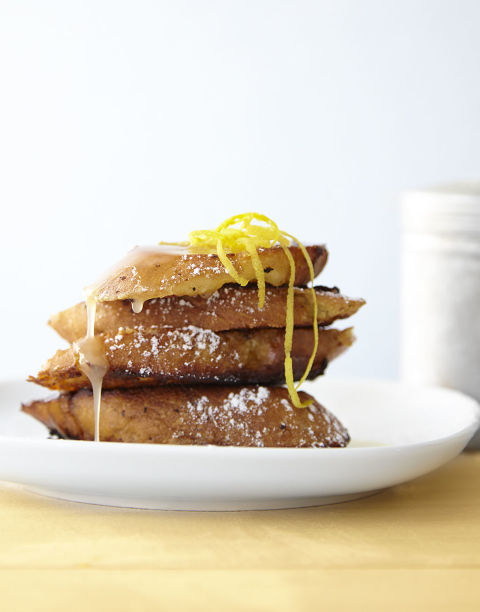
I'm a Fraud French Toast
Earlier this year, I was promoted to staff writer at the TV show I work for. I had handed in a script to my boss and asked for what I wanted. This was a VERY new thing for me (I had spent five years as an assistant, not feeling good enough), so when I got the job, I still didn't feel like I deserved it: It was luck. It could not have been me or my talent. I was not a comedy writer. I was just a fraud, lying at cocktail parties about what I wanted to do with my life.
My first day of work arrived, and I was excited but also panicked and petrified. I would not be able to do it. I would prove all my naysayers right. (Life lesson: Everyone is always thinking about YOU and your tiny issues. They are definitely not just consumed with their own problems.) So I decided to wake up early and cook myself a proper breakfast to get my mind off things.
I chose French toast because it had been my favorite morning meal as a child. It was what I ate in elementary school, before I stopped eating carbs or believing in myself entirely. That first morning of work, I cracked the eggs, poured the milk, et voilà. Eeet was done! The action of cooking helped me to forget my immediate fears, but, more important, the taste of the delicious French toast reminded of who I had been when I ate it years ago: I was someone who raised her hand way too much in class, spoke out of turn constantly, and truly thought she was very funny. (Because at least her dad laughed at all her hilarious jokes.) I tried to hold on to that confident version of myself for the rest of the day. I told myself I could be funny, or at least get a word in in a writers room. Deep down, it was the thing I had always wanted, and in some ways, hopefully, was meant to do.
Now whenever I feel like fraud, I eat this French toast and feel a little bit better. (Also, guys, eat carbs. Carbs are great. I'm fully on the carb train these days.)
—Miranda Berman
Ingredients
2 eggs, lightly beaten
1 pint milk (any fat percentage will work, as will nondairy milk)
3 tablespoons granulated sugar
Zest of 1 lemon
12 (1⁄2-inch) slices from a baguette, or 6 slices sourdough bread
2 to 3 tablespoons unsalted butter, for frying
1⁄4 cup lemon curd or lemon marmalade
Powdered sugar, for serving, optional
Directions
In a large mixing bowl, whisk together the eggs, milk, granulated sugar, and lemon zest.
Dip each slice of bread into the egg-milk mixture, soaking both sides completely. Let soak for at least 2 minutes.
Melt the butter in a large frying pan over medium-high heat.
Cook the soaked bread slices, working in batches if necessary, until golden brown with lightly crisp edges (about 1 minute per side).
Serve warm, topped with the lemon curd or marmalade and powdered sugar, if desired.
Serves 2 to 3.
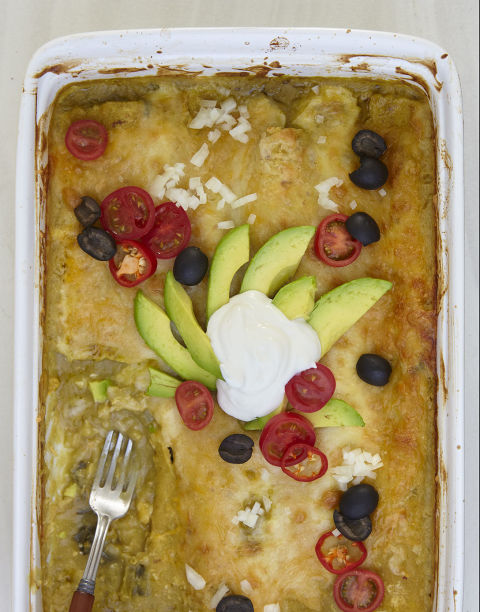
My Ex Is Engaged Enchiladas
This recipe is an ode to the underappreciated green chili enchilada, but also to that magical moment that happens after a breakup when your tears have finally begun to slow and your anger, though palpable, is not driving your every waking moment and you finally get a little reprieve from feeling shitty all the time. For me, this came in the form of a steaming plate of enchiladas at a roadside diner somewhere in Nevada City. I took a bite, closed my eyes, and savored the deliciousness. It was the perfect mix of seasoned potatoes, green chili sauce, and just enough cheese that finally took my mind off my broken heart.
—Gabi Moskowitz
Ingredients
Extra-virgin olive oil
1 medium russet potato, scrubbed and diced
1 large or 2 medium sweet potatoes, scrubbed and diced
1 large bunch kale or Swiss chard, destemmed and thinly sliced
Salt and pepper 12 corn tortillas 2 (16-ounce) cans green enchilada sauce 2 cups shredded jack or Cheddar cheese
Directions
Preheat the oven to 375°F.
Grease a 9-by-13-inch baking dish with olive oil.
Place the potatoes, sweet potatoes, and kale or chard in a large pot with 3 cups of water over high heat. Cover with a fitted lid and bring to a boil.
Once the water boils, reduce heat to medium-low and simmer until both kinds of potatoes are cooked through, about 10 minutes.
Remove from heat, drain, season with salt and pepper to taste, and set aside.
Microwave the tortillas for 30 seconds or so to soften them.
Pour the enchilada sauce into a mixing bowl or baking dish.
Dip a tortilla into the sauce and pull it out, shaking off excess sauce.
Lay the tortilla on a flat surface. Place 2 to3 tablespoons of potato-kale filling and a generous sprinkle of cheese in the center of the tortilla and roll it up.
Place the rolled-up tortilla seam-side down in the prepared pan. Repeat with the remaining tortillas, sauce, filling, and cheese. Reserve about 1⁄2 cup cheese for the top.
Pour the remaining salsa over all the rolled tortillas in the pan.
Top with the reserved cheese.
Bake for 30 to 35 minutes, or until the cheese is bubbly and browned.
Serve hot.
Serves 4 to 6.
Gabi Moskowitz is the author of four books and the co-producer of Young & Hungry on Freeform.
Miranda Berman is a television writer in Los Angeles. She also hosts a popular podcast called High School With Miranda Berman. | | | | | | | | | | | | | | The email newsletter where there's no such thing as too much information.
From Lena Dunham + Jenni Konner. | | | | | | | |  |  |  |






No comments:
Post a Comment