| | | A rendezvous with ghost hunters, plus Janet Mock interviews Kris Jenner. | | | | | | | | | |  | | | | August 8, 2017 | Letter No. 98 | | | | | |  | | | | | | | To my dearest Lennys,
I am writing this last letter to you from a little room in the Berkshires. There is no TV, but there are giant windows that overlook the mountains, and there is a raging thunderstorm outside. For over an hour, I've just been sitting here in total stillness, marveling at how incredible nature can be. It is beautiful, and I am humbled.
I started working at Lenny in July of 2015, a few months before we sent out our first issue, before I knew what this would become and the absolute joy it would bring me. Sometimes people would ask me if I liked working here, and I would always respond, "This is my baby!" Meaning: of course I love it, of course. I loved finding cool new artists to work with, because nothing beats the incredible pleasure of seeing a beautiful illustration that perfectly captures the heart of an essay or an interview. It's been a privilege to work with artists from all over the world and learn to look at the things around me with new eyes. For that I will be forever grateful.
I am thankful to have been able to work alongside and learn from our genius editor in chief, Jess Grose, whom I will be forever indebted to. And of course it was wonderful to have been able to see the magic that Lena and Jenni create firsthand. They work hard and they love hard, and I hope I can carry that same power with me for the rest of my days.
OK, enough with the sappy goodbyes. Let's get to the good stuff. This week's issue is phenomenal.
—In this week's episode of Never Before With Janet Mock, Janet talks to the one and only Kris Jenner. You know Janet will go there, and she does.
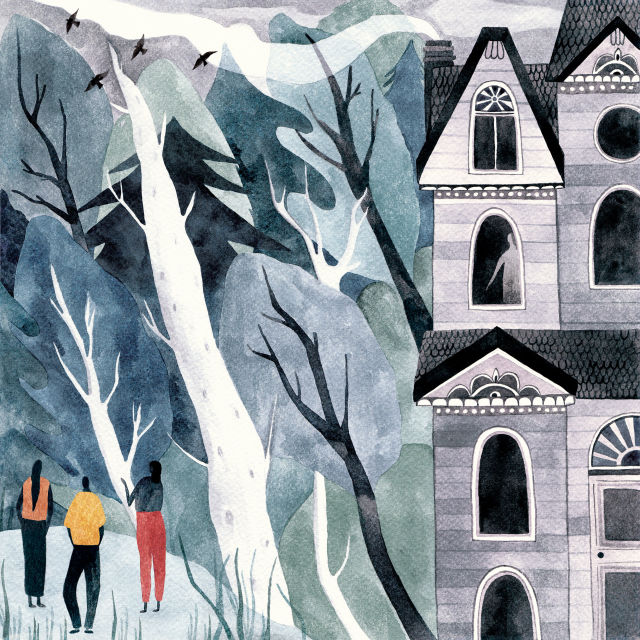
—The amazing Mira Ptacin writes about having a paranormal-investigation husband-and-wife team come to her house to help her get rid of some bad juju.
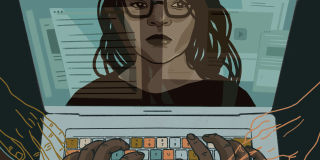
—We have an interview with Nighat Dad, an activist who is trying to make the Internet a safe space for women in Pakistan.
—And, last but not least, we have a really funny and touching essay about making friends with naked women at the YMCA.
Hasta la proxima, Lennys!!
Un beso,
Laia Garcia, Lenny deputy editor | | | | | | | | | | | | When Kris Jenner Was Down to Her Last $200 | | | | By Janet Mock | | |
Walking into Kris Jenner's office was as unnatural as it was intimate.
I had been in that room in her house perched in the Hidden Hills, California, gated community dozens of times before. Keeping Up With the Kardashians cameras had provided me entry, alongside millions of viewers in 160 countries. I was familiar with Kris's beloved monochromatic palette and her self-aware desk décor (like her daughter Khloe's framed 2007 DUI mugshot and her "I'm Kind of a Big Deal" nameplate). But it was a surreal experience to actually sit across from the world's most famous momager in a luxurious white Hermès chair surrounded by stacks of magazines — Vogue, Cosmopolitan — featuring her five daughters: the superstar Kim, the supermodel Kendall, the natural-eating mom-of-three Kourtney, the revenge-fit denim designer Khloe, and the millennial cosmetics mogul Kylie.
Staring at Kris's meticulously coiffed head and impeccably dusted face, I was interested in learning more about her story before the cameras had entered her home. I wanted to know how she learned business, marketing, and strategy without stepping foot in a B-school classroom and how her instincts, contacts, and passion to make her children's dreams come true led her to build an empire, an empire that most recently enabled Kim to make $14 million in mere hours with KKW Beauty.
Kris's coming-to-bawseness journey came to fruition when she met Caitlyn Jenner, an Olympic gold medalist and twice-divorced parent of four, in 1990, when she was in the middle of a then-contemptuous divorce from the high-profile lawyer Robert Kardashian. It was during her marriage to Jenner that she sunk her hardworking nails into making her spouse relevant and bankable again for the good of their growing family, which included daughters Kendall and Kylie. In the context of their early years together, Kris refers to her ex by her given name during our conversation.
Below is an edited excerpt from Kris's appearance on my podcast Never Before, on which we retrace her earliest business roots through three of her most intimate and formative relationships — with her first husband, her second spouse, and her second daughter, Kim Kardashian West. Oh, and in case you're curious: Yes, I wiped myself with the black toilet paper in the all-black guest bathroom. It was indulgent and everything my Kardashian-loving self has ever desired.
Janet Mock: What training did you have before managing the Kardashian-Jenner empire? Was it all instinctual from years living in Los Angeles?
Kris Jenner: I married Robert Kardashian when I was 22 years old. Everybody that I was surrounded by for two decades was at the top of their game in the entertainment business: the head of every studio, the best attorneys in the world, the people that were running the most incredible industries.
These people were our friends. We saw them every single weekend in the backyard, playing tennis and barbecuing, but also intimately going on vacations with a lot of these families when I had Kourtney, Kimberly, Khloe, and Robert, and they had their kids. Those relationships are the closest and best of my life. They taught me the most. I didn't even realize it at the time.
I was watching my husband be the biggest kick-ass attorney that I'd ever seen. I was so proud of him doing that. I learned a lot along the way. Then, when I met and married Bruce Jenner, I became his manager instantly because he didn't have a lot going on. I saw this incredible potential, and he wasn't doing anything. Nobody was booking him for speeches. Nobody was sending him out on the road. I thought, Wow. You should be this incredible public speaker. I just figured it out to that point.
JM: What does that figuring out look like? Are you creating press kits and pitching speaking agencies?
KJ: Exactly. I told my assistant, Lisa, "OK, listen. We have the greatest guy here. He really knows his craft. He is really good at what he does, but he doesn't have anybody doing anything for him. He doesn't have a lot going on. He has $200 in the bank. What are we going to do?" Because the kids have to eat. We have to get it together.
JM: Wait, first of all, Kris, how were you able to survive after your first divorce from Robert? I read about the credit cards being frozen and you not having much income because you spent your time raising and building a family.
KJ: Right.
JM: And you choose a partner who has $200 in the account.
KJ: That's right.
JM: Wait.
KJ: Well, it didn't look so good on paper.
JM: So was it love?
KJ: Yeah. I fell in love with him, 150 percent. I've always looked at things like, "We're just going to figure this out." I don't stop and think about, What's the plan here? I just went for it. I realized after we got married and I had a limited amount of money, and I said, "We're going to move into this house. We're going to work hard."
He didn't have a business card. He didn't have a bio. He didn't have press, nothing. There was no Internet that I used or knew about. I mean, I had a cell phone the size of a brick and a typewriter and an old-fashioned Rolodex thing on a spindle. I had two big huge ones. I remember thinking: "Lisa, this is what we're going to do. We're going to get every fabulous picture of Bruce Jenner. We're going to do a photo shoot." I had a friend take photos, and I had another woman I know make a sizzle reel that we could use as an intro to his speech.
JM: You were producing already.
KJ: Yes. I think I spent my last dime, I'm not even kidding, making these beautiful, glossy press-kit folders and took every great article that had ever been in Sports Illustrated and any really beautiful magazine and I started making copies. We put together 7,000 press kits, and we mailed them to every speakers' bureau in the United States. Then we sat back, and we waited for the phone to ring.
Little by little, we started booking these speeches for Visa; Coca-Cola started booking him. I remember sitting with Doug Ivester, the head of Coca-Cola, at the Olympics and thinking, Wow, we've really come a long way.
JM: Your illumination of how you were a team is powerful, because I feel like oftentimes when there's one person in front who's a star, we overlook the person behind them. My husband buys the groceries, walks the dog, counsels me, helps me run through and make decisions. He does all this work that no one sees. That's so much a part of the investment. When you're in a relationship, you're often not taking a percentage or a cut from that. The benefit is the pride and the joy, and hearing you speak about this for the first time, your relationship makes more sense.
KJ: A strong woman doesn't just get there because she woke up one day and she was strong. Being a strong woman is almost earned. You go through a series of events in your life that make you stronger each time. If you could keep getting up and dusting yourself off, it's very rewarding. I used to go to bed at night and lay down and put my head on the pillow and think, That day was so satisfying. I just got so much joy that I was able to feed my kids and send them to the school they had been going to and be able to get them what they wanted.
It was all about their dreams, but then in the meantime, I had to figure out a way to pay the mortgage and the car payments and all that kind of stuff. It was very scary at first because I realized that I was responsible for these kids. They had their dad Robert and everything, which was great, but they were living most of the time with me, and I had to figure it out, so I did. Thank God. By the grace of God, I did. I just never gave up.
JM: Obviously, you created your own business school just through the friends you had around you. Then there's Kim's emergence and her prominence in culture. What were the initial goals between you and Kim?
KJ: Well, Kim got so much attention in the very beginning for not the greatest reason.
JM: Doing what we all do?
KJ: Yeah, exactly. Just being a silly kid. She had so many things that she wanted to do with her life. We sat down, as we do every year and I do with all of my kids individually, and said, "What is your goal for the year? What are your dreams? How high do you want to set the bar?" Going through a series of questions and really trying to figure out what was realistic and what I could help them accomplish from my end, and then they can take it away and fly.
I think the first thing that Kim wanted to do was do a fragrance. I didn't know that much about social media and the emergence of all of that. She embraced it and sort of handled it like no other. She really knew how to talk to her fans, which was so interesting to me.
JM: Like an immediate, intimate connection.
KJ: She really had a heart for what they thought, how they felt about her. She engaged and really wanted to be a part of that moment. I remember when she said, "I want to do a fragrance." We made that all happen.
My motto in life has always been if somebody says no, you're talking to the wrong person. We, together, figured out fragrance. When it came time for her to choose her bottle in the development stage, she knew the shape of the bottle, but she was stuck on the color. It was going to be a black bottle with a pink trim, and it was either dark pink or light pink. One day she just puts it up on Twitter and says, "Hey, guys. What do you think? This color or that color?"
JM: She's got her focus group right there.
KJ: I said, "You are a genius." She got such an overwhelming reaction in such a positive way. She chose the color that they wanted, and then she would have a contest and send fragrance bottles to their home because they helped her pick the color. I thought that was so remarkable.
That's really the moment that I learned boundaries about when to jump in with my kids and our businesses. Because we work together on all of the things we do, but there's a moment when Mom has to step back. Manager has to be there, but let my daughter/client, in some cases, do her thing and not be too overbearing.
JM: Did you know when you had children that you were going to be a good mom? Were you confident in that?
KJ: Yes. I was. I mean, I didn't know if I was going to be a good mom and I would change the best diaper, but I started off as that was my heart's desire when I was sixteen, was to have six kids. I don't even know where that came from. When I had kids, I took them to Mommy & Me, and I had classes at my house. I was the soccer coach, the Brownie leader, the room mother, and the carpool driver. I volunteered for everything, and I'd be in Brownies going, "What can we do for the craft this week?"
I enjoyed every second of being a mom. To watch my babies have babies has been the most joyful thing in the whole world. The most satisfying way to live life is watching your kids be successful at whatever that means for them. Success isn't always about money. It's about them finding out what they want to do in life and what their passion is and what makes them happy.
This interview has been condensed and edited.
To hear the entire interview, click here to subscribe to Never Before With Janet Mock.
Janet Mock is the author of Redefining Realness and the new memoir Surpassing Certainty. | | | | | | | | | | | | HAUNTED. Are You Living With a Ghost? | | | | By Mira Ptacin | | |
Recently I found myself in the middle of a Thursday afternoon pussyfooting about the indoor perimeter of my house, smudging tangerine-scented oil across every window frame, door hinge, and crevice while chanting in unison with a pirated CD of the om chant. I was trying to rid the place of any accumulated negativity or "residual energy" that might be left over from an angry deceased alcoholic recluse I'll call Lucille, from whom we'd purchased our home four years earlier.
A few weeks before that, I'd been sitting in a lumpy, velvety armchair belonging to Dr. Barbara and Steve Williams, a husband-and-wife paranormal investigation duo that I was interviewing for my next book: a history of Spiritualism — a modern, American, and woman-made religion based heavily on clairvoyance, intuition, and communication with the dead. The book is set in a tiny town in Maine not far from Bangor at a Spiritualists camp, which is where I found Barbara and Steve.
Camp Etna was established in 1876, and back then, it was home to some of the greatest summer gatherings of mediums and Spiritualists across the country, many traveling hundreds of miles to spend the summer with other like-minded women. As many as 5,000 lived in tents and cottages, holding séances and communicating with deceased loved ones. Incredibly, Camp Etna still exists (but with far fewer inhabitants). When I was making my research rounds about the camp, I came across Barbara and Steve's existence by way of a magnetic advertisement on the side of their minivan's sliding door that listed their phone number and read HAUNTED. Are you living with a ghost?
I immediately thought of Lucille, our home, and the way it felt. Ever since we moved in, I'd felt something heavy, something thick and contagious, almost like a tangible bad mood. The house felt gray, no matter how hard we tried to hype it up with positive energy and new life.
Four years and two kids later, I still felt the "vibe" of what I imagined was Lucille, or what might have been her last mood — angry, sorrowful, unhinged, still around our house, enduring. So not only did I think spending time with the ghost hunters at our home would be a fun bit of research for the book — to see them in action, to learn what they do — I thought we needed it. I thought they could do something I hadn't been able to do, even if it sounded goofy or hokey. I was willing to give it a try.
On the day I first visited Dr. Barbara and Steve at their grape-colored, dream-catcher-covered home, "Peacefull Solitude" (yes, two L's) in the middle of the camp, their Brussels griffon, Spirit, jumped up and settled into my lap. "So," Barbara said, taking the reins of my interview. "Tell me about your house."
It was my first house, and we bought it cheap, with all of Lucille's furniture still in it. I live on an island off the coast of Portland, Maine, with a population of about 800 people (though it feels closer to 50). The island is only about three and a half miles around, and we have at least five cemeteries; many are inhabited with bodies of sailors who died at sea or in World War II. But most of the alive demographic is in their golden years. Neighborhood legend had it that Lucille's son and husband died long before her; she took up drinking and morphed into a grouch, eventually passing away in a nursing home. When we moved in, the house was set up just like she'd left it — popcorn plaster ceilings; rusty brown linoleum floors; vinyl soffit; and sad, musty couches with a faint, meandering odor of cat pee.
But in exploring the basement, I raked away a ball of cobwebs and found a bunch of gardening tools that seemed pretty prized. As time went by, I noticed, despite the yard's being neglected and overgrown and covered in weeds, evidence of Lucille's love of landscaping; her superb green thumb still peeked out throughout the yard. Since then, I'd been teaching myself to garden. But often, with my bare hands digging in the soil, I'd find shards of glass, broken bottles that I suspect Lucille had thrown into the yard in a fit of anger. I daydreamed that she'd wanted to hurt someone with them. Maybe even me.
Since we'd moved in, life had become stressful, extremely busy, syncopated, and difficult to manage. Maybe our home was cursed, I wondered, or haunted. Maybe Lucille still lingered. So, when I was visiting Steve and Barbara, I asked Barbara what she thought. Could our place be haunted? "Maybe so," she replied, and she suggested she and her husband come out to investigate.
When I picked up Barbara and Steve from the ferry terminal on my island, Barbara glowed. She stood tall and radiant, her mermaid hair wrapping around her like a waterfall. She was as glorious as Stevie Nicks, and she waved at me as smoothly as a willow tree. She was confident and I was intimidated.
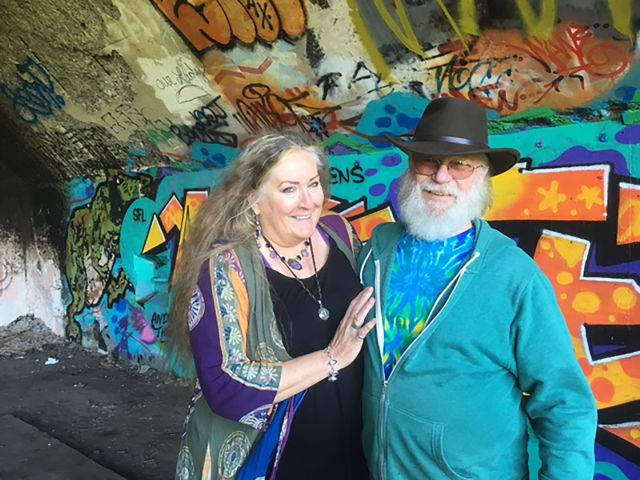
Behind Barbara stood Steve, as he often did. Gnome-bearded, wearing acid-washed blue jeans and a tie-dyed tee; very lovable, and carrying all their supplies. Barbara and Steve met after a few failed marriages; it was a blind date. Barbara's son's bus driver gave Steve her number, told him to call Barbara. When they met, Barbara told him about her clairvoyance, and he told her he was an atheist. "I looked at him and said, 'No, no, you're not.' He was just sick and tired of all the dogma and all the crap people shove down your throat. He believed in something, but he didn't have a name for it."
Within time, Barbara showed him the light of Spiritualism: that you could believe what you wanted, that you didn't need to prove it to anyone, and that you could live according to your gut instincts. That most important, you live by the Golden Rule, treat others like you'd like to be treated. And also: ghosts really do exist.
Barbara would know. As a child, she would wake up at night every night seeing ghosts. "They were in the corner of the room; dead people talking and being disruptive. I'd ask them to be quiet and they'd come over and look at me. They weren't nasty. But when you're tired, you're tired. And they were so darn noisy. That was my beef — the ghosts weren't scary, they were just annoying," she told me.
In the mid-1980s, Barbara was working as a pediatric nurse and made friends with a respiratory therapist. The therapist happened to be a Jesuit priest who had worked with the famous paranormal researcher Hanz Holzer. The priest asked Barbara if she'd like to join them in investigating cemeteries, and she obliged. "I had an edge over what they were doing because I could see Spirit and they couldn't. And listen, Spirit never steers me wrong."
Barbara was raised Orthodox Jewish by her adopted parents and wasn't baptized, so each time they met at the cemetery, the priest doused her in holy water so she'd be safe. "I didn't understand what all the hubbub was about — I'd only talked to people who were dead, and they certainly were not harmful."
She continued to learn how to investigate at cemeteries until about thirteen years later, when she witnessed a series of unfortunate events unfold, involving a shaman from Puerto Rico, a refusal to sacrifice a pig, which led to the inability to coax out a dark spirit, leading to the death of her friend's child. "Spirit had gone into the weakest link of the family. The whole thing blew me right out of the water."
After that, Barbara felt like she didn't have enough information about the paranormal, so she spent the next twelve years studying and investigating. "My study wasn't about how to see Spirit, my study was how to protect people and keep people safe. I had firsthand experience of something that shouldn't have happened. What you can't see can hurt you. People call me to help with clearing and cleansing. It's our duty to help people ... we are the way-showers. We are the light."
According to Steve, "Barbara can literally see ghosts," and she'd always been able to see them, as clear as day, alongside people, buildings, trees. No big deal — like they weren't out of place. But that was one major difference between Steve and Barbara. Her sight of ghosts was literal; his was not. "I just see them in my head. I close my eyes, and that's how I see it."
Shortly after arriving at my house, Barbara told me she could definitely sense residual energy. "The woman who lived here — her son committed suicide, didn't he?" She nailed it. Although I couldn't remember if I'd told her or not. "She died all alone, yes?" Yes, it was true. "If your kids aren't sleeping in their beds, there's probably a reason for it," she continued, and then suggested we stop gabbing and proceed with the cleansing.
We were to cleanse the home of anything that could bring negativity or darkness into our life. We would begin in the backyard, then work our way up from the basement. Steve lit the sage behind my kids' swing set, where dark clouds were gathering. "Bless the element of the earth," said Barbara. The clouds above us cracked. "All my relatives it is indeed so. Bless the element of the earth, the power of the physical, we call in archangel Muriel. Bless the element of the earth. Power of the mind, we call in the archangel Raphael." We continued on like this until we hit up all the elements and all directions, north, south, east, west; held hands; then ran inside right as a tremendous thunderstorm began to pour down on us.
The box Steve and Barbara brought to my house contained house-clearing items for the ceremony: a compass, black tourmaline, tobacco, cornmeal, sage, holy water, banishing oil, house-blessing oil, protection oil, seashell, a feather for smudging, four-thieves vinegar, a blessings script, a medicine wheel script, salt, black salt, a lighter, the om CD, paper, and a pen.
We were in the basement of my house. The om CD was chanting out of my laptop computer. Steve lit more sage, letting it burn in a conch shell, while I trailed Barbara around the house and rubbed oil on all the exit points of the structure.
"White magic, entity attachment points, entity energy reproduction programs, eggs, cocoons, sperms, placenta, entity slag, entity trail, diseases, mini-entity, entity halters, and all voodoo. Clear all European black magic, India black magic, Kahuna, Aztec, Inca, Mayan, Egyptian, Druid, Atlantean, Lemurian, Alien, Satanic, and Wicca black magic," Barbara chanted as she walked.
I hustled to keep up, trying to be as intentional as possible as I was smudging the oil along the windowpanes, an audience of Barbara's chants while apologizing for the unmade beds, the piles of laundry, the balls of dog hair in the corners of the room. The place did feel dirty. "Cleanse away," I told Barbara. She turned to me and said, "You cover everything. And if you don't, it's a problem."
"It sounds like hocus pocus, but it really does matter," Steve assured me in between spaces of silence. Barbara has her Ph.D. in metaphysics, he said. I didn't even know what that meant, but I went with it. I asked, why the sage smoke? "Sage is positive ionization. It's indigenous to the area, too. In the true spirit, you must use things that you resonate with and that are from this area that you have bonded with."
I was doing my best to roll with it. I was being as objective as I could possibly be — I kept teetering between the role of journalist and participant, but I strived to be nonjudgmental. I was open and willing — I really wanted to see a ghost — but at the same time, I needed concrete answers to my questions. How was this working? And why were we doing things a certain way? Why sage?
But then I stopped myself. Why did I need all this information? I think I wanted a tangible explanation so that I could explain my belief in Steve and Barbara, or my support in them, to a nonbeliever. But deep down, it didn't matter to me if I saw the Ghost of freaking Christmas Past or Slimer. Barbara had nothing to prove to me, nor was she trying to. And that was her gift, ultimately: the biggest challenge for me wasn't to believe Barbara and Steve — it was to respect them and learn to follow their example, to come up with my own belief system and keep it solid and unwavering, and to not give a fuck if someone believed me or not.
What Barbara was proving to me wasn't if ghosts exist. She was teaching me that I needed to listen to myself.
"Bless this home and all who live here. May the joy, happiness, love, kindness, abundance, and prosperity of God exist here. May this place be a place of love and harmony. So be it."
We continued upstairs and through the rest of the rooms in the house, saging, rubbing oil, chanting, until we finished with my bedroom. After that, Steve and I went outside to wrap things up, pouring salt around the perimeter of the house, while Barbara took her time coming downstairs (she has a bad foot) to rest. The skies outside had cleared and were blue, but a thick ocean fog still seeped around our neighborhood.
After the cleanse, Barbara, Steve, and I sat somewhat awkwardly around the dinner table making small talk about my dogs, one of whom Barbara had done Reiki on while Steve and I were out on the porch packing up the supplies. After dinner, we hugged and said our goodbyes, and I gave them a lift to the ferry.
When I got home, aside from my dogs having a bit of a hop in their step, nothing appeared to be all that different. I had about an hour left before I had to pick up my kids from day care, so I decided to go outside and do a little gardening. And as I was walking to the porch door, a sharp recognition passed through me. Levity. A feeling of grace and dexterity. Kind of like a white light.
Maybe the cleanse did work. Perhaps we actually had cleared the place of all gargoyles and dark spirits or any lingering voodoo or witches or sorcerers. Or maybe instead, the act of the cleanse, of Barbara and Steve's compassion and caring to make our house feel good and full of love, had produced a new feeling — a new point of connection between me and my home. A new memory, perched on top of the other layers of memories that existed from within these walls. Whatever it was, I couldn't see it. But I could feel it when I closed my eyes.
Mira Ptacin is the author of the memoir Poor Your Soul and the forthcoming book The In-Betweens. Follow her on Twitter. She'd like to thank James Walsh for transcribing her interviews and being game for a ghost hunt. | | | | | | | | | | | | Taking Back the Internet for Pakistani Women | | | | By Saba Imtiaz | | |
When you buy pads or tampons in Pakistan, grocery-store owners double-bag the purchases, ostensibly so people on the street can't see what lies within layers of brown-paper bags.
This culture of secrecy and shame around women's lives and bodies is an apt parallel of life for women in Pakistan. Conversations about everything from sex lives to physical health are "brown-paper-bagged." If women do speak, they do so in hushed tones or they're immediately shouted down.
The Internet is opening up spaces for women, leading to private Facebook groups like Soul Sisters, a space for women to seek advice from their peers and talk about personal issues, with over 16,000 women who discuss everything from workplace issues to marital dilemmas.
But despite the apparent freedom of 140-character updates, Pakistani women are still slut-shamed and criticized and silenced online. The Pakistani author and researcher Ayesha Siddiqa was subjected to an organized trolling campaign accusing her of being a spy. In 2016, the social-media star Qandeel Baloch was allegedly killed by her brother because he objected to her posts and said her behavior was "intolerable."
Nighat Dad, 36, is trying to make the Internet a safer open space for women in Pakistan. Dad is a Pakistani lawyer whose advocacy is informed by her personal history and politics. After a financial crisis, her parents couldn't afford to keep sending her to a private school, so she had to study at a bare-bones, government-run school. Dad didn't have access to a cell phone or the Internet at law school; her brother curtailed her personal and online freedom by taking away her computer at home and objecting to her going to university. An abusive marriage led to a severe bout of depression.
"This is where my personal politics came from," Dad says. "We're often labeled 'privileged feminists' by critics. I belong to a very lower-middle-class family. I started from zero. I have no privilege. It's very important to set the record straight: that my personal is my politics."
Dad was named a TEDGlobal fellow in 2017 and is also an affiliate at Harvard's Berkman Klein Center for Internet and Science. Dad and her Digital Rights Foundation work on everything from state surveillance to online harassment. Her initiative Hamara Internet ("Our Internet") aims to instill a sense of ownership over the Internet in women, create safe online spaces for them, and offer a support network, including a help line, for women whose digital privacy is violated.
Saba Imtiaz: I want to talk about online spaces for women. But can you tell me about yourself first?
Nighat Dad: In 2007, the year I got divorced, I got my law license and started working at a law office in Lahore. I had access to the Internet and found this great world. There was a lot happening online. You can speak your heart and mind, make friends, and do whatever you want. After leaving a suppressed environment, when you find this space, you can do wonders.
My friends said they got a lot of unsolicited messages and friend requests and porn-type messages. I started looking at online spaces from a legal perspective: Is this harassment; is it entertainment?
The Internet, especially in conservative middle-class families in Pakistan, was always considered entertainment or a place to find friends. There was always a negative aspect. I think that's why women weren't allowed to use it. This forced me to look into the politics of the Internet: who has access and who doesn't; who is being harassed and by whom.
I expanded into Internet governance and freedom of expression in online spaces, access to information, surveillance and privacy, and the politics of the Internet and feminist Internet. My major focus was why vulnerable communities don't have access [to the Internet] the way men do, especially in closed societies.
We did the Take Back the Tech international campaign in Pakistan, and I met all these amazing women online: Sana Saleem, Fariha Akhtar. Jahan Ara, the president of the Pakistan Software Houses Association, really inspired me to do a lot.
SI: How did you start Hamara Internet?
ND: There were organizations working on offline harassment, but I thought, who was going to work on online spaces? This is where we can set a precedent.
I founded the Digital Rights Foundation in 2012. I wanted to work on the ground, but I didn't have money. It was just an idea. Sana [Saleem] was a huge support during those years. That's why I feel women are so important for each other. She registered the domain and helped make the website.
At DRF, we work with young women and talk about how harassment is also a form of violence and the need to realize and report this. If they can't report it because of their circumstances and where they live, they can document it and find support networks and know how to fight harassment. We tell them that the Internet is our space; we have as much of a right to it as others.
We went to around twelve universities. We went to the university in Charsadda just a month after the terrorist attack there. More than a hundred women attended. We went to universities in areas where nothing like this [information events] had ever happened and covered 1,600 young women.
After a year of awareness sessions in universities, we started getting a lot of calls and messages from women about what they were facing. Hamara Internet became a movement. We got so many complaints that we thought about starting something more organized.
Then Qandeel was killed. There was a lot of slut-shaming around her murder and arguments like "She didn't deserve to be killed, but …" There was a whole story after the "but."
SI: How does the help line work?
ND: We started it in December 2016 with very little money. [As of May 2017, the help line had received more than 700 calls, an average of 82 a month.]
We offer digital-security support on hacked accounts, identity theft. We provide legal support and advice and support from a counselor for emotional trauma. We get calls from girls crying, "For God's sake, do something, and get us out of this."
A lot of girls ask if we have a lawyer who can take on their case. That's a need we've identified, but we don't have female lawyers in Pakistan working on online harassment.
We also get calls from men. This goes back to the deep-rooted patriarchy; that men can't talk about the violence they face, harassment, or blackmailing — sextortion.
We get a lot of complaints where people have shared data with their partners and feel helpless. We've gotten calls about rape cases, like the woman who was blackmailed — for years — over a video [of her rape by the man blackmailing her]. That messed with my head.
Girls have called saying "If you don't do anything tonight, my dad will kill me in the morning" because people have found their anonymous profiles and posted their names and numbers and tagged their family members.
We started talking to Facebook, Twitter, and Google, saying that you need to understand the context of Pakistan. Your reporting mechanisms are so shitty.
SI: Oh my God, yes.
ND: I always shame them — your reporting mechanisms are shitty, you don't even understand local languages. We're lobbying Internet companies. The target audience for their products lives in Pakistan and closed Muslim societies where culture and religion has an impact on daily life. It took us years, but they're now realizing they need to address this issue.
Now if someone's life is at risk, we can reach them directly and say, "You need to do something in a couple of hours or a few minutes." Due to our lobbying, they've hired people who can understand languages and analyze content and translated their reporting mechanisms into different languages.
SI: There's always a narrative around women. Qandeel and even Benazir [Bhutto, the late prime minister] were trolled. [Ed. note: Women in the public space in Pakistan are routinely subjected to organized vilification campaigns that target their personal lives or reveal personal information. Bhutto's images were doctored to show her wearing revealing clothes and distributed in public.]
ND: It's the same mindset shifting to the online space. The traditional way of doxxing is that girls' names were written on walls with their numbers and addresses if someone wanted to harass them. Social media is not bad, it's people using it wrongly. The long-term solution is to integrate digital literacy into our syllabus.
SI: Are you optimistic?
ND: That's why I keep coming back to this despite risks and threats. Just yesterday when I was talking about the hijab [on Twitter], so many men were angry at me.
SI: Someone commented on your hair …
ND: It's body-shaming. If it's a victim, they'll victim-blame; if it's a feminist, they'll say feminazi. I don't know if you saw, one guy said all feminists are apostates. This is [what happens] when you speak your mind.
This interview has been condensed and edited.
Saba Imtiaz is a freelance journalist and author currently based in the Middle East. She writes about culture, urban life, religion, and food. Find her on Twitter @SabaImtiaz. She reported from Pakistan with a fellowship from the International Reporting Project. | | | | | | | | | | | | With Love, From the Naked Ladies in Goggles | | | | By Susannah Meadows | | | |
First we got naked, then we saw each other day in, day out, then we started smiling and saying hello. And then we introduced ourselves. Pretty soon, my friend Phoebe was saying to our regular neighbor in the locker aisle, who's in her 70s, "I have to tell you, you have a great bosom."
Some people go to church. I attend the women's locker room at my local Brooklyn Y. We all need community, and this is mine. It's where people would notice if I stopped showing up.
For three years, I've seen the same bunch of women there in the mornings as we grunt on our bathing suits and trudge downstairs to swim laps in the cold water of the pool. We reconvene at the showers, often continuing a conversation we'd started 40 minutes earlier. Then we return to our lockers, where we carpet the floor with our little white towels, shedding our terry-cloth skirts and shawls we'd improvised only minutes before for the walk over from the showers.
One of the reasons it works is that there's nothing forced about it. This isn't ladies' night out, with its contrived letting loose and stupid pink cocktails. We do not talk about shoes.
We talk about our children and grandchildren. The autism diagnosis, the extra hug we got that morning. What is it like having a thirteen-year-old boy? How did your grandson like his first opera?
We talk about our work. You should use this author photo instead of that one. Where can I see your paintings?
Twice, people I don't know have jumped into conversations to say something about a book. One time, Phoebe and I were talking about how good my sister's novel was. A woman getting dressed near us said, "Excuse me, I just have to know the name of this book." Another time, someone said, "I'm sorry to interrupt, but I just have to tell you about the incredible book I'm reading." It was one of Elena Ferrante's novels from the Neapolitan series, appropriately enough. That kind of word-of-mouth is the stuff of publishers' fantasies, although they probably imagine us clothed.
We talk about our health and track what's happening with our bodies. "Your skin is a wonder!" we'll say, and we're let in on the secret: "Forty years of Oil of Olay." We've checked each other for ticks, noticed fresh scars from biopsies, suggested getting a mole looked at.
When Kerry, one of the regulars, had a mastectomy years before my time, the women took up a collection for a Victoria's Secret gift certificate. The card was signed: "From the naked ladies in goggles."
Kerry told me that when she came back to the locker room after recovering from reconstructive surgery, she was feeling shy about disrobing. Our friend Jane told her to take off her shirt. "Let me see," she said. And then: "You look great. You don't ever have to cover up again." Kerry told me, "That was the end of it for me. I moved on to feeling normal again."
This is one of the locker room's great gifts: its glorious display of bodies. We are tall. We are short. We are overweight, and we are not. We are old, and we are older. Everyone seems perfectly comfortable naked. Some of us even keep our shower curtains open — the better to keep talking.
I could probably stand to be a little more self-conscious: my own shaving efforts have become rather lackadaisical. Once a well-patrolled border, my bikini line is now run under the auspices of "Who gives a crap?" If I had daughters, I'd relish the chance to take them there, to show them what women really look like.
Jane told me that years ago, one of our buddies, Randi Sue, had quit coming. One day, Jane ran into her on the street and asked where she'd been. Randi said she'd put on so much weight that she was embarrassed to be seen. Jane told her, "No one looks at you and thinks, Why is that fat lady here? They think, Good for her!" Randi Sue came back and has been there ever since.
Jane, who's 76, is our leader, our idol. Like several of the people we know there, she's been coming to the Y for more than 30 years. She swims every day. Arriving on her bike. After a three-mile walk in the park. Sometimes she'll tell us, "Quit chatting, girls, and get in the pool." Being called "girls" when you're 44: the greatest compliment of all.
It is the one place outside of my family where I interact across so many generations. Unlike the society outside the locker-room walls, our admiration is aimed upward, the younger generations in awe of the older women. They're there more consistently than we are. They're more fit than we are. We want to be like them when we're their age. We want to be like them now.
The camaraderie has happened on its own, almost in spite of ourselves. We're not there to make friends. We're there because we have a job to do. We need to exercise. We all have work we need to get to. And let's face it, as New Yorkers, we're not looking for a smile from a stranger.
As with soldiers who fight together or people in arranged marriages, some of the strongest bonds are born from steadfastness and shared circumstances. We don't have to have picked each other to feel genuine affection.
The locker room is a remarkable constant, while the years do what they do, to us and to our families. Marital problems have come and gone. Spouses have died. Children have grown up. Once, the ladies threw a baby shower for one of the women in the group. Their choice of venue? The shower room, of course. That child is now in high school.
While Kerry was recovering from surgery and couldn't go in the pool, she kept visiting the locker room to see everyone. It was her support system. "They continued to be there for me," she told me.
Over time, I've started to go more frequently. Part of me, I'll admit, is just trying to impress Jane. But I've also noticed that as much as I still dread those first shivering seconds in the water, I now look forward to being there in the morning. The exercise is starting to feel incidental.
Recently, Jane said she had an extra ticket to a show at the Brooklyn Academy of Music. Did any of us want to go with her? I was the lucky available one. It would be the first time I'd seen her out of context. I'd only known her naked under the bright lights. Would sitting next to her in the dark with our clothes on somehow break the magic? And then I met her at the theater on that Saturday afternoon, this person with whom I'd shared laughs and stories, advice and fears. This person who'd become a real friend.
Susannah Meadows is the author of the new book The Other Side of Impossible: Ordinary People Who Faced Daunting Medical Challenges and Refused to Give Up. | | | | | | | | | | | | | | The email newsletter where there's no such thing as too much information.
From Lena Dunham + Jenni Konner. | | | | | | | |  |  | | |







No comments:
Post a Comment