| |  | | | | October 3, 2017 | Letter No. 106 | | | | | | | | | | | Advertisement | | |  | | | | | | | | | Dear Lennys,
"What are your ideas about power?" That's something horoscope master Melissa Broder is asking you to consider this month. It's also a thought I'm returning to after weeks of feeling drowned in the deluge of sickening news coming out of Washington. I've reclaimed my radical spirit, but now I'm left wondering how I can focus my energy in a useful way. Somewhere in the midst of nature's never-ending fury, I woke up. Nothing our president does (or doesn't do) surprises me anymore, but a reminder that our existence here is being decided by something larger than one man's maddening decisions is making me rethink how I use my voice — even if it's just to call my friends together for a therapeutic craft night.
Power is something that all of our writers are dealing with this week:
—Comedian Whitney Cummings shares her history with bad doctors and tells us how she finally realized she had agency in making choices about her health.
—Programmer and entrepreneur Tiffani Ashley Bell writes about the power of sisterhood, especially when you find it in unexpected places.
—Julia Turshen, author of Feed the Resistance, brings us a recipe for hungry activists.
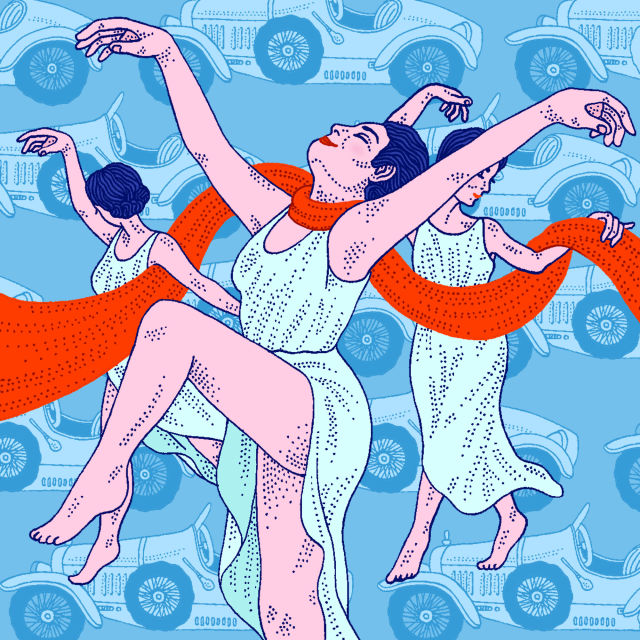
—Historian at large Alexis Coe explores the impact of historical artifacts, specifically the mystical power of the infamous red scarf that killed modern-dance luminary Isadora Duncan.
—Finally, the aforementioned Melissa Broder brings us October horoscopes.
Here's to feeling powerful this week, Lennys!
XO,
Molly Elizalde, associate editor | | | | | | | | | | | | Advertisement | | |  | | | | | | | | How I Learned to Break Up With Bad Doctors | | | | By Whitney Cummings | | |
Looking back on my twenties, I regret a lot of what I put my body through, whether it was stripping the vitamins from my bones by starving myself, bathing my brain in cortisol from dating narcissists, blowing out my adrenal glands from workaholism, undersleeping, or drinking a shocking amount of blueberry-vanilla coffee from 7-Eleven. By the time I got into my late twenties, I decided that maybe it was time to get my shit together because, let's face it, being crazy isn't cute in your 30s.
I was sick of being a mess and sick of being, well, sick. I had been living with a partially healed broken shoulder, chronic migraines, weird abdominal pains, and a sharp stabbing foot pain; my monthly colds had evolved into a couple bouts of pneumonia. Not wanting to perpetuate the stereotype that women are "weak" and "dramatic," I never thought to get any of these maladies treated. Also, doctors are expensive as hell, and I wasn't going to waste my money on silly health insurance. Back then, the money I saved went to more important things, like self-tanner and hair extensions.
I finally scraped together some self-esteem when I was 31, thanks to intense therapy for codependence. I started going to tons of doctors — basically anyone who took my health insurance. I went to an allergist, an optometrist, a rheumatologist, and even a couple of wack-job "healers," one of whom called himself Dr. Bob. If you glean nothing else from this essay, it's this: Do not go to any doctor who goes by his or her first name only. Unless, of course, it's Dr. Dre, because that would totally be worth the story.
After I saw all those docs and got a good shrink, I started to develop things like "boundaries" and "standards," two concepts about which I was oblivious in my twenties. I had a harrowing epiphany: there's such a thing as a doctor who is an asshole.
This may not be news to you, but for someone who hadn't been to doctors very much, a crappy doctor felt like an oxymoron, given that they supposedly dedicate their lives to helping people. But every doctor I was going to was dismissive, mansplain-y, too busy, and, frankly, seemed kind of bored. For example, I told a doctor about some stomach issues I was having, and he nonchalantly mumbled, "It's probably just cramps," as if I were his naggy wife trying to get him to talk about my feelings. After I told him I wasn't on my period, he said, "You probably have IBS." Turns out I did not have IBS; he was just full of BS.
When I finally made the time to see a neurologist about my recurring and debilitating migraines, I asked the doctor if I should get an MRI on my brain, and she rolled her eyes at me. And it wasn't even a subtle eye roll. It was one of those eye rolls that seem to reverberate all the way into someone's neck and cause their head to tilt, to the point where I think she should have gotten an MRI too. Apparently, it wasn't just male doctors who perceived my desire to heal as dramatic and annoying.
Just when I thought that was as poorly as a doctor could behave, I had an ER doc tell me to "Calm down" when my ear was hanging off my head after a dog bite (you may just have to read my book for this story). After saying "Calm down" — a command I thought I'd only ever hear from boyfriends I was arguing with — the doctor followed it up with, "You're not gonna die." What's worse is during this whole ordeal, he had the audacity to be wearing a coral-and-turquoise cuff bracelet, so in addition to dealing with a condescending tone and a dismissive hand gesture, I had the added confusion of having to process the complications of a doctor shopping at the same stores as Stevie Nicks.
Even if a doctor's demeanor wasn't overtly dismissive, their game plan for my health was. Three years ago, I realized that I was on four pills I didn't need to be on, many of them not even for the ailment they were formulated for. Doctors had put me on an Alzheimer's medication for migraines, a thyroid medication for low energy, birth control for depression, and antidepressants for sleep issues. Not to say that these pills aren't miraculous for many people, but the combination triggered headaches and made me tired and dizzy. I felt like a grumpy science-lab guinea pig.
After I froze my eggs, I got sick of pumping my body full of hormones and chemicals, so I tried to go off the antidepressant. It didn't occur to me to ask for a doctor's help. To my surprise and chagrin, when I stopped taking the pill, I felt terrible. When the psychiatrist had given it to me, he hadn't told me going off it would be tedious and uncomfortable and would entail six months of weird zapping sensations in my fingers and eye twitches that made first dates very awkward.
A painful withdrawal from a pill I didn't even need to be on was my rock bottom in terms of allowing doctors to treat me like a number. I was sick of losing my quality of life to people who promised to improve the quality of my health. When I finally had the courage to confront one doctor about the plethora of pills I had been given, he said, "The medical field is doing the best we can with the information we have." Well, I guess that's why it's called a "practice" and not "the championships."
After being ignored, overdiagnosed, and misdiagnosed, I'm finally ready to start being as picky with doctors as I am with the guys from Tinder I swipe right on. I started speed-dating doctors, desperate to find ones who didn't cut corners, dismiss me, throw drugs at me, or make me wait an hour reading an Us Weekly from 2015. It was news to me that that I don't have to settle for a doctor who isn't present, respectful, punctual, and available by text. If I have to call and leave a message, you're already causing me the kind of anxiety that a doctor is supposed to mitigate. Yes, in America, it's sadly a privilege to even be able to carve out the time and have the money to go to doctors, but that doesn't mean anyone's pain should be ignored.
Today, I regularly challenge doctors to give me an alternative solution to quick-fix pills, and if my gut is telling me my issues have been minimized, I'll refuse to settle and get a second opinion (but not from WebMD, because every time I go on that site, I quickly come to the conclusion that I have leprosy).
A couple of months ago, I left my gyno of ten years because she was consistently an hour late and I could no longer justify paying someone to disrespect my time. I was auditioning a new gyno, and within minutes she'd told me that that the birth-control pill I was on was very dangerous for me, given the fact that I'm prone to neurological migraines. She pulled up some recent trials linking that kind of pill to strokes. She bluntly stated, "The risk is unacceptable." I replied with, "Well, I'm going to Italy for a vacation with my boyfriend in two weeks, so can I just keep taking it for another month, then I'll switch?" She looked at me and again stated, this time more slowly, "The risk is unacceptable." I begged and pleaded, but she refused to prescribe me the pill. Yes, she sounds borderline annoying, but I'm finally at the point where I'd rather my doctor be a pill than mindlessly give me one.
Whitney Cummings is a stand-up comedian whose new book, I'm Fine and Other Lies, is now available. | | | | | | | | | | | | Advertisement | | |  | | | | | | | | | | | | How I Found Sisterhood in an Industry With Few Women | | | | By Tiffani Ashley Bell | | | | | | |
It was the spring semester of my sophomore year of college, and Hewlett-Packard (HP) was on campus recruiting from Howard University's engineering department. My pangs of hunger became pangs of guilt after devouring several slices of pizza at the company's internship-information session and then leaving, so I quickly ran to a nearby lab and cleaned up my résumé. I handed it to a 5'2" black woman who was physically easy to overlook but impossible to overlook professionally. This was Ann, a black HP executive who would become my mentor and my friend.
Mentorship has been essential to my career. Being a woman in tech can be lonely, and being a black female programmer can be even lonelier. People still aren't used to seeing you in certain spaces. There are days when some bro blurts out something sexist or decides a black joke is how he'll greet you, or more recently, pens a manifesto professing your inferiority. In this environment, you need support. Or sometimes you just need guidance on negotiating a salary. Some days you don't just need mentors, you outright need sisters ― women who get it and get you.
In Ann, I saw me, fast-forwarded twenty years, right down to the copy of C Programming Language she kept from college on the massive bookshelf at her house. She took me under her wing: She introduced me to the joys of Frenchy's Chicken and Jesus. I got baptized ten years ago at her church.
But that wasn't all. One Sunday after church, I asked her what it was like being a black female executive in an environment where she was often the only one among many men, some even more senior than her.
She told me how they would sometimes talk over her and ignore her ideas. As we crisscrossed Houston's tangle of highways, she told me that if they didn't acknowledge her ideas in meetings, she would repeat herself and, if necessary, bring those thoughts up later in writing. She instilled in me that I am my most powerful advocate. She also taught me about looking for "allies" long before that word became a part of diversity in tech's lexicon.
But she changed my life in an even more important way. During my second summer at HP, despite doing really great work, I found that I was easily distracted, often pulled all-nighters to finish projects, and had difficulty concentrating and staying organized. Since she wasn't my direct supervisor and I trusted her, I pulled Ann into a conference room one day and told her about this. After listening, she gave me strategies for managing myself and my time.
But later, she emailed me an article listing symptoms of adult attention-deficit hyperactivity disorder (ADHD). Three years later, after struggling back on campus and in my first job out of college, I remembered this article and went to get officially diagnosed. I'm not sure how she knew to send me that article, but being able to name the constellation of struggles I had had up to that point was life-changing. Now I work with a coach to keep me organized and better able to leverage the gifts of ADHD, such as immense creativity and a knack for learning.
The secret here? Ann was a Howard alumna who reached back to recruit at her alma mater. Don't be afraid to tap alumni networks for mentorship and connection.
Before becoming an entrepreneur, I reserved the word mentor exclusively for someone much more senior than me. Someone who, in some circles, would be called "seasoned" as if they were on the hot-food bar at Whole Foods. The further along I've gotten in my career, though, the less useful it seems to classify mentors only on the basis of where they sit on an org-chart. They don't have to be the woman with the corner office and an executive assistant.
One example of this is a friend and peer-mentor named Danielle I found via Twitter. Though Twitter some days might leave everyone wondering if we're on the brink of nuclear war, it has so much more depth than an afternoon's worth of deranged tweets, so with that in mind, don't hesitate to think of your social-media connections as potential allies. After college, I went back home to Fayetteville, North Carolina — a place not particularly known for tech unless it's for the U.S. Army. To keep up with everything, I found myself spending more and more time on the 140-character network.
One day, I looked for people in my local area who also used Twitter and stumbled upon "tweetups."
Through friends I connected with at a tweetup on a beach, I met Danielle. Danielle has been everything from a bouncer at a club to an expat who lived in France for ten years to an entrepreneur with her own social-media-management company. She is formidable. Danielle is my go-to person if I need to know if I've gotten my point across effectively in a business email or how to respond in moments where I feel taken advantage of professionally. Eleven years my senior, Danielle is basically the sister I never had. Later on, when I started The Human Utility, which pays water bills for families in Detroit and Baltimore (and sprung from a discussion on Twitter — see, I told you it was useful!), Danielle provided unparalleled support.
Lately, I've found myself moving into an advisory role: rattling off everything I know about building a not-for-profit from scratch to anyone who cares to listen, or fielding questions, over tea, about what programming framework to use to quickly test a startup idea (be lean and validate ideas by building as little as possible by avoiding frameworks as much as possible). Other times, I've had an inbox full of startup incubator applications to edit after offering to do so on Twitter. I truly like to help when I can. But as I think mentor-mentee relationships are more than just one-off moments of offering advice, my own path to becoming a full-blown mentor for anyone is incomplete. Still, I hope my career thus far can at least be held up as one example of what's possible.
Harkening back to the Houston summers of nights spent leafing through my Bible, one verse always sticks with me — Proverbs 27:17: "As iron sharpens iron, so one person sharpens another." Whatever your religious leanings, seek to be the sharpest knife in the drawer. Get mentors. And if you're lucky, they'll be like sisters, too.
Tiffani Ashley Bell, a programmer and serial entrepreneur, is the founder and executive director at the Human Utility, helping families in Detroit and Baltimore with their water bills. | | | | | | | | | | | | | | | | Advertisement | | |  | | | | | | | | The Resistance Will Be Fueled by Pasta | | | | By Julia Turshen | | |
My new cookbook, Feed the Resistance, is filled with recipes, essays, and lists of ideas from a diverse group of chefs, writers, and activists to help you get involved. In the wake of the election, I found that feeding people, the thing I love to do and have dedicated my life to, was also a way for me to resist. I started cooking for activists in my community and figuring out other ways to use food as a means for connection, progress, and action. I reached out to other members of the food community to find out ways they used food as a form of activism. The result is Feed the Resistance, which is as much a response to the call to action as it is an amplifier: we want to inspire you to do something on your own.
And one of the easiest places to take action is at your kitchen table. It's not just a place to eat a meal. It's a place to gather people, create community, and make concrete action plans. It's a safe place to talk about hard things. It's a place to be comfortable being uncomfortable.
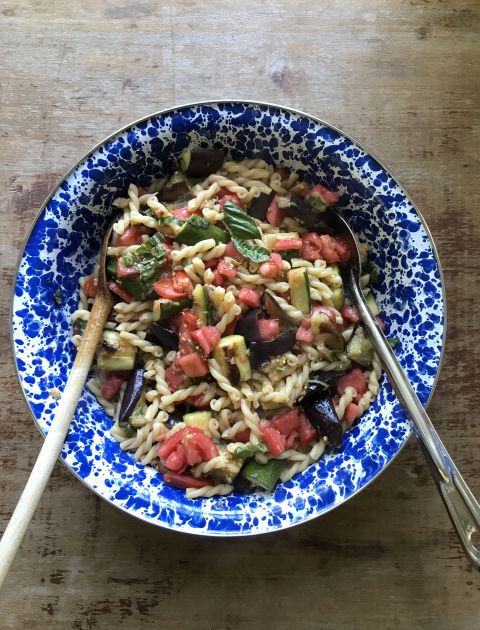
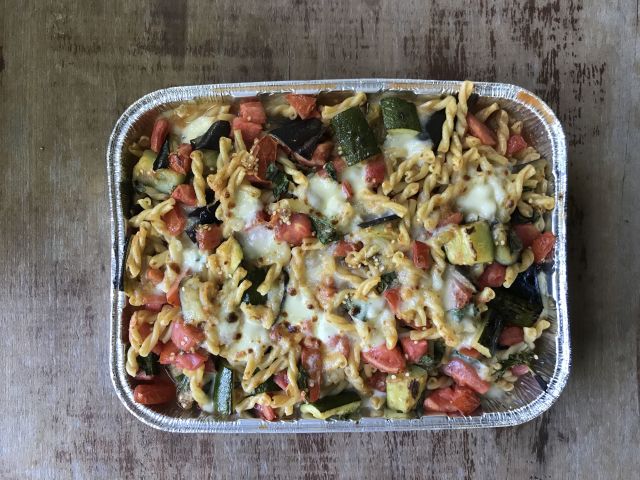
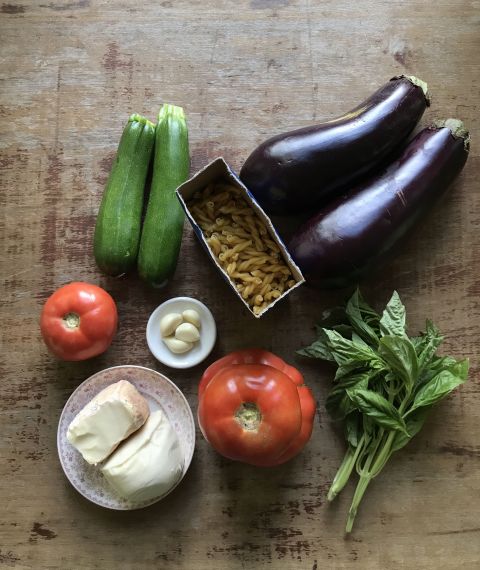
And the food on the table? At its best, it should be fresh and healthy, easy to prepare, and comfortable to eat. It should feel like you want to share it. A great example is the recipe below. It's a simple, flexible baked pasta filled with vegetables and topped with melted, slightly crispy cheese. You can leave off the cheese if you're vegan, change the type of pasta if you're gluten-free, skip the pasta altogether if you want, add some cooked sausage, swap one vegetable for something else. Whatever. The key isn't the food itself, it's the feeling of making something easy and comforting that serves your needs and gives you a reason to gather people around your table.
You can also, of course, bring it to someone else's table. I make this pasta, or something like it, often for my local chapter of Citizen Action of New York in Kingston, New York, where I run the "Food Team." The grassroots organization works on issues like ensuring after-school programs, providing affordable health care, and promoting racial justice. Running the Food Team is one of the most practical ways I resist. Between my network of fellow home cooks in my area and myself, we make sure every meeting, phone-banking session, training, and more is supplied with something good to eat. This food saves the organization money, provides the members with healthy food, helps to incentivize both new and seasoned activists to show up, and also acts as a palpable reminder that their work is appreciated.
Whether you're preparing meals for activists, bringing people together in your home, or cooking for yourself as a meaningful act of self-care, being in the kitchen is a tangible and effective way to literally feed the resistance.
Easy Baked Pasta for a Little Crowd
This is a very flexible recipe. Yes, you can use all mozzarella instead of two types of cheese (when I made this, I had a bit of Fontina kicking around in the fridge and thought this would be a good home for it). You can also leave out the cheese entirely to make this vegan (if you do that, you can skip baking the pasta, or you could top with coarse bread crumbs that you've mixed with olive oil and garlic; broil with those on top until crunchy). You could mix in some crumbled cooked Italian sausage. You can swap the pasta for whole-wheat pasta, your favorite type of gluten-free pasta, or just leave out the pasta and serve the vegetable mixture on top of grilled or toasted bread, polenta, or rice. The vegetables could also be a nice side dish for roast chicken, grilled fish, or whatever else you might be having for dinner.
Serves 6
2 1/2 pounds tomatoes, cored and diced
4 garlic cloves, minced
1 large handful fresh basil leaves, roughly chopped
1/4 cup extra-virgin olive oil, plus 3 tablespoons
3 tablespoons red-wine vinegar
Kosher salt
1 pound zucchini (2 large), ends trimmed, cut into 1-inch pieces
2 1/2 pounds eggplant (2 large), ends trimmed, cut into 1-inch pieces
1 pound short pasta (penne, ziti, gemelli, fusilli … whatever you like!)
1/2 pound mozzarella, coarsely grated
1/2 pound fontina, coarsely grated
Preheat your broiler to high, and adjust your oven rack so that it's about 6 inches from the heat source. Set a large pot of water on the stove to boil.
Place the tomatoes, garlic, basil, the 1/4 cup of olive oil, the vinegar, and 2 teaspoons of salt in a large bowl, and mix well to combine. Let the tomatoes relax while you get everything else going.
Place the zucchini and eggplant on a large baking sheet, drizzle with the remaining 3 tablespoons of olive oil, and sprinkle with 1 teaspoon kosher salt. Use your hands to mix everything well, and spread the vegetables out so that they're in a nice, even layer. Broil the vegetables, stirring them now and then, until softened and browned in spots, about 15 minutes total depending on the strength of your broiler (keep an eye on these!). Transfer the vegetables to the bowl with the tomatoes, and stir well to combine. Keep the broiler on.
Generously salt the boiling water (this is how you will season your pasta!), and drop the pasta in the water. Give it a good stir, and then boil until just cooked through, about 1 minute less than the package instructs. Drain the pasta, add it to the bowl with all the vegetables, and stir well to combine. If you're vegan, you can stop here and serve it and call it a day.
Place half the pasta mixture in a large baking dish, and top with half of both of the cheeses. Top with the rest of the pasta and the rest of the cheese. Broil the pasta until the cheese is melted and browned in spots, about 5 minutes. Serve immediately, or let it cool down for a bit and serve at room temperature (both have their merits).
Julia Turshen is the author of Feed the Resistance and Small Victories and lives in upstate New York with her wife, dogs, and cat. | | | | | | | | | | | | Advertisement | | |  | | | | | | | | The Dramatic Life and Shocking Death of Isadora Duncan | | | | By Alexis Coe | | | |
In this column, Alexis Coe, Lenny's historian at large, will conduct Q&As with specialists in archives across the country, focusing on one primary source. For this post, Alexis spoke with Amelia Gray, author of Isadora: A Novel, about Isadora Duncan, the fascinating woman now considered the mother of modern dance. (Read Alexis's previous columns here and here.)
Alexis Coe: Your new novel, Isadora, is inspired by the life of Isadora Duncan (1877–1927), a dancer who rejected the rigidity of classical ballet in favor of a style that emphasized freedom of movement. Underappreciated in America, a young Duncan boarded a cattle boat headed for England, where the fashionable, well-heeled hostesses of London embraced her. She toured European crowds, developing a taste for the kind of barefoot woodland nymphs she popularized. Today, she is considered the mother of modern dance, a title she would've hated, but as Anne Sexton once said, "The dead belong to me."
Duncan went on to become an eccentric, a feminist, and a Communist who ran with artists and intellectuals and sexy Brits, all of which we'll get to, but first I have to ask you about something you saw in the archives of the Library for the Performing Arts at Lincoln Center: a piece of the scarf.
Amelia Gray: Isadora was living in Nice and trying to get in touch with her old benefactors, asking here and there for loans. Her friend Mary Desti was visiting at the time and gave her a beautiful garment, which I've read was a scarf or a shawl, crimson red and twice her size. She draped herself in it one afternoon to ride in a convertible car, a handsome mechanic behind the wheel. She called out one last line to the gathered crowd — Adieu, mes amis. Je vais à la gloire! (some argument here if she said "gloire" or "l'amour," off to a tryst) — and as the car leaped forward, the tail end of the scarf wrapped around its rear right tire. The accident broke her neck at once, and she died right there.
AC: In front of everyone???
AG: It must have been horrible! Mary Desti was there, her dear friend, and a Russian filmmaker named Ivan Nikolenko who had just convinced her to allow him to record her on film. A 32-year-old mechanic and driver named Benoît Falchetto was behind the wheel, and a crowd gathered on the promenade des Anglais as Falchetto was running around, crying, "I've killed the Madonna! I've killed the Madonna!" Mary was the one who cut the scarf away from her and got her out from where she was tangled up against the wheel of the car. She flagged down a motorist and got her to the hospital, where they found her spine broken in two places; she had died instantly.
AC: When Gertrude Stein heard about Duncan's death, she said, "Affectations can be dangerous." She was definitely eccentric, but some newspapers said she'd been wearing the red scarf since she "took up Communism." Do you think she was truly devoted to the cause, for which her American citizenship was revoked in the 1920s, or do you think the color of the scarf was just a coincidence?
AG: At one of the later performances, she pulled her costume aside to bare her breast, shouting, "This is red and so am I!" She was a performer since she was nine years old and seemed very aware of things like that; I'm certain it wasn't her only red accessory. From her own writing on the subject, she claims to have seen Communism as an answer to abusive labor practices, to child labor, to a sense of racial inequality she seemed more aware of toward the end of her life.
AC: So she went through a considerable change toward the end of her life, from conspicuous consumer to Communist. How much of this was a reaction to the tragic death of her children?
AG: Well, in some ways she never changed. Before she died, she had been trying to get more money out of her former lover Paris Singer — the son of Isaac Singer and heir to the Singer Sewing empire — and around that time, she'd been selling the furniture in her studio, which doesn't seem to have been a moral choice on her part. It seemed that she loved the idea of Communism, the invitations from the Bolsheviks to Moscow, but she denied the cause from time to time. I think the reality of it was that she found New York difficult and Europe passé, and she might have seen in Russia a unified set of ideas into which she could maybe insert her own. I do think she tried to fit herself to the time, understanding how she needed to fill a theater one way or another.
AC: Is the infamous scarf the story that brought you to Isadora?
AG: The scarf, the scene. The last words, the dispute of them, that argument between glory and desire. After crawling around in her head for a few years, I found myself wanting to push the whole sad ending away, though. The end of Isadora's story became tragic in a different way for me, tragic in the way that she was reduced to tragedy, an entire life boiled down to a cute line about affectation. I think it's because I'm usually working in pure fiction, where I control the vertical and horizontal, rather than working with a life that never really belonged to me in the first place.
AC: What was it like to actually see it in person?
AG: Oh, I immediately burst into tears. This came at the end of a long day of navigating the Jerome Robbins Dance Division of the New York Public Library, requiring two locations and twenty boxes. I wasn't looking for it particularly, rather taking notes on her notes and considering her handwriting, ephemeral stuff. It was there next to an envelope where I think Mary Desti herself must have saved it, in the same way my mother keeps a lock of my baby hair. All they had was a few thick crimson threads tucked in a plastic pouch, but it was as if the thing had an electric charge. I put my palm over it and cried.
Alexis Coe is the author of Alice+Freda Forever and a consultant on the movie adaptation. Follow her. | | | | | | | | | | | | Advertisement | | |  | | | | | | | | "Deep Meditation Is One of the Best Drugs Out There" | | | | By Melissa Broder | | |
LIBRA
(September 23 to October 22)
Happy birthday, Libra! If your mind is an apartment building, what is taking up the most real estate in there? I say, draw a picture of a building. Draw a bunch of windows — at least fifteen. Throughout the course of a day, whenever you find yourself thinking (or dare I say obsessing) about something, write it in a window. If you run out of windows, then write it in the clouds. Ask yourself: Is this what I want to be filling my building with? Are there any other tenants I'd prefer to see move in?
SCORPIO
(October 23 to November 21)
There is a myth in the human race asserting that the people, places, and things that are more challenging to us are more worth having. But this is sometimes untrue, especially when it comes to love and/or creative collaboration. This month, simply go where it's warm. Go where you are wanted. Trust in ease.
SAGITTARIUS
(November 22 to December 21)
Eat something gooey, soft, or even liquidy with your hands, and do not allow yourself to use a napkin. Sometimes it's important to lick your fingers and just be with yourself in that messy way. Also, btw, you are always allowed to forgive yourself for everything.
CAPRICORN
(December 22 to January 19)
A fixed identity allows us to feel safe, because it creates the illusion of control in our lives. But the truth is, a fixed identity is a mirage. This month, consider some of the labels you've held on to only so as to possess a feeling of containment. Maybe let yourself leak a little.
AQUARIUS
(January 20 to February 18)
The phrase "Rest in power" applies not only to the dead but to the living. What are your ideas about power? Are there certain qualities, actions, or struggles that you feel are implicit to getting and maintaining power? Where do these ideas come from, and do they even feel like you? This month, consider the idea that power can come from a state of rest as much as it can arise from struggle.
PISCES
(February 19 to March 20)
I've come to realize once again, through a renewed commitment to my meditation practice, that deep meditation is one of the best drugs out there. I'm not sure why, but something inside me said that I should share this information with you this month. So I'm going to go with my instinct and do just that: Pisces, meditation can be a really good drug. Also, anyone can meditate.
ARIES
(March 21 to April 19)
What does it actually mean to heal emotionally? And how do we know if we are healing? One good sign is when the things we once found acceptable are no longer acceptable at all. Another sign is when the things we may not have been able to sit with in the past suddenly become things that we can easily sit with — and maybe even delight in.
TAURUS
(April 20 to May 20)
It can often be hard to let go of resentment, because our moods are always shifting. One minute, you can feel at peace with a situation, and the next you can become totally enraged again. It can also be hard because sometimes we feel like we are supposed to be angry, even if the anger is exhausting. This month, if you're tired of being angry, say to yourself repeatedly: The act of forgiving is for me and not for them.
GEMINI
(May 21 to June 20)
This month, trust in the fact that unless you are hurting another living creature, there is never anything wrong with liking the things you like. Sometimes we feel that our preferences should be different, based on social expectations or fear of perceived judgment. But I'm telling you, it's safe to trust that what you are naturally drawn to is what's for you.
CANCER
(June 21 to July 22)
It's not our negative character traits that get us into trouble so much as our defense of them. This month, if you find that you have made a mistake (or there is the possibility that you have made a mistake), be open to honestly admitting it whenever it comes up, without the need to defend yourself. Things will turn out better this way, and you might even find that you like the letting go.
LEO
(July 23 to August 22)
The annoying thing about self-esteem is that it can't be achieved to any lasting measure through glittery things, accomplishments, requited love, beauty, or other people's opinions. I'm sorry. The other annoying thing about lasting self-esteem is that it comes from doing estimable acts.
VIRGO
(August 23 to September 22)
It's the harvest time now, and Virgo is the goddess of the harvest. To the Greeks, the harvest goddess was Demeter, obsessing about her daughter Persephone in Hades. To Christians, she is Mary, and we all know Mary had a lot to deal with as a Jewish mother with a renegade prophet on her hands. This month, give those girls a break and don't try to control anyone's behavior. Maybe buy a bunch of vegetables or fruits. Eat them all by yourself.
Melissa Broder is the author of four collections of poems, including Last Sext (Tin House 2016), as well as So Sad Today, a book of essays from Grand Central. | | | | | | | | |  | | | | | | | | | | The email newsletter where there's no such thing as too much information.
From Lena Dunham + Jenni Konner. | | | | | | | |  |  |  |







No comments:
Post a Comment