| | | A chat with Sophie B. Hawkins, plus tips to prevent burnout and more in this week's Lenny. | | | | | | | | | |  | | | | October 10, 2017 | Letter No. 107 | | | | | | | | | | | Advertisement | | |  | | | | | | | | | Hi Lennys,
The other night, I had a dream that I was starting a cash app — meant to be a Venmo competitor — with Matthew McConaughey. Dream McConaughey and I were fighting over the app's name: I thought it should be called Alright, but he was adamant that it be called Alright Alright Alright.
I mention this because it was a goddamn perfect dream — this is exactly how it would play out if I were starting a cash app with McConaughey IRL — but also because I think it relates to this week's newsletter, where we have a bunch of women charting their own paths and fighting for what they deeply desire in unexpected ways.
—Couples therapist Esther Perel writes about women who are trying to fulfill their deepest desires by having affairs. She's by no means justifying cheating on a partner — she's trying to help her clients find their sexual truths. In her words: "As a seeker of truth, I have come to find the truth often hides in places that are less comfortable."
—Career strategist Cali Williams Yost solves our readers' most pressing work problems, including how to pivot to a new opportunity. If I were going to start a cash app with Matthew McConaughey, Cali's the first person I'd ask for advice. Don't miss our amazing video with Cali's wise responses.
—Next up, we have the actress and playwright Danai Gurira, writing about how she is fighting the global crisis of girls' education. Did you know that 130 million school-age girls aren't in class simply because of their gender? We must fix this.
—The illustrator Naï Zakharia takes us along on her trip to the Svalbard archipelago, an island chain between Norway and the North Pole where polar bears outnumber people.
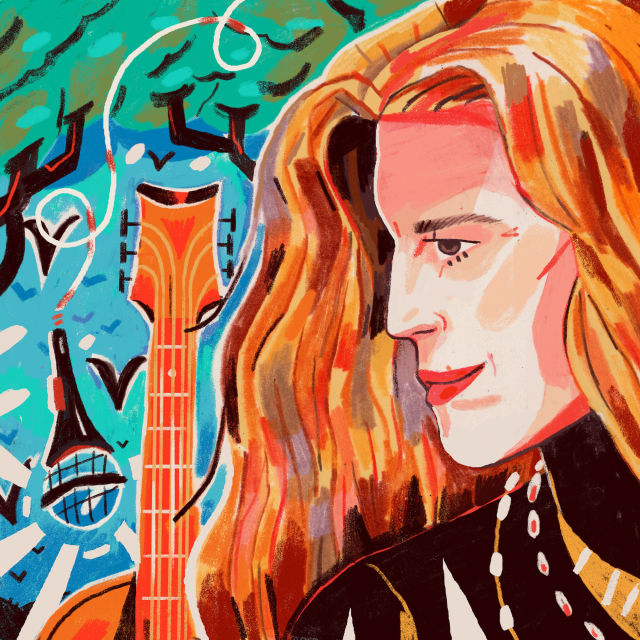
—Finally, the talented Grace Dunham interviews the singer Sophie B. Hawkins, who was ahead of her time when she refused to conform to sexual binaries in the '90s.
Take inspiration from all these women and see where your subconscious urges take you. What I'm trying to say is … Matthew, call me.
Xo
Jess Grose, Lenny editor in chief | | | | | | | | | | | | Advertisement | | |  | | | | | | | | Want to Know What Women Want? Ask Them About Their Affairs. | | | | By Esther Perel | | |
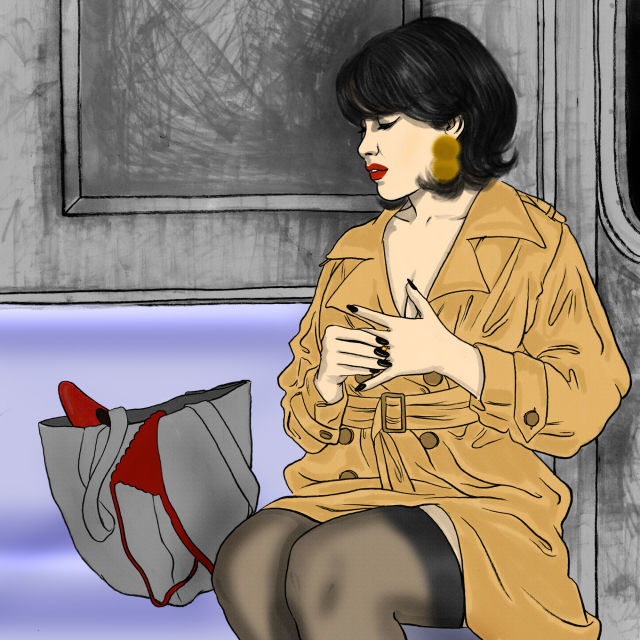
If you want to understand what women want, don't ask them about their relationships; ask them about their affairs.
In writing my book The State of Affairs, I came to realize again and again that illicit relationships offer a window like no other into the mysteries of female desire. Perhaps this is because, in the context of marriage and committed relationships, women are still accustomed to doing things according to cultural norms and expectations — whether due to pressure, obligation, or simply as part of a trade-off.
What women do in marriage tells us less about what they want than about what they value. In their affairs, however, we get a penetrating glimpse into their free will. Far be it from me to justify infidelity, but as a seeker of truth, I have come to find the truth often hides in places that are less comfortable.
A woman I'll call Madison, 31, has been living with a man I'll call Steve for almost five years. They met at the Brooklyn coworking space where she runs her startup. She tells me that she loves Steve and still believes they'll get married and have a family in a few years' time. But two months ago, she reconnected with her college boyfriend on Facebook, and they've been hooking up.
When I inquire as to why, she tells me that in the last year, she has lost interest in sex. "I used to be so into Steve," she says. "And I was often the one who'd jump on him when he came through the door. But then it just became such an effort, I couldn't muster it up. It really freaked me out. I'd do it because he wanted to, and sometimes I'd get into it, but mostly I felt numb. I reached out to my old flame to find out if I had really lost that part of myself."
Madison discovered that her playful, erotic self was far from dead. In my conversations with her, we explore the fact that she often finds it difficult to hold on to her own identity in the context of her relationships. In her affair, however, she knows for a fact that she is doing what she actually wants. She's not taking care of anybody; this is just for her. Secrecy becomes her pathway to autonomy. She is no longer playing a culturally sanctioned role — the nice girl, the girlfriend, the wife, the mother. Through talking to women like Madison about their affairs, I've observed a few themes about their sexuality:
1. Women tire of monogamy faster than men.
One of the most widely held beliefs about women's sexuality is that it is rooted in security and commitment.
It's commonly thought that men are not really wired for monogamy while women are more naturally inclined to be content with commitment or exclusiveness. Men, the theory goes, need novelty and variety in order to feel turned on, while women need closeness and attachment. Researcher Marta Meana invites us to question this assumption.
If it were true that women's sexuality is primarily dependent on relational connectedness — love, commitment, and security — then shouldn't sex be thriving in loving, committed relationships? But too often, it's not. Take Madison, for example, and the countless other women like her who've reached out to me in recent years. In many cases, though surely not all, when the spark dies, it's a woman who shuts down first and loses interest in her partner — male or female.
Meana suggests that in fact, "Women may be just as turned on as men by the novel, the illicit, the raw, the anonymous, but the arousal value of these may not be important enough to women to trade in things they value more (i.e., emotional connectedness)." As I have often said, our emotional needs and our erotic needs do not always neatly align. But women are well trained to put their emotional needs ahead of their erotic needs — they have much to gain from choosing stable relationships over sexual pleasure. It doesn't surprise me that Madison still intends to marry Steve — but it also doesn't surprise me that she's reconnected with the ex who wasn't "husband material."
Research shows that men remain sexually interested in their partners for longer, with the decline of desire happening gradually. Women tend to lose their interest in a shorter amount of time and rather precipitously.
I can't tell you how many desperate husbands have shown up in my office with a reluctant wife in tow, telling me that they are tired of the nightly rejections. "She's obsessed with the kids," they tell me. "She's tired every night. No matter how much I try to help out around the house or encourage her to take a break, I can't get lucky. She's just not interested in sex anymore." Often the wives agree, telling me they don't really care if they never have sex again. All of this reinforces the commonly held belief that women's sex drives just aren't as strong as men's. But more often than you might imagine, those same women shock themselves and their partners by ending up in a torrid affair.
So what does this tell us? Not that women are less interested in sex, but that women become less interested in the sex they can have. Female desire is a drive that needs to be stoked more intensely and more imaginatively if women are not to lose interest. And because women's sexuality is so responsive to context, it's less about one man versus another and more about the narrative in which the sex is taking place — the story she weaves for herself and the character she gets to play within it.
Madison is enchanted by the girl who jumps on the subway at lunchtime to meet her lover at his studio. The girl who makes dinner for her boyfriend leaves her cold. An affair is always an erotic plot that is inherently exciting.
2. Selfishness is sexy.
We often hear straight men say that nothing turns them on more than to see a woman who's really into it. But that's rarely what I hear women say about their partners. What turns a woman on is to be the turn-on. The unspoken truth about women's sexuality is how narcissistic it is. I'm using that term not in a pejorative sense but as an indicator of a woman's ability to focus on herself, away from her caretaking identity.
An affair is the antidote to a woman's social world, which revolves around tending to the needs of others. Madison and Steve's Brooklyn apartment is hardly a suburban family home, but she still feels like a wife, with motherhood waiting a few years down the road. The selflessness required of the wife and mother is at odds with the selfishness that is inherent to desire. When women find themselves in caretaking roles, they sometimes find it difficult to embrace the kind of self-absorption that is essential to sexual pleasure. If she's busy taking care of others, she cannot retreat inside her own body, feel her own pleasure, and encourage her own mounting excitement. Some women can just take off the apron, put the baby to bed, and let go. But others find that they can do this only when they are outside of the home, and with someone who has no need of their caretaking.
3. Commitment is not proof of desire.
Women often seek commitment because it's the ultimate affirmation — to be chosen above all others. But ironically, once the commitment is made, the equation shifts.
Rooted in evolutionary theories, we tend to think of women's desire as more discriminating. When a woman wants a man, he can be pretty sure that it's him she wants. But we see men's desire as more indiscriminate. Hence, when a man wants a woman, she's never really sure if he wants her or just wants sex. And this is even more true in committed relationships, where the woman may suspect that she is simply the convenient object of desire, rather than the chosen subject.
"I'm right there," Madison says dismissively. "It's easy. He doesn't seem to care if I wear my sexy lingerie or just some old pajamas. He just gets on with it." No seduction, no romance. With her lover, however, who is also risking his own marriage, she feels more confident that it's her he wants.
Madison's story challenges a common myth about infidelity and gender: that men cheat for sex, while women cheat for love. Women, the story goes, stray only when they are sad, lonely, and love-starved. Men, on the other hand, are driven beyond the marital bed by the force of their physical desires. A little historical context helps put this assumption in perspective.
Let's not forget that throughout history, men had license to cheat with impunity, conveniently supported by a host of theories about their roaming natures. Women faced pregnancy, mortality, public shame, and ostracism. Even today, there are still nine countries where a woman can be killed for straying. So while it may be true that over the centuries women have been more likely to cheat when they were miserable, maybe that's because the consequences were too dire to do it for more frivolous reasons. If women didn't stand to lose everything, perhaps they would not wait until they were desperate.
Madison has enjoyed her fling, but she feels bad about lying to Steve. She wants their relationship to work, and she asks me what she can do to reignite their erotic connection. "You seem to know very well how to stoke your desire," I tell her. "You've just not been doing it with your boyfriend."
I often say to my patients that if they could bring into their relationships even a tenth of the boldness, the playfulness, and the verve that they bring to their affairs, their home life would feel quite different. Our creative imagination seems to be richer when it comes to our transgressions than to our commitments. It is no accident that many of the most erotic couples lift their marital strategies directly from the infidelity playbook.
Renowned couples therapist and TED speaker Esther Perel is the best-selling author of Mating in Captivity and the host of the top Audible original series Where Should We Begin? Her newest book, The State of Affairs: Rethinking Infidelity, is out now. Learn more at estherperel.com or by following @estherperelofficial on Instagram. | | | | | | | | | | | | Advertisement | | |  | | | | | | | | | | | | An Expert Tells You How to Turn Your Career Challenges Into Opportunities | | | | By Cali Williams Yost | | | | | | |
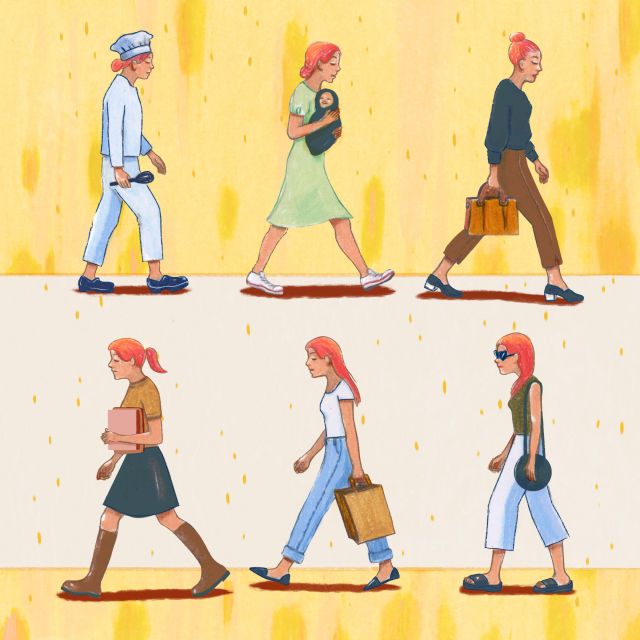
Even though today's work and life reality is more flexible than you think, managing our day-to-day in a 24/7 economy can still be a challenge. As the founder of Flex+Strategy Group, a growing business that helps create a flexible work culture for clients, and as a woman with two kids and a husband, I face the same array of seemingly endless choices many other women encounter: Where and when do I finish this presentation most productively? When will I be able to attend one of my daughter's field-hockey games? When can I get a haircut? Then there are bigger life transitions, like the pregnancy that caused one of my clients, a rising star at an investment bank who loved her job, to question her ability to have a career and a family. But the truth is, whether we work in an office or remotely, full-time or on a project basis, in-person or online, creatively rethinking how, when, and where we get our jobs done can offer countless opportunities for extraordinary women to turn what can feel like obstacles into triumphs.
First, we have to rid ourselves of the limiting, all-or-nothing mind-set that says it's either "this or that." There are many ways for you to earn money and manage your life throughout your career. It begins by recognizing that each of us has a different set of circumstances at any given time — there is no one right way to do it, except to keep learning and adapting as we go.
For me and for my clients, that recalibration of how work and life fit together can simply happen week to week. Even a bigger reset, like the one I guided the aforementioned banker through, might have an outcome that surprises you. As she was expecting her third child, she presented a plan to work four days a week, one of those days remotely. I wasn't surprised when her manager agreed, but she was. Today, this woman has three happy, healthy children and is a C-suite leader of the U.S. division of a global bank. When I see her, she will often say, "I can't believe I almost walked away."
Here, I answer Lenny readers' questions about how to live and work with strategic intention so you, too, can be your best self at work and at play.
Q: Four years ago, I left my career in luxury cosmetics to follow my husband to another country. I didn't work for two years when I had my first child. Then I started a jewelry company, but after two years, my cofounder and I decided it was far from profitable and stopped business. Now I'm a receptionist. How do I turn this detour into something positive for future employers?
Cali Williams Yost: This is something that I find very interesting with people who have taken different career paths: You actually didn't take a career break, you worked for yourself. It's the craziest mentality: "If I'm not getting a paycheck from somebody, I'm not working." You were an entrepreneur. That would be a great example of a pivot into a different type of flexible work and life reality.
So how do you expand your skill sets so you're even more valuable the next time you pivot and you go on to the next job that you want? As a receptionist, you are in a customer-service role, and many organizations have client-relationship management systems, like Hubspot or Salesforce — learn that, offer to be one of the people who contribute to maintaining that. You can also be somebody who monitors social media. Say, "Look, it's like people are walking into the front door of our organization when they go on Twitter or Facebook. I want to keep track of what people are saying." They will value that information, and it allows you to learn these systems, which you can then use in your next job.
To check out Cali's answers to other pressing career questions, click here to watch her on video.
Q: How do you prevent burnout? And how do you deal with it when you realize you're already burned out?
Cali Williams Yost: Burnout is the 21st-century challenge that we do not talk enough about. The first thing you need to do is understand what your signs of burnout look like, because not everybody's are the same. For me, for example, all of a sudden, things just start to get really hard — the thing that used to take you two minutes to do now all of a sudden takes 45 minutes. When that starts happening, the first thing I do is say, "What are some small activities or actions that I could put back into my work-life fit that may actually make me feel good?"
Typically when I've gotten into this place, I've started ignoring the things that actually fill me up, that make me feel really good. That could be something as simple as, "OK, I'm going to leave half an hour earlier, and I'm just going to go for a walk with my friend. Or I'm going to make sure I make a dinner date with my husband for the weekend. Or I'm going to sit down and spend some time with my daughter, because I've gotten so busy that I haven't even connected with her." It's about understanding the things that give me perspective again and help me reconnect with myself.
This is where you could begin to leverage this flexibility that more and more of us have but that we don't tend to thoughtfully use. You could say, "I actually can work remotely in my job. Maybe what I could do is think about the tasks that require a lot of thought and I have a hard time finishing when I'm in the office." So do those tasks like a report or a data analysis when you're working remotely and save yourself the commute.
You really have to think about how you're working and where you're working. That's when you start to say, "I think I am going to go to my kid's play" or "I am going to go to the gym." All of a sudden, you start to be efficient with your work, but you're also rebuilding these other things into your life that really do make you your best self.
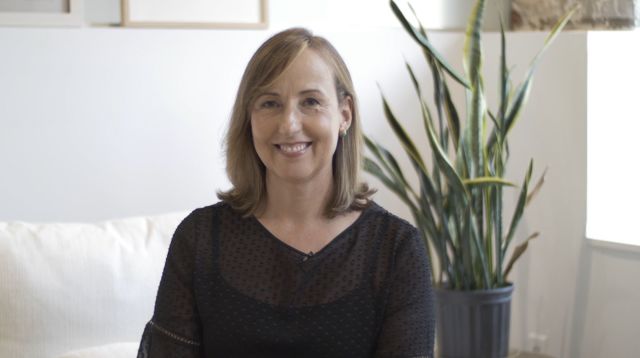
Cali Williams Yost is a noted workplace strategist, researcher, author, speaker, and the founder of the Flex+Strategy Group/Work+Life Fit Inc. | | | | | | | | | | | | | | | | Advertisement | | |  | | | | | | | | 130 Million Girls Don't Go to School, and It's a Global Crisis | | | | By Danai Gurira | | |
"He was a good man. He sent all his daughters to school, too." I used to hear this every now and then, from my mom and other relatives, when I was growing up in Harare, Zimbabwe. They would usually be talking about an older uncle who had passed, the fact that he had made sure all his children were educated, not just the boys.
My own grandfather, the father of one son and six daughters, was among those highly-spoken-of men; he not only made sure his girls received a high-school education but also helped them get into universities. That was no small feat in colonial Africa in the '50s and '60s. It was considered something exceptional to send girls to school back then. Unfortunately, it still is exceptional.
How is it possible that we are still in a world where 130 million girls don't go to school simply because they are girls? If the girls out of school globally formed a country, it would be the tenth largest in the world. What an absolute waste of potential and possibility.
This is something American women may take for granted, but in the developing world, where I grew up, to be a girl comes with so much liability, gaining an education is still considered a privilege, not a right. In some instances, even if girls are sent to school, they're not allowed to learn math or science or subjects that are relevant to the world they inhabit. It's literally crippling their future and perpetuating oppression.
I wrote a play, Eclipsed, and focused on what I learned when I interviewed girls and women who had survived Liberia's vicious civil war. So many of these amazing women and girls had not received much education; so many had received none at all. This was the effect of a twenty-year war, painfully revealed. But they were hungry to learn. I would always ask them — each and every woman I interviewed — what they wanted. Some told me no one had ever asked them that. Ever. But they all, literally all, wanted the same thing: access to schooling. Access to an education that would allow them to truly explore what they were capable of. What society had denied them.
Liberia remains on the list of the countries where girls are least likely to be educated. Nearly two-thirds of primary-school-aged girls in Liberia are out of school. I see that, and I see their faces, those girls and women. And I feel helpless.
But I could not sit idly by and let this global crisis continue without taking action. During the time Eclipsed was on Broadway, I collaborated with an astounding man, Emmanuel Ogebe, a Nigerian human-rights attorney who founded an organization called Education Must Continue (EMC). His work is particularly focused on the conflict in Northern Nigeria, where the girls at a boarding school in Chibok were abducted in the middle of the night by the terrorist group Boko Haram. On that night in April 2014, 272 girls were taken from their school and loaded into trucks, to be transported God knows where. Fifty-odd girls jumped out of the trucks. Some of the ones who escaped were brought to the United States by EMC, to continue their schooling without fear of re-abduction. The movement known as #bringbackourgirls is the result of this.
We dedicated each Eclipsed performance to the girls still in captivity, speaking their names aloud. We had our Broadway audiences speak them, too. Boko Haram is an example of the attack we are under. Their name literally translates to "Western education is sin." They told those girls they had no business being in school as they abducted them into a life of captivity and systematic assault. These girls were assigned as "wives" to the men of this group. Many of them are still living this hell.
The girls I met here in the United States have graduated from high school and are on their way to pursuing a bright future. But the struggle is still real for many of their peers. The ONE campaign, which advocates for people living in poverty around the world, uses the phrase "Poverty Is Sexist," and it is. You can see this clearly in the fact that the poorest countries in the world have the largest gender gap around access and education. According to the ONE campaign, "If every girl completed a primary education in sub-Saharan Africa, maternal mortality could fall by a dramatic 70 percent — in part because women with more education tend to have fewer children."
So what do we do? I grew up bicultural. Born in middle America, I was raised by Zimbabwean parents in Zimbabwe, and I returned to the United States as an adult for university and beyond. It's a bit of a mind warp, feeling intimately close to these two deeply disparate places to the same degree.
The most painful part of this cultural duality is when my Western peers don't see the plights and issues in the developing world beyond a sad and distant story to scroll past on their Twitter feeds. When they don't see the shared humanity and equality they have with those on the other side of the world who suffer so much simply because of geography. It's the very reason I write African female-led narratives in the West.
Until we get rid of that level of apathy and passing fancy interest, we will continue to see our sisters across the globe suffer and the issues worsen. To become a part of the solution, we have to start with ourselves. We are, by virtue of being from the United States, some of the most powerful females on the planet. We may not feel powerful, but by comparison, there is no question.
I don't have the perfect answer to how to fix this massive global education gap, and it's something I grapple with all the time. But I do know we have to start by giving a darn. We have to start by recognizing the true connection we have to women everywhere. Then we have to hold ourselves accountable to consistently garner awareness, and we have to work together with shared strategy and goals.
Because the hopeful part of it all, and I grew up witnessing this, is that educated girls do incredible things. They lift their families out of poverty, and they combat the issues of their communities with innovation and courage. Girls who are educated are more likely to wait until adulthood to get married, and they raise the GDP in their nations once they are able to participate in the economy. Often, when education is introduced to girls, even in poor nations, those countries outperform wealthier nations.
I saw this hopefulness in the eyes of the girls I met from Chibok, who were willing to be away from their families and friends in this strange land at such a young age just to get a chance to explore what they were capable of without fear.
October 11 is the International Day of the Girl. Remember the girl in Ethiopia working in a field instead of going to school, the girl in Mali who watches her brother going to class every day while she has to stay at home, the girl in Northern Nigeria who started her day in April 2014 thinking about her math quiz and ended it as the forced "wife" of a rebel-army officer. They need you on the battlefield, at least trying to figure out how to effectively participate.
Joining ONE's Poverty Is Sexist campaign is a good place to start: You can call attention to the education crisis by using the most powerful tool at your disposal — your voice. Take action right now with #girlscount, a bold campaign that brings this problem to life by inviting us to count from one to 130 million — one number for every girl out of school. All you have to do is pick a number, then upload and share your counting video. ONE is compiling each and every count into the world's longest video to show both the scale of the problem and the enormous amount of global support that exists for addressing it. ONE will be using this film to petition your leaders to take urgent action to get these girls in school. The organization will make sure your voice gets heard.
Get your activism on. It is a journey, and you choose where the path leads. We are all a lot more powerful than we think. Now is the time, and the Day of the Girl is the day that we figure out just how much we can use our power for the future of a sister across the world.
Danai Gurira is an actress, Tony Award-winning playwright, and activist. She is also the founder of LOGPledge.org. | | | | | | | | | | | | Advertisement | | |  | | | | | | | | Arctic Journal | | | | By Naï Zakharia | | | |
My plane from Oslo arrived in the town of Longyearbyen after midnight. I was seated next to a weathered Frenchman and an American girl who chewed her gum with oblivious passion — all of us were awake and celebratory after the three-hour flight.
I had come to this Arctic island, Spitsbergen, part of the Svalbard archipelago, mostly on impulse. After I decided to go, I planned to note the effects of the extreme cold and majestic whiteness while living as an artist-in-residence at the world's northernmost art gallery, Galleri Svalbard.
When I stepped off the plane to wait for Andreas, the guide who would drive me into town, the cold hit me hard. I staggered backward, sputtered, and coughed. During my five-day stay there, the temperature never rose above 5 degrees Fahrenheit (the low was negative 20). The cold was so severe, it could best be described as lethal.
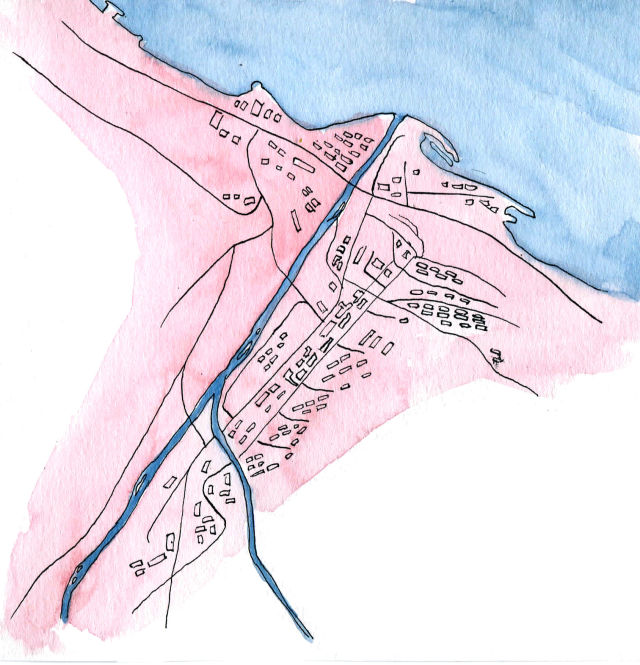
The Svalbard archipelago is located at 78 degrees north, 12 degrees from the North Pole. Shaped like a uterus and home to the world's northernmost civilian population, the archipelago, which have belonged to Norway since 1920, are cold, kind, and human. The local inhabitants are outnumbered by polar bears, and for everyone's safety, people are required to carry flare guns and rifles or travel with an armed guide if they go outside the populated areas, represented in pink on the map.
My first morning, Andreas picked me up for a snowmobile safari. I learned that while he was originally from Thüringen, Germany, he was one of the first tour guides on Svalbard; there was no one more knowledgeable about the islands.
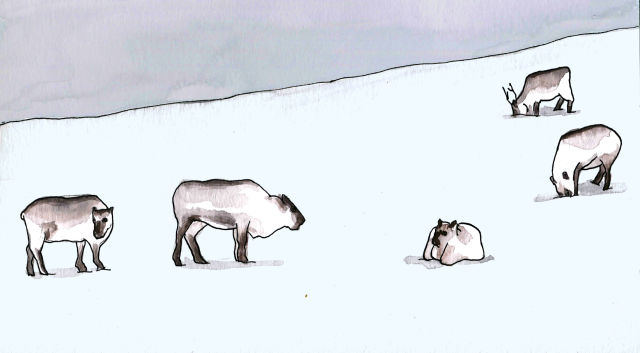
We drove up the mountain behind Longyearbyen; from this vantage point, the town and the fjord plunged into the Arctic Ocean. The land was vast and pristinely white — alien and surreal. The wind twisted the snow into ghostly wisps, but underfoot, it was so compact it could make a snowmobile buckle. I saw a Svalbard reindeer, the archipelago's eponymous subspecies, for the first time. They are an odd, hunching product of this extreme environment: small, with dirty white coats and comically short legs, they're surprisingly able to outrun polar bears.
Now on foot, Andreas and I hiked farther up the mountain. We came across the crash site of Vnukovo Airlines Flight 2801, where there's still scattered debris and a mutilated plane wing, along with a makeshift memorial. The 1996 crash killed all 141 passengers onboard; most were relatives of Russian coal miners. Pyramiden, the site of their mining operation, was abandoned two years later.
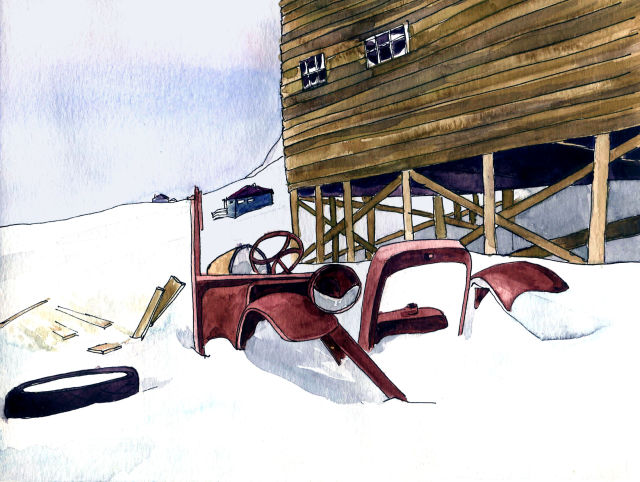
On our way back, we drove around the bay facing Longyearbyen, stopping to walk along the black pebbled beach. I pocketed a few stones like a visitor to the moon. There is an abandoned mining town up the hill that dates from the 1910s. Stilted homes stand in disrepair, and a rusty Ford pickup is half-buried in the snow. The gears and cogs of a dilapidated power station face the glazed fjord, and the sky has faded into a thin strip of pink horizon. The view here is desolate.
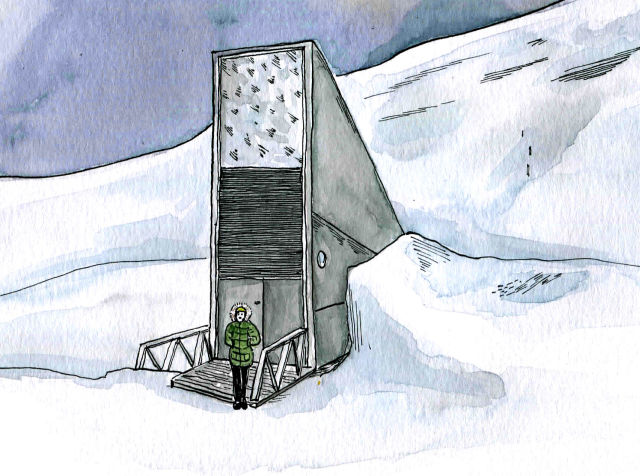
The next day, Andreas took me along Longyearbyen's coastal road, which runs parallel to the shore for ten kilometers on either side. Toward the airport and wedged into a mountainside, facing the ocean, we saw the Svalbard Global Seed Vault, which stores seeds from countries around the world. Foolishly, I asked whether it was heated and if I could go inside. The answer to both was no.
For my third day in Svalbard, I had signed up for an ice-caving expedition in a glacier. I was attracted to the mix of comfort and adventure in the event description: "Pickup to and from accommodation, cookies and tea." By 9:01 a.m., I was ready and waiting. A handsome and mysterious man finally arrived, twenty minutes late, in full expeditiongear. He sized me up and announced that we were headed for a three-hour hike up a very steep mountain slope and I would not withstand it. Emboldened by the challenge, I declared that I was more than capable, and even more equipped, and that we should really be going already, shouldn't we?
Within five minutes, I realized that I was neither equipped nor capable. My boldness was no match for the physical reality of the mountain peak ahead. I whispered breathless and desperate prayers as I watched while my team went on without me. Only one participant, Alastair, stayed with me. He cheered me on, but alas, I looked at the oblivion around me and sobbed. We went back down into the valley and saw the glacier from there, its blue and beautiful protrusions. We sat in the snow for our tea and cookies.
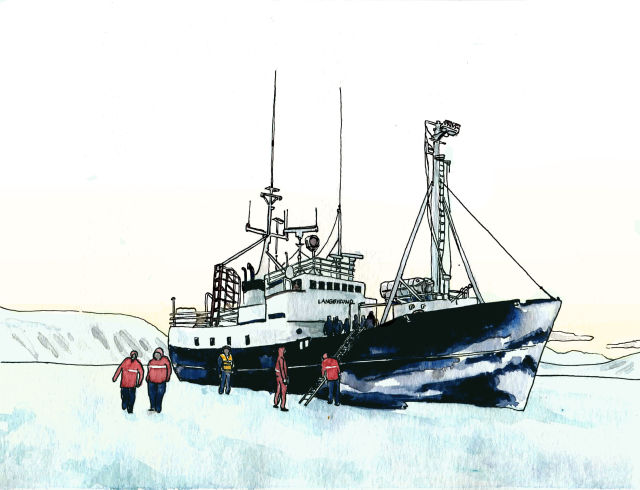
A bus picked me up at dawn on my fourth day in Svalbard. I was going to Pyramiden, the Soviet coal-mining town that had been abandoned two decades earlier. The view from the boat that would take us there was stunning: The water was black, the sky was gray, and the ice-covered mountains surrounding the fjord sparkled. Farther along the trip, the fjord grew icy; inch-thick layers broke against the boat's hull in wide sheets, like the punctured crust of a crème brûlée.
As the ice got thicker, the boat couldn't go any farther. We were just ten minutes from Pyramiden's harbor, so we disembarked and walked to shore. I had heard that earlier in the week, a man had fallen through the ice and had then been fished out and left behind to thaw; it was somewhere near here, and I was careful.
Once at Pyramiden, our guide greeted us with jokes he'd surely told hundreds of times. He added, in his thick Russian accent, "Stay close. Last year someone wandered off and was eaten by a polar bear." We didn't know whether to believe him; either way, after walking for only a few minutes, our group carelessly dispersed.
We learned that Pyramiden was conceived by the Soviets as an Arctic Utopia, with its mines of purest coal. But the idealism of the town's origin is glaring in contrast to its present, dilapidated state.
First, the guide took us to the cultural center, which sprawled behind the "earth's northernmost bust of Vladimir Lenin." Apart from visitors like ourselves, the building was abandoned. On the second floor, there was a particularly interesting room used for storing and projecting film, one of the amenities that made Pyramiden more hospitable to coal miners in the 1970s. The room had fallen into a state of disarray, and there were still remnants of the past. The floor was carpeted in celluloid and technicolor ribbon. I picked up one strip, and I swear I recognized Rex Harrison and Elizabeth Taylor in Cleopatra.
We finished our trip in town at the Hotel Tulpar bar. It is in the only building on the settlement with heating and water, home to six residents and a few occasional guests. The bartender was boyish and fresh. His eagerness to please was youthful and heartbreaking. I could not buy a drink because they don't take credit cards that far north, so I returned to Longyearbyen, where I met up with Alastair. We drank white Russians and stayed up until the arctic sun shone brightly.
Later that morning, foggy-brained and irritable, I got on a plane back to Oslo. It flew below the clouds, over spectacular vistas. The captain's voice described the peaks, glaciers, and fjords below, and I was lulled into a dreamless slumber.
Naï Zakharia is an illustrator, editorial designer, and part-time contrarian. You can find more of her illustrations at naizakharia.com and follow her on Instagram at @naizakharia. | | | | | | | | | | | | Advertisement | | |  | | | | | | | | "You Have to Keep Choosing to Fail" | | | | By Grace Dunham | | |
In 1992, Sophie B. Hawkins released her first single, "Damn I Wish I Was Your Lover," from her debut album, Tongues and Tails. MTV banned the song's original music video, in which Hawkins wore very little and danced quite a lot (the second version featured Hawkins in boot-cut jeans and a sleeveless plaid button-down, dancing somewhat less "suggestively"). This scandal only increased the song's cult status. Additionally, Hawkins publicly identified herself as "omnisexual," long before anyone knew what the fuck that meant (do people even know now?).
This was four years before the first Lilith Fair, a concert tour featuring only female solo artists and female-led bands, which probably explains why Hawkins was seen as something of an iconoclast. Not that the subsequent rise of women singer-songwriters would have made a more suitable home for Hawkins; she staunchly refused to identify with a set notion of "femaleness," either in herself or for her sexual and romantic partners. We talked about love, aging, and the perpetual failure of art-making, and I was impressed by her candidness. She seems genuinely invested in continuing to change and learn, for as long as she can.
Grace Dunham: I heard you're in the process of working on two projects right now, a musical and a new album?
Sophie B. Hawkins: So the album is technically finished. It's a matter of rerecording certain songs, and then there's the stuff that didn't make the album, which may turn out to be better than the album itself. I've written a lot of songs for the musical, but I'm working on the book now.
GD: So what's the story line of the musical?
SBH: The only thing I don't want to tell you is the story line, because it's so close to me. But it's got several layers …
GD: I don't need to know! I trust that you're keeping it a secret because you need to.
SBH: My first album [1992's Tongues and Tails]came out, and it was a whole life's work in there. It's kind of like that with this musical. There's not one day that I don't love working on it, even when I get notes from my director telling me to tear the whole thing apart.
GD: With your first album, you had some huge hits. How do you reckon with that as you move forward and try to keep growing as an artist? Does it ever feel like something that keeps you trapped?
SBH: I always felt I had things to say and to live out. I never knew how I was going to get them out. It was so challenging to figure that out. Recently, I've started to understand that I have something lasting to offer, that I can keep contributing. It makes me feel so good when I sit down to work. It doesn't feel like something to contend with; it feels like something that makes me happy.
Also, I'm single. I often wonder if there's ever gonna be anyone who will fall in love with me, who will be my equal. I went to a certain place, and then I felt like I was on a steady line for too long in my relationship, fighting battles that were really somebody else's battles. And then I finally got to break away, and five years later, I feel free and excited. Really simple and open.
GD: As a young person, I often hope that with time, I'll be less preoccupied with those questions, of finding someone to love, to be loved by …
SBH: But now it's a different kind of quality that I'm looking for; it's a different kind of relationship. Now I don't get involved with other people's problems, like jealousy and possession. I can just walk away and say, I love you, but that's not what I want to deal with. I'm telling you, there's something about being in your 50s … sexually, you're still everything, but you've let go of so much obligation.
GD: And what does that feel like?
SBH: There's so much less insecurity.
GD: If someone drains you, you know to keep them out?
SBH: I've been drained to the absolute bottom. I definitely know the signals. And now I have friends that are really able to be honest with me. Because I think when we're young, we project so much onto people. We have all these dreams from childhood we're trying to fulfill with our lovers, and then once you can go through that, go through all the story lines, then it's a beautiful new beginning.
GD: And how do you feel about the way people have taken an interest in your identity, your sexuality? How do you feel about people politicizing your music because of that?
SBH: In some ways, I have to say, my political motive is stronger now. When "Damn, I Wish I Was Your Lover" came out and I said I was omnisexual, I got so much backlash.
GD: Why? Because people just weren't ready for that language?
SBH: Yes! They wanted me to say "I am a lesbian" or "I am not." Well, they probably wanted me to say "I am a lesbian." And the fact that I would say "I am a lesbian, and I am all these other things" made them uncomfortable. What if I met a trans person and I fell in love with them, then what? That's the whole thing about being omnisexual: it's creative; it's allowing myself to always keep growing. I want to give that permission to anybody I'm in love with. The whole point of it is that I identify my sexuality with my fantasies, my feelings, what I need to work out. I don't identify my sexuality with another, individual person.
GD: I think you were ahead of your time, and maybe your audience, with that language and approach to sexuality.
SBH: I think you're absolutely right. Your generation is in this creative, powerful, empowered, place. You know what needs to be done. You're not answering to questions that aren't relevant to you. My generation was dealing with all these authority figures and rebelling against them, rather than just saying, "This is what I'm going to do, and it's going to be beautiful, and just you watch me." Your generation is like, "Watch me. I'm going to do what I'm doing." I love it so much.
GD: How do you feel about making work in this political moment?
SBH: There's nothing like coming up against something to build, refine, and define yourselves. People are actually stronger than ever right now. Artists, activists, speaking with such a clear, sound voice against this dope, this dopey way of thinking. It demands the people be forceful. And we're not going to be fooled. That's another thing. Sometimes a person appears to be one thing, "the hope," and then we realize there was no hope in that hope because that so-called hope wasn't really disconnecting from the status quo. It was actually feeding off of the status quo. Well, now we can say, "Clearly, we know there's no hope with this dope, so actually we are the hope." I didn't like the period of time where people looked at someone else and said, "That's the hope." It's never true.
GD: I feel like, in a way that's not so common, you have a pretty wide-ranging fan base, politically speaking. Not all queer people share the same political positions. Not all women share the same political positions. What kind of responsibility does that feel like?
SBH: I don't hate people; I love people. I want to understand why they think what they think. Then maybe we're going to find this way of talking where I get to their inside heart. It always happens.
My mother reads Noam Chomsky; she brought us up on Howard Zinn. But I learned this from her, I think. She listens to people, and that only opens her ideas up more and more.
GD: Being open to connection, seeing what comes from that.
SBH: Most people are really terrified and feel like they don't have a voice. There's so much economic fear. And it's real. How many people are on food stamps? How many people can't get health care? How many people can't get jobs? This is a scary time, and for people thinking about their future who are older, it's scary too. I know lots of 50-year-old men who are white who don't have jobs, who are looking for jobs. It is terrifying to them. They have health problems. And maybe they reached a different conclusion, but it's all about that fear.
GD: I know that you just recently had a child. What did it mean to bring a child into this climate? Into the world as it is right now?
SBH: I just had Esther. I had Esther when I was 50. You don't have to change children. They come in with a very strong idea that you really have to be nonjudgmental and loving and creative, that you have to love the earth. They feel that way automatically. So they think this is all ridiculous. Your child is a powerhouse.
GD: What advice do you have, as somebody who's been making work for decades now, on how to sustain that kind of creative longevity?
SBH: I think the one thing that I would say about being an artist is that you have to keep choosing to fail. You cannot choose to succeed. If you succeed, you're so lucky and it's usually accidental. If you choose that you're going to be willing to fail, you're going to do great work. And so the disheartenedness can't be because you're not loved, you're not succeeding. It can be because you're tired, and you're not getting enough food, you work too many jobs, you don't have health care. That is something to complain about. But the other stuff, that's just part of making art. I'd rather be surprised my work has an audience than sad it doesn't.
This interview has been condensed and edited.
Grace Dunham is a writer and activist from New York City. | | | | | | |  | | | | | | | | | | The email newsletter where there's no such thing as too much information.
From Lena Dunham + Jenni Konner. | | | | | | | |  |  |  | |








No comments:
Post a Comment