I was lucky enough to finally visit the National Museum of...
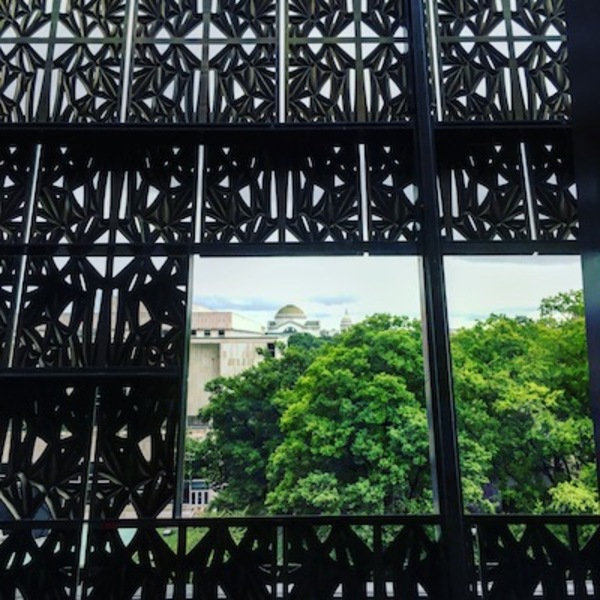
| |  | | | | Alyssa Rosenberg on culture and politics | | | | | | A view from inside the National Museum of African American History and Culture. (Alyssa Rosenberg) | I was lucky enough to finally visit the National Museum of African American History and Culture in Washington this week, thanks to the generosity of some friends who snagged tickets and offered one to me. (Being a critic means I get to see a lot of things early, but not this one.) The museum is an overwhelming experience. And though I spent six and a half hours there, I think I’d want to visit again before rendering a more comprehensive judgment on the curation; there was so much on display that only fragments are standing out to me as I try to get a handle on the whole. I’m still reckoning with one moment in particular: my own realization that I had never seen the photos of Emmett Till’s decimated face that Jet magazine published in the aftermath of his lynching. I know Till’s story, of course. Hopefully, most Americans do. I know that his mother, Mamie Carthan Till-Mobley, decided that his casket would be open, and that his body would lie in state, so that the world could see what her son’s killers had done to him before they murdered him, tied his body to a cotton gin fan with barbed wire and sunk his body in the Tallahatchie River. I know that it was a difficult decision because Till was so maimed, and I know that there has been controversy over Dana Schultz’s abstract painting of Till, entitled “Open Casket.” And because Till’s story is so familiar, I guess I assumed that I had seen the photos of him in his coffin at some point. Till’s casket is on display at the museum, in a solemn space where photography is forbidden. And as soon as I saw the Jet layout, with its small picture of Till’s face, beaten until it almost cannot properly be said to be a face at all, I realized my assumption was wrong: I had never seen these pictures, and I had never really known what this part of American history meant. The exhibition on Till at the museum emphasizes what Till looks like in life; the photographs of him as a vibrant, living person are presented 10 and 20 times larger than the Jet thumbnail. But I’ll certainly never forget that picture of his face, or mistake my hazy assumptions for real life in this matter again. That is one of the many powers a good museum has: It can make you realize you’ve never really seen something, whether you have in fact not seen a famous image, or whether you’ve just not looked closely enough at something familiar. There are a lot of other things I’m still pondering from my visit. Seeing Emmett Till’s face reminded me to be careful with what I think I know. | | | | | | | | | | | | | | | | |




 Twitter
 Facebook
No comments:
Post a Comment