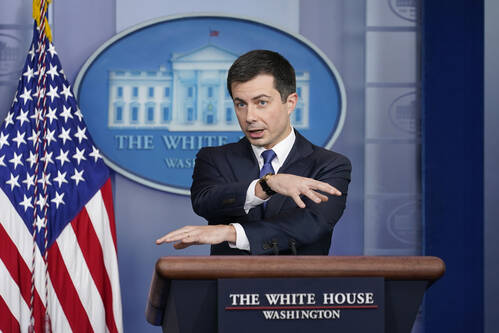
Buttigieg's spotty history on a 'racist' bridge in New York Few have had a bigger hand in the design of a city than Robert Moses in New York. The city's highways and bridges, hundreds of playgrounds, sports fields and pools, the UN headquarters and the Lincoln Center for the Performing Arts all bear his imprint. He designed beautiful beaches and state parks on Long Island and across New York — and the parkways that led people to them. Transportation Secretary Pete Buttigieg brought up a darker side to those iconic blueprints. At the White House this week, Buttigieg said "an underpass was constructed such that a bus carrying mostly Black and Puerto Rican kids to a beach" could not pass by because the clearance was too low. "That obviously reflects racism that went into those design choices," he said. He was referring to a passage from Robert Caro's famous biography of Moses, "The Power Broker," which is generally regarded as one of the 100 greatest works of nonfiction. It destroyed Moses's reputation and shaped how people think about his legacy. Caro also cast Moses as a racist who made it harder for people of color to visit his properties, and Buttigieg referenced one of the book's most famous anecdotes. Moses instructed "to build the bridges across his new parkways low — too low for buses to pass. Bus trips therefore had to be made on local roads, making the trips discouraging long and arduous. For Negroes, who he considered inherently 'dirty,' there were further measures. Buses needed permits to enter state parks; buses chartered by Negro groups found it very difficult to obtain permits, especially to Moses's beloved Jones Beach; most were shunted off to parks many miles further on Long Island." In the endnotes, Caro reveals that this story is based on a single source, a top aide who worked for Moses and gave the author 100 hours of interviews decades later. But since "The Power Broker" was published, Moses has gotten another look, and the anecdote about the parkway bridges has been increasingly questioned. One professor found that all parkways at the time had low bridges. Another pointed out that buses have always run to Jones Beach and that the landscape architect who was in charge of design for the bridges said the height was due to cost. However, a third professor analyzed the clearances for 20 parkway structures and found that Jones Beach had the lowest. A reminder to all, even a Pulitzer Prize-winning book is not always the last word on a subject. Enjoy this newsletter? Forward it to someone else who'd like it! If this email was forwarded to you, sign up here. Did you hear something fact-checkable? Send it here; we'll check it out. Trump gets Four Pinocchios for a change It's infrastructure week for this newsletter again. Former president Donald Trump claimed in a statement that "only 11% of the money" in the bipartisan infrastructure bill, which President Biden is due to sign in the coming days, "goes to real infrastructure." The bill authorizes about $566 billion in spending and tax cuts over a roughly five-year period. About 20 percent of the new money — $110 billion — would be used to fund roads, bridges and other surface transportation programs. So, already, we are above 11 percent. On top of fixing bridges and roads, the bill allocates $39.2 billion for mass transit, $66 billion for passenger and freight rail, $25 billion for airport improvements and $17.3 billion for ports and inland waterways. That takes you to nearly 46 percent. "Then there is also $55 billion for wastewater, drinking water, and water supply, which is also infrastructure that is almost exclusively owned by the public," a transportation expert told us. (That's 57 percent.) When Trump was president, he described much of the above as "real infrastructure" in his own, failed proposals. And the rest of the money in Biden's bill includes items that could also be considered "real infrastructure." Trump earned Four Pinocchios. We're always looking for fact-check suggestions. You can reach us via email, Twitter (@GlennKesslerWP, @rizzoTK, @AdriUsero) or Facebook. Read about our process and rating scale here, and sign up for the newsletter here. Scroll down for this week's Pinocchio roundup. | 


 Email
Email 





No comments:
Post a Comment