| |  | | | | April 18, 2017 | Letter No. 82 | | | | | | | | | | | | Dear Lennys,
I'm Molly, the newest member of Team Lenny. I'm heading up our social media, managing our Lit Thursday feature, and wading through the piles of new books sent to us every day at our HQ. When I'm not working, you can usually find me obsessing about some absurd art show (I was just reminiscing with deputy editor Laia about that Anicka Yi show where the artist created sculptures using bacteria cultures from 100 women's saliva samples) or stitching illustrated designs onto shirts and jeans (a hobby my mother has been trying to get me to take up my entire life that I'm only just slowing down to appreciate).
Before I got this job, I spent a lot of time on my couch, staring at my email inbox and feeling guilty about how many hours a week I spent working while not actually getting paid. After jumping ship at my last media job, I've questioned a lot of my decisions: Why would I ever think that working at a magazine was a sustainable life plan? How did I not seriously consider that my brain (and bank account) would go into panic mode after I became full-time freelance?
But something I always come back to is that finding your place takes time. Being patient with your own humanity (and that of others, too) — however arbitrary or crazy your inclinations can sometimes seem — can be rewarding. That's something that our writers are grappling with in today's issue.
In her essay, the actress and writer Annabelle Gurwitch reflects on her search for the perfect family unit, flitting from one support system to the next, trying each on for size. She wonders something we all think about: How does anyone get from one day to the next as a functioning person? Also considering human error is Claire Cameron, whose essay on female Neanderthals takes a closer look at how the stories we tell (including our own) are often shaped by our individual beliefs and experiences.
The comedian and actress Nicole Byer is understandably sick of being patient in her essay. She goes off on Hollywood makeup artists who don't know how to apply makeup to darker skin (that's most of them). Nicole has been bringing her makeup bag to sets for years and doing her own base because so many professional makeup artists can't be bothered to learn how to work on a wide range of skin tones. It's despicable that something as essential to performers as makeup has become such a divider — I don't know how Nicole keeps her cool.
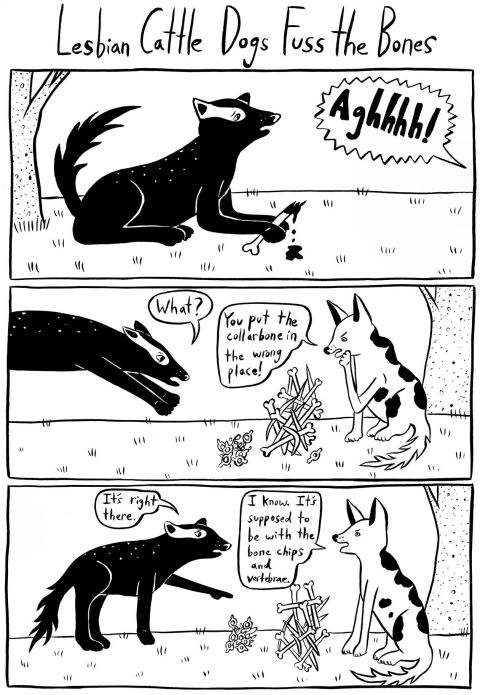
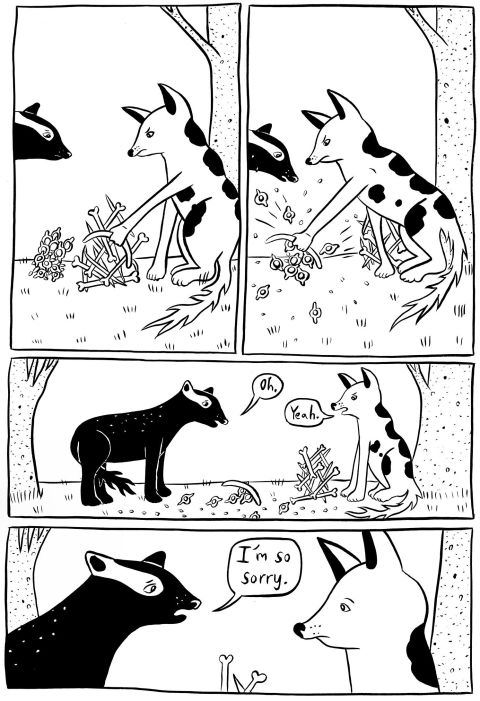
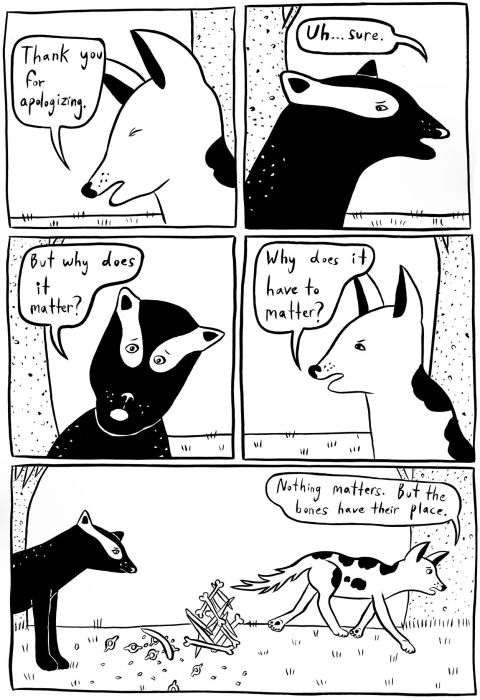
We also have an interview with the Italian filmmaker Lina Wertmüller, who is celebrated for her complicated, human characters in beloved films like Swept Away and Seven Beauties, and the third installment of Lydia Conklin's "Lesbian Cattle Dogs." In this edition, the dogs are feeling very particular about an activity that has no consequence at all. This week, it's good to remember that sometimes things that don't seem consequential to other people can be truly meaningful to you.
Until next time,
Molly Elizalde, Lenny assistant editor | | | | | | | | | | | | Makeup Artists Need to Get It Together for Actors of Color | | | | By Nicole Byer | | |
Things I've looked like after getting my makeup done by "professional makeup artists":
1. A black woman in blackface.
2. A dead woman.
3. Dry and/or dusty or a crusty combo of the two.
Lemme explain. Although I am a fat actress and I dread costume fittings, the most stressful thing about being on set is having my makeup done. I'm very used to not having clothing fit and/or the wardrobe department not even having clothing in my size (which is a shitty thing to get used to). I could write for days about how fucked costuming and wardrobe is for fat women. But that's not what this is about. This is about how makeup artists on set FUCK UP my beautiful black face.
I remember my first job where I was getting paid in more than thank-yous and snacks. It was a truly wild ice-cream commercial shot in Romania (please YouTube it: "Nestle Fairy Nicole Byer"). I remember getting my makeup done and looking in the mirror and having to resist clutching my pearls and screaming. The woman had somehow covered my face in a grayish-brown color and given me bright-blue eye shadow that looked as if it she were trying to bring the sky inside and put it on my face. In short, I looked truly insane.
When we showed the director, he was confused as to why I didn't look like I did on my audition tape. I then had to walk the sweet makeup artists through how I do my makeup, using my own products that I had brought with me (thank God I had them). On the shoot days, I did the base, and she would do the extras … glitter, blush, and lashes. At this job, I didn't mind that the artist was working with an incomplete kit, because (A) It was my first job, and (B) I saw one black person in Romania, and he was at the airport, leaving. So I get why there was a lack of knowledge. But I was very naïve, because I quickly learned that this is basically the standard in America, too.
Things that have happened to me with American "makeup artists":
1. Had a shade of pink put on my lips that made my face lips look like pussy lips.
2. Watched one artist mix six different shades of beige foundation for a full ten minutes. I assume she was praying that they would somehow get darker (I finally offered her my personal makeup, which she accepted).
3. Realized when I got home after working that my neck didn't match my face even a little bit.
4. Was dusted with translucent powder and nothing else because I had "good skin."*
*I knew this was a lie because I have lots of acne scarring, and I never saw a color darker than tan on this artist's workstation.
I haven't worked that much … but if you're curious about my résumé, I was on a show on MTV called Girl Code. I had my own show you never saw because it was so poorly promoted called Loosely Exactly Nicole — RIP (I'm still salty). And I perform all over the country … mostly in LA. I've totally worked enough that it's mind-boggling that I've met only a small handful of makeup artists who had a full working understanding of how to do black makeup, and surprise fucking surprise, they were mostly people of color.
Not to make it about privilege, but having makeup for your own skin color IS A PRIVILEGE. Now if you're a nice white actor friend and you're reading this and you disagree, just imagine having to bring your own makeup to set for every job you book. Waking up at 4 a.m. so you can do your own makeup before you get to set for a 6 a.m. call time so you don't insult the makeup artist by doing your makeup yourself in their allotted time. Spending countless hours on YouTube watching makeup tutorials. Not for fun (sometimes for fun) but to keep up with the ever-changing makeup trends, so you don't make yourself look dated. Plus, you have to learn different looks for different kinds of scenes. Is it a "no makeup look" or is it a "party look"? Now, my nice white actor friend, imagine you go to work not having done any of the above, and there's an all-black makeup and hair department. Not one of them knows how to do your makeup. They also have only one shade marked "pale," and they don't feel bad about it, because you're an "other" and it doesn't matter.
For my white non-actor friends reading this, it is a privilege to go to ANY makeup counter and/or drugstore you want and be able to find your shade. Over the years, it has gotten better for people of color, but it's not enough. It's incredible that EVERY SINGLE makeup line on the market has a million shades for white people, from ivory to light sand and everything in between, whereas some lines have one or two or ZERO shades for people of color. It's fucking gross and rude. It's also just something I've become used to.
But it's not all bad. Some makeup brands are better than others. This may sound like a commercial for them, but I love MAC Cosmetics. I love the quality, but that aside, I like that they have my shade and also darker shades of makeup. Female, male, and trans friends of all shades work there, representing all the colors they sell. That, to me, is beautiful. I realize that other companies do it, too, but MAC stands out to me. Sephora is also a great resource — its branded line goes pretty dark. Also, don't sleep on Fashion Fair. If I remember correctly, they start at a deep olive and have like 15 shades that go to like super-dark onyx. Also, just this year, Dior launched darker shades. Black Radiance and Black Opal also are decent drugstore brands that cater to people of color (but I've only seen them in Harlem or other heavily black areas, which is kinda shitty).
So it has truly gotten better since I was fourteen and trying to cake on drugstore brand shades like butterscotch and almond brittle. However, I'm saying that larger color selections need to appear at all price points, and it would be great if every makeup company had a range that was more inclusive.
I mention makeup lines that don't offer makeup in darker shades because a lot of makeup artists start their careers at makeup counters. If they don't have the tools, how can they learn? That being said, I've taken audition classes and acting classes, so I expect the same from makeup artists. Take a seminar or a class and educate yourself in order to do your job at full capacity!
I live in a world where if I see a family show, or a show where siblings are the lead characters, I almost always move on and don't worry about auditioning for it, because unfortunately white in our society is the norm. So inclusion or a blended family isn't even a thought unless the show or movie is about that topic. I've been on many sets where I've been the only person of color, and it sucks. So when I actually book a job, and get to set, and it's the rare occasion when I give the makeup artist a chance to do my face, and they fail me, it's just another reminder that I'm different. Not that I don't want to be different, because I love what makes me different. I love my dark skin, and even though I wear wigs and weaves, I love my naturally kinky hair that barely ever does what I want it to do. I love my fat 'lil body. I love me inside and out and when I get to work I would love to have my differences embraced.
P.S.: I also do my own hair, because I have natural hair/wear hairpieces, and no one knows how to work with those either. And don't get me started on how a lot of lighting people don't know how to light me.
Nicole Byer is an actress and comedian living and performing in LA. You can see her live: follow her Instagram and Twitter for live show updates — @NicoleByer on both. | | | | | | | | | | | | Neanderthals Were Women, Too | | | | By Claire Cameron | | |
When I was 9 years old, my dad and I started writing a musical together. He was a linguist with a taste for opera, and I was deep into disco. We found our point of overlap in Cats, the first in a wave of mega-musicals that swept through the '80s. My dad suggested our musical should tell the story of Emily Carr, one of the early modernist painters in Canada. I was sold when he showed me a photograph of Carr living in a caravan with a pet monkey named Woo. Her life would become a series of songs. Every number would star me.
The egocentric approach suited my young mind, and the first song we wrote was a showstopper with a throaty chorus. My dad indulged my theatrics by accompanying me on the piano, like a church organist set on fire. I sang the solo tonsils-out and danced with the vigor of a girl in love with Donna Summer.
But we never got further than the first song. My dad had cancer. He died the next year.
I imagine he knew he was dying when we started writing the musical. I don't know if his choice of subject had any significance. Maybe writing a musical about Emily Carr was just his way of spending time with me, a kind of parting gift. And for the life of me, I can't remember how it was supposed to end.
About six years ago, I became fascinated with Neanderthals. In school I was taught that they were primitive, uncivilized, and brutish — an evolutionary stopgap between modern humans and apes. They were extinct because they didn't evolve, or we killed them off, or we outsmarted them with our large brains. In 2010 many scientists started to rethink Neanderthals based on evidence found in modern human DNA. People of European and Asian descent have inherited between 1 and 4 percent of their genome from Neanderthals.
Modern humans and Neanderthals lived in the same areas for thousands of years, and, it's becoming clear, they were physically more like us than we had allowed ourselves to imagine. Their brains might have been slightly larger than ours. They had a hyoid bone, which anchors the tongue and possibly allowed for speech. They also had the FOXP2 gene, and it plays an important role in our ability to talk. If I asked a Neanderthal a question, could she answer? If we could find words in common, how else could our relationship develop? Somehow, it did. The presence of their DNA in us confirms that we had sex and reproduced with them. The more I read about this new view of Neanderthals, the more I struggled to understand why our similarities to them weren't always obvious. In modern clothes, after a shower and a moment with a razor, a Neanderthal might look like what they are — our closest cousins. Why couldn't we see it?
A beautiful and sprawling piece in The New York Times Magazine, "Neanderthals Were People, Too," recently explained how our similarities to Neanderthals go beyond genes. We shared behavior that was previously believed to be exclusively human, like burying our dead, making jewelry, and using toothpicks. The article summarized much of the research I'd done for a novel I was writing. It was affirming to see that the Times agreed with so many of my opinions. But when I finished reading, something niggled. I wasn't sure what, so I started again and found a question in the fourth paragraph: "Who was Neanderthal Man?"
There are many things that we will never know about Neanderthals, but there is one thing we do know: around half were women.
While researching Neanderthals, I developed a professional crush on many women who earned their Ph.D.s in the '70s, but specifically on Jeanne Altmann, who is now a professor of ecology and evolutionary biology at Princeton. She started university as one of three women in a class of undergraduate math majors. The men in her class were assigned academic advisers, but the women weren't because it was assumed to be a waste of faculty time — women wouldn't continue to study seriously. Nevertheless, Altmann persisted. She later switched to biology and started to study baboons.
The field of biology was, and still is, heavily influenced by the Darwinian idea that females have a fairly passive role in sexual selection. Altmann found this view inherent in the scientific methods used in fieldwork. For example, when a male baboon made a show of asserting his need for sex, food, or whatever else, the researcher would notice the fuss and start taking notes. With her background in math, Altmann pioneered a statistically representative method for choosing an animal to watch for a set amount of time. It meant she paid more attention to the less dominant males, females, and immature baboons. She found they had active, complex, and nuanced ways of meeting their needs. One finding was that females form long-term bonds with each other, and those with stronger friendships tend to have more success in raising offspring. We know this because Altmann's observation methods ensured those baboons were considered important enough to see.
When I looked for similar research about female Neanderthals, I found almost nothing. This can partly be explained by how we have historically overlooked Neanderthals as a group in both science and popular culture. We've used their existence as a foil for defining human specialness, rather than attempting to gain much insight about them. H.G. Wells wrote about Neanderthals in 1921, and his description expresses the sentiment of his day: "A repulsive strangeness in his appearance … his beetle brows, his ape neck, and his inferior stature." Things have changed. Our old ideas about Neanderthals are being upturned. For instance: A recent analysis of dental plaque by researchers at the University of Liverpool found that, rather than the Paleo-diet carnivores we've imagined them to be, Neanderthals may have had a predominantly vegetarian diet. It's a good example of the more open minded modern approach, but — with a few exceptions — the focus has yet to extend to women
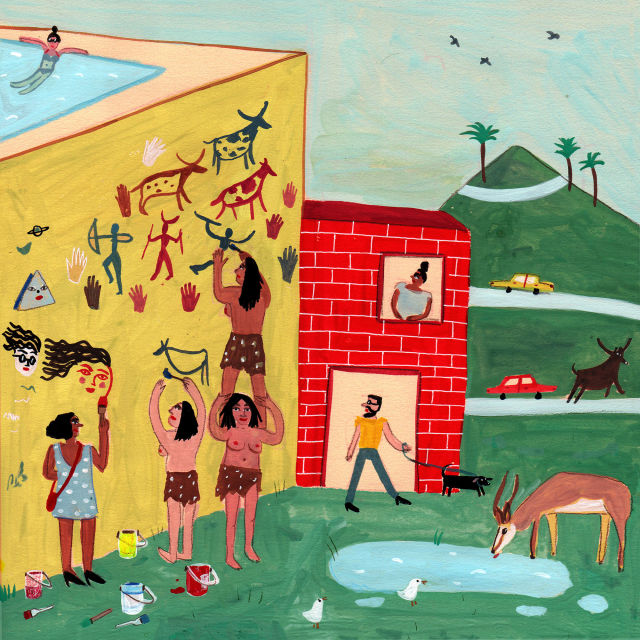
For insight into Neanderthal women, I looked for studies about their close cousins, female modern humans who lived during the same period. I found more research, but archaeology, like biology, has historically seen men as the main players. Some of the oldest cave paintings ever found, for example, were made by artists who stenciled their handprints onto cave walls. For years it was assumed that these artists were men, possibly because some of the prints were found near depictions of hunting scenes. Archaeologist Dean Snow did a study to measure the finger length of the handprints — some argue that the ratio of the ring and index fingers of women tend to be closer in length. In eight cave sites in France and Spain, he judged that three-quarters of handprints belonged to women. It's only one study and, like many important studies, is open to question. However, if I allow myself to think that women who lived during the Paleolithic might have made art, it loosens my imagination. I can see more.
Math and measurements can be useful, and science should be a system that corrects for our inclinations, but we all star in our own show. It's impossible to have a truly impartial point of view because we form beliefs by gathering information about what we notice — seeing is believing. While that statement feels intuitively correct, a more accurate way of understanding how we form ideas might be to flip the statement — believing is seeing. In order to make sense of a confusing world, we select what to see based on what we believe. I ran headlong into this problem when I first started trying to write a plausible story about what happened when modern humans and Neanderthals made contact. I still held the old stereotypes about Neanderthals I'd learned in school. Everything I read was filtered through that lens. It took many drafts to reset my brain.
When I tried to imagine what a Neanderthal might be like, I used the revised scientific research as a guide, like a set of creative constraints. Then I imagined a girl with a life as varied, complex, and confusing as any other, and I took time to observe her. She has a shock of red hair. She is always hungry and craves meat. She takes pride in her thick ankles and loves the smell of fresh pine boughs when she brings them inside to freshen up the hut. She dotes on her brother, who was born with a crooked arm, and worries about what will happen if their mother dies. She chants about bison, but if she had been born 40,000 years later, she might have been the type to belt out show tunes in a raspy, high-pitched voice.
We all star in our own show, but it's a lonely way to live. I've found the richness in life lies in trying to see beyond the tip of my own nose. I write fiction so that I can imagine how it might feel to live another life. Maybe I'll start a novel about Emily Carr and her monkey, Woo. I'll probably never remember how the musical I was writing with my dad was supposed to end. It might be that we didn't even have a good ending — maybe it just fizzled out.
But I can also imagine it another way. Maybe my dad knew he was dying. And he wanted to make sure I knew I could play a central role in a story, even if I turned out to be less fabulous than Donna Summer. It's not the ending that mattered, but what I choose to see from the start.
Claire Cameron's novel The Last Neanderthal will be published in April 2017 by Little, Brown and Company and is available for preorder. | | | | | | | | | | | | Adventures of Lesbian Cattle Dogs | | | | By Lydia Conklin | | |
Lydia Conklin is the 2015–2017 Creative Writing Fellow in fiction at Emory University. She has received a Pushcart Prize, and her fiction has appeared in The Southern Review, The Gettysburg Review, Narrative Magazine, and elsewhere. | | | | | | | | | | | | Family Envy | | | | By Annabelle Gurwitch | | | |
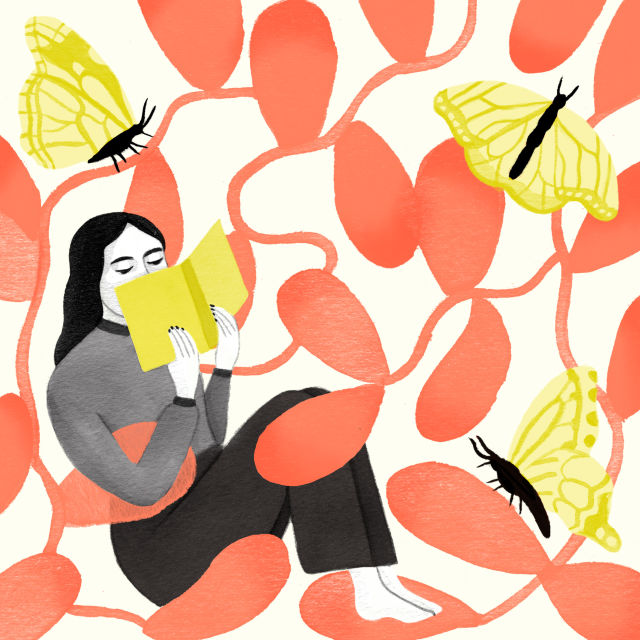
Everything was going to be perfect, just as soon as I became a Butterfly.
Or a Hollyhock.
What kind of hallucinogenic do you have to be on to want to be an insect or shrubbery?
None. Unless you consider reading an altered state. I was fifteen when I cracked the spine of Slapstick, the novel by Kurt Vonnegut, and I experienced that kind of "everything makes sense now" ding that went off in Don Draper's head when he cooked up the Coke commercial in the final episode of Mad Men. Vonnegut spins your typical dystopian future, except that something wonderful has come from the slew of catastrophes that has befallen society. The world's citizenry has reorganized into clans: Butterflies, Orioles, Chickadees, and assorted botanically inspired fraternities.
Each of us instantly linked to hundreds of thousands of cousins spanning the globe. Hence the subtitle of the book, Lonesome No More. We'd all become one big happy family. Well, more like lots of big happy families. Or lots of unhappy ones: the Hollyhocks, Chickadees, Orioles, and Butterflies, each unhappy in their own way. This sounded even better than caffeine and wedge heels, both of which I'd also just discovered and still pledge unwavering allegiance to.
Reading Vonnegut wasn't my first case of family envy.
Mrs. Brownstein, my fifth-grade teacher, was a fresh-out-of-college hire at River Road Elementary School in Wilmington, Delaware. If you were an outstanding student in Mrs. Brownstein's class, you'd get the privilege of receiving a dinner invitation to her home. My mother, who has diligently saved the writing assignments from my childhood, sent me a report I wrote in Mrs. Brownstein's class. It was on how I wanted to be a teacher and be pretty, kind, and have good penmanship just like her. I got an A, but Mrs. Brownstein added, in her excellent script, Okay, Anne, you don't have to try so hard!
Lady, you have no idea.
I was included in the first group of students chosen to come to dinner. She and her husband, also an elementary-school teacher, served meatloaf and an iceberg-lettuce salad. The Brownsteins were sweet but a bit on the boring side. They were exactly the kind of people I wanted to bunk in with. They seemed so orderly, so stable, so … unlike my family.
We'd landed in Delaware a few years earlier, without enough money for winter coats. After my father's latest get-rich scheme had belly-flopped, we'd lost our house and all but skipped town in the middle of the night. Camping out at my mother's sister's home, my father tried to find work, while my mother took to her bed and my grandmother slipped our aunt money for luxuries like food, shoes, and shampoo.
The only thing is, in my memory, Mrs. Brownstein looks a bit too much like Carrie Brownstein, and her husband too closely resembles the comedic actor David Krumholtz. I remember us as seated around a circular white plastic table on white plastic modular chairs, but that's also a description of the dining room set in my Barbie Malibu Dreamhouse. Memory can be a trickster. What I am certain of is that I wanted them to adopt me.
This plan was thwarted because halfway through fifth grade, my dad announced we were moving to Florida, where I found plenty of enviable families, parents with recognizable jobs, steady incomes, and homes that felt like secure harbors. Even though we had a tony address on a private island, there was always a sense that the bottom might drop out again. On any shopping excursion, I'd hold my breath while my mother handed her credit card over. Every purchase required a phone call to confirm the charge. Many times it would be turned down, and I'd hope no classmates were nearby to witness.
I wasn't privy to the details of the slew of businesses my father failed in, but his bankruptcies spanned everything from fast-food chains to soft-core porn. He was truly an overachiever in the realm of money mismanagement. Having your father lose your bat mitzvah money at a poker table falls under the category of first-world problems and white privilege on the scale of global suffering, but still, my mother's depression, my father's rage, and the volatility in the house were palpable and contagious.
I didn't find another family to rescue me, but it was in Miami that I joined the tribe that's like a homing beacon for teenage malaise — the high-school drama club.
Those long hours of rehearsing Bye Bye Birdie, Our Town, and scenes from The Rocky Horror Picture Show, and even longer hours of pretending to rehearse but screwing off together, fostered a kind of intimacy, though I wouldn't have used that word at that time, which was appealing, having been indoctrinated into keeping family secrets.
A play has well-defined rules: dialogue and blocking that are repeated each time the play is staged. Relationships, no matter how volatile, resolve with reliability. The emotional timbre might vary from performance to performance, but Brutus is always the betrayer in The Tragedy of Julius Caesar. If an actor blurts out, "Et tu, Mark Antony?," that's a production that's gone off the rails. The temporary abolition of ordinary life provided a tonic to the unpredictability of my family life. Every time I'd do a play, it was like being rescued from a sinking ship and put into a lifeboat.
Not surprisingly, I followed my high-school boyfriend Danny, president of our club, into the drama department at NYU. When my parents called to let me know they were broke and there was no money for my education, his family agreed to let me take up residence in the living room of the condo they'd bought for him while I tried to make a go of an acting career, even though he and I'd broken up by then. He and his family were beyond kind, but I also suspect that they didn't think they had a choice. I clung to them for support, and like a mold infestation, it was really hard to get rid of me. When, by an amazing stroke of luck, I began earning a living as an actress, I moved out and into a studio apartment in the building next door to his place.
That I've formed a family, relished motherhood, and get out of bed each day to try to be useful still astonishes me. A string of days rarely goes by when I don't picture myself pushing all of my belongings down the street in a shopping cart. I am stunned and awed by people's ability to function in the world. How does everyone do it? How do they manage to make their lives work? How secure are their family's finances? What kind of secrets are they keeping? I'll look at a home and wonder what their story is and whether they'll ever have to get out of Dodge in the middle of the night.
I've been thinking about Vonnegut lately and his impact on me and other readers. I'm not exactly pining to read him again, but I recently learned that he studied anthropology in college and was deeply fascinated by the rootlessness that marks modern life, which makes sense and mitigates some of the more wacky plotlines of his novels. His writing sparked the idea that I might one day find my people. I would never put myself in the same sentence as him, except to write that I share that interest. Reading and writing about the mistakes and missteps in an attempt to connect with other humans isn't a cure-all, but it does lessen the shame of holding secrets, and that's transformative, perhaps offering us all the potential to become butterflies after all.
Annabelle Gurwitch is a New York Times Bestselling author who writes about finding your tribe in her new collection of essays Wherever You Go, There They Are: Stories About My Family You Might Relate To, out today. | | | | | | | | | | | | "We Are Directors, Not Female Directors" | | | | By Hannah Fidell | | |
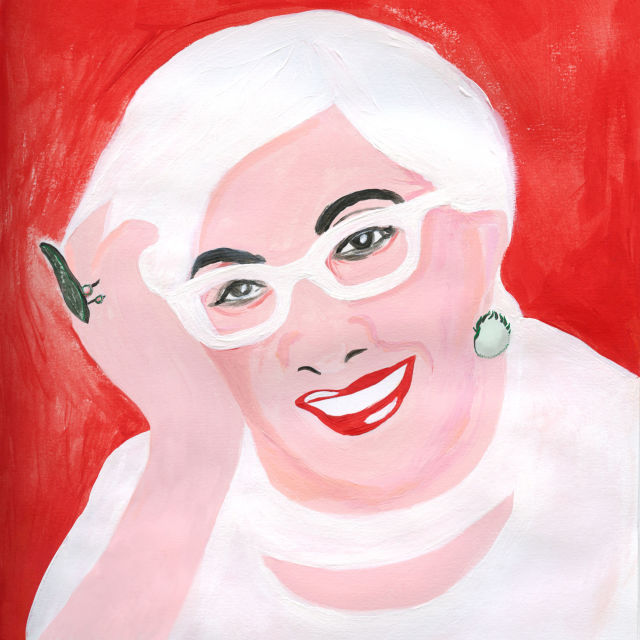
I studied film theory in college and graduate school. I now write and direct movies. I even like to think that I know a lot about, specifically, European cinema from the '70s. But I had never heard of the prolific First Lady of Italian cinema, the Academy Award–nominated icon Lina Wertmüller, until I was asked to interview her for this wonderful publication. As happens often, it became clear that I have a lot of learning left to do. Lina's movies Seven Beauties and Swept Away were met with near-universal acclaim, and she was a film-society doyenne back in the disco era. Parties thrown in Lina's honor got written up in the Washington Post and were paparazzi events where Barbara Walters stood a "canapé tray away" from Woody Allen.
So I called up my local movie-rental store (sadly, perhaps the last one in all of LA), Vidéothèque, and asked if they had any of Lina's films. They did. Soon I was posted up in front of the TV, diving headfirst into what can only be described as a glorious marathon movie session the likes of which I hadn't done in years.
I started with what would end up being my favorite of her films, Swept Away, about a rich aristocratic woman who becomes stranded on an island with a working-class deckhand from her yacht. The master became the slave. The slave became the master. Sex and power, class relations, an exploration into the feminine and masculine … I was blown away. In Seven Beauties, for which she was nominated for a Best Director Oscar, Wertmüller again flips convention — instead of a tale of the horrors of concentration camps, her protagonist is a violent gangster who deserts the complicit Italian army, gets caught, is thrown into a concentration camp, and all in all is a pretty terrible dude. And yet, the film is about so much more — it's about survival, and of course it is a statement on Italy's complicated social and political history. In all of her work, Lina creates portraits of both men and women who are complicated, who make wrong decisions, who are annoying, who are human.
My filmmaker friends and I talk often about how rare it is that we see a film that just wows us these days, and when you've watched a lot of movies, these gems become rarer and rarer. But Lina's body of work shines brightly, putting her rightfully among the heavy hitters of 20th-century cinema. The newly reopened Quad Cinema in New York is hosting a retrospective of Lina's films, so you can catch up with her brilliance just like I did.
Hannah Fidell: I'm always interested in the writing process — what's your writing routine like? Or even an average day for you these days?
Lina Wertmüller: I think writing needs some strict rules, because it's a job, first of all. I always wake up early in the morning to start to write in the first hours of the day, when you are not distracted by calls and commitments. I've always worked that way. I used to sleep three or four hours per night, so I had a lot of time to write, to read, and to watch films. Now I'm used to sleeping more, but I haven't lost that routine.
HF: What I love about your films is that you don't judge your characters — they are who they are, and they are far from perfect human beings. I've tried to do this myself, and I feel as though I've been taken to task for portraying female characters negatively, that as a female director I MUST always portray women in a positive way.
LW: A writer or director should never judge his or her characters. We tell stories from their particular point of view, we can see the world through their unique eyes and through their mistakes too. This is the privilege of being a writer. If the author judges his character, he loses the spontaneous and intimate point of view on the story.
HF: So I feel a kinship with you and your work — to me, being able to create full female characters who might make bad decisions is an act of feminism unto itself. How did you handle that sort of anti-feminist criticism over the years?
LW: I think you are definitely right. I've never believed in the feminist movement. Feminists criticized me and my movies. They didn't like the portrait of women in Swept Away.
HF: I often tell people that I look at myself not as a "female writer/director" but as a "writer/director who happens to be female." Do you look at your own work as having a purely female viewpoint?
LW: I agree with you once more. We are directors, not female directors. It doesn't make sense to me to mark differences between men and women filmmakers. The question is to make good movies. I always say that a good writer should be able to identify with all the different characters he or she may create. We should always remember Flaubert's provocation: "Madame Bovary, c'est moi."
HF: How do you feel about Guy Ritchie's remake of Swept Away?
LW: I didn't see it indeed. I remember that when I came to the U.S. the last time, in 2005 or 2006, journalists were very disappointed about the remake. They reproved me. In their opinion, I should have not given the rights to make the new version. Madonna is a genius in her field, and she played some good roles too. I had simply thought she may have had an idea about the movie. But I can't say more about the remake because I didn't see the film.
HF: I love how you are able to blend genres — your films are a beautiful mash-up of politically charged dramas that understand the humor in the everyday … it's really an incredible feat.
LW: I feel my soul is shared in two parts. One part has a very high sense of humor and irony; the other is more dramatic. I always combine the two aspects in my works. I love comedies and musicals on a hand, on the other I've always been inspired by human and social problems.
HF: How do you think your work has changed since your first film?
LW: I really don't know … I'm not used to looking at my work with the critic's eye. I'm not interested about myself. I prefer to look at the world around me. I'm curious about the others. I already know everything about myself.
HF: For those readers who haven't seen your films yet, what do you think they should start with?
LW: Perhaps they could start with my "cult" movies. They are funny and dramatic at the same time. But I'd be happy if they could appreciate my first one, too, The Lizards. I think the film can still speak to today even if it was made more than 50 years ago!
Hannah Fidell is a writer, director, and producer known for her films 6 Years, A Teacher, and the upcoming The Long Dumb Road. | | | | | | | | | | | | | | The email newsletter where there's no such thing as too much information.
From Lena Dunham + Jenni Konner. | | | | | | | |  |  | |





No comments:
Post a Comment